SIPOC-R Template
Map Suppliers, Inputs, Process, Outputs and Customers — plus the Requirements each must meet — for a rock-solid process definition.

What is a SIPOC-R Template?
A SIPOC-R Template extends the standard SIPOC framework by adding a Requirements (R) column that captures what each customer group expects from the process outputs. It creates a direct link between process outputs and customer standards.
When to use a SIPOC-R Template
Use it in the Define phase as an enhanced alternative to the standard SIPOC when CTQ requirements are a key focus of the project, or when customer expectations need to be made explicit for the team.
Who should use a SIPOC-R Template
- Green Belts and Black Belts — enhancing standard SIPOC analysis with explicit customer requirements in the Define phase
- Process owners — documenting the customer standards their process outputs must meet
- Quality and compliance teams — linking process outputs to regulatory and customer contractual requirements
- Project sponsors — reviewing whether current process outputs are meeting customer requirements before approving a project
Vote yes and we’ll prioritise a quick walkthrough showing you exactly how to use it.
How to use a SIPOC-R — step by step
-
1Write the problem statement at the top
Start with a clear, factual problem statement. 'Machine stopped' or 'Customer received wrong item' — specific, observable, factual. Vague problems produce vague root causes.
-
2Ask 'Why did this happen?' — Why 1
Write down the first-level cause. This is usually a symptom or a direct cause — not yet the root. Examples: 'Machine overheated', 'Wrong item was picked'.
-
3Ask 'Why did that happen?' — Why 2
Challenge the previous answer. Keep the team focused on causes, not blame. If the answer is 'human error', push further — why did the human make the error?
-
4Continue to Why 3, 4 and 5
Keep going until you reach a cause that is systemic — a missing process, a failed control, a gap in training or a design flaw. The number five is a guide, not a rule.
-
5Check the logic by reading upward
Read the chain back to front: 'Because of X, Y happened, which caused Z.' If the logic holds, you have a valid chain. If it breaks, revisit the step where it breaks.
-
6Identify the actionable root cause
The root cause is the deepest level where a corrective action can prevent recurrence. Document it clearly — this feeds your Improve phase solution design.
-
7Validate before acting
Do not jump to solution immediately. Check whether data or observation confirms the root cause is real and significant before committing resource to fixing it.
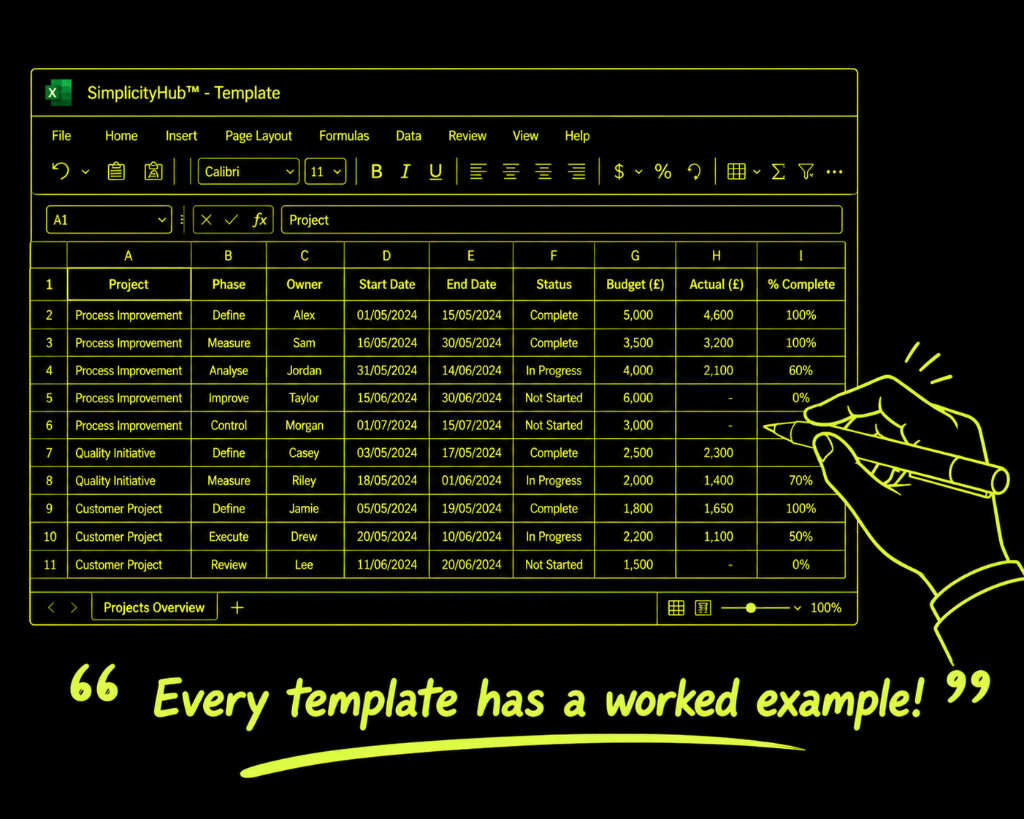
Worked example — Procurement Process SIPOC-R
A procurement team completed a SIPOC-R that revealed 3 of their 7 process outputs had no documented customer requirements — two of which were later identified as key drivers of internal customer dissatisfaction.
Common mistakes — and how to avoid them
Copying requirements from internal standards. Requirements must reflect what the customer actually needs, not what internal policies say. The two are often different.
Leaving requirements blank. An output without a stated requirement is a risk — it means the process has no defined success standard. Every output needs at least one requirement.
Treating SIPOC-R as just a SIPOC with an extra column. The Requirements column changes the purpose of the tool. SIPOC-R is a gap analysis tool — the gaps between current outputs and stated requirements define the improvement opportunity.
Not updating requirements when customer needs change. Customer requirements evolve. A SIPOC-R should be a living document reviewed whenever customer contracts, regulations or expectations change.
Tips for getting better results
Involve the customer in completing the Requirements column. Don't assume what customers require. Invite them to review and add to the requirements column — even a brief conversation can surface important gaps.
Use the gaps as project scoping inputs. Requirements that are clearly not being met are natural project scope candidates. Use the SIPOC-R to brief the sponsor on the improvement opportunity.
Compare SIPOC-R to your VOC data. Cross-reference the requirements column with Voice of the Customer data. Inconsistencies reveal where your internal understanding of requirements diverges from reality.
Frequently asked questions
What does SIPOC-R stand for?
SIPOC-R stands for Suppliers, Inputs, Process, Outputs, Customers and Requirements. The R column extends the standard SIPOC by capturing what each customer group requires from the process output.
When should I use SIPOC-R instead of SIPOC?
Use SIPOC-R when customer requirements are complex or varied, or when you want to make the link between outputs and CTQs explicit during Define. It adds very little time but significantly strengthens the customer focus of your project.
How many steps should the process column include?
Typically 5–7 high-level steps. The SIPOC-R is a summary tool, not a detailed process map. Each step should be a verb-noun phrase (e.g. Receive order, Process payment, Dispatch goods).