What is a Value Stream Map Template?
A Value Stream Map (VSM) is a visual tool that shows the complete flow of materials and information required to deliver a product or service from start to finish — including every step, every wait, every handoff and every decision point.
Unlike a process map, a VSM captures time data for every step: the time spent adding value, the time spent waiting and the total lead time from end to end. This makes waste immediately visible — typically 80–95% of total lead time in most processes is non-value-adding wait time.
VSM is used in the Measure phase to baseline the current state, and in the Improve phase to design a future state that eliminates or reduces the identified waste.
When to use a Value Stream Map Template
Use a Value Stream Map when you need to see the full end-to-end picture of a process, not just isolated steps. Use it when:
- Lead time reduction is a primary project goal
- You suspect significant waste exists between process steps rather than within them
- Multiple teams or handoffs are involved and the full picture is not visible to any one person
- You want to design a future state process that eliminates identified waste
How to get the most from this template
- Walk the actual process on the shop floor or follow the real workflow — do not map from memory or documentation alone
- Record cycle time, changeover time and uptime for each step, not just the obvious metrics
- Mark inventory accumulation between steps with triangle icons — these reveal where work is waiting
Common mistake: mapping the ideal process instead of the current state. A future-state map comes later — the current-state map must show what actually happens, including workarounds and delays.
Who should use a Value Stream Map Template
- Green Belts and Black Belts — as a core Measure and Improve phase tool for lead time and flow improvement projects
- Lean Practitioners — as the primary tool for Lean transformation and waste elimination work
- Operations Managers — to understand end-to-end flow and identify where investment will have most impact
- CI Facilitators — to run current and future state VSM workshops with cross-functional teams
Watch: a quick explainer
New to this? This short video walks you through mapping a value stream to see where waste hides — a helpful primer before you download and use the template.
How to build a Value Stream Map
A VSM is built by walking the process — physically or virtually — from end to end, collecting time data at every step. Never build it from memory or from existing documentation alone.
How to build a Value Stream Map — step by step
-
1Define the product family or service to map
Choose a specific product, service or transaction type. A VSM that tries to cover everything covers nothing. Pick the highest-volume or most problematic flow.
-
2Walk the process — go to the Gemba
Follow the actual flow from customer order to delivery, observing each step. Record what actually happens, not what the procedure says should happen.
-
3Record cycle time and wait time at every step
For each step, record: cycle time (time actively working on the item), wait time (time the item sits idle before and after the step), and number of people involved.
-
4Map the information flow
Above the process steps, show how information flows — orders, schedules, instructions. Is it push (batched) or pull (triggered by demand)? Are there electronic or manual flows?
-
5Calculate total lead time and value-added time
Add up all cycle times to get total value-added time. Add all cycle and wait times to get total lead time. The ratio reveals how much of the lead time is actually adding value.
-
6Identify waste between steps
Look at the wait times between steps — these are your biggest targets. Why does the item wait? Queue, batch processing, approval delays, handoff gaps?
-
7Design the future state
On a separate map, design the future state: what steps can be eliminated, combined or parallelised? Where can pull replace push? What is the target lead time?
Worked example — Order Fulfilment Value Stream
A completed current-state VSM for an order fulfilment process showing total lead time, value-added time and the largest wait-time gaps between steps.
Common mistakes — and how to avoid them
Building it from documentation, not observation. Process documents show the ideal state. A VSM must reflect reality. Walk the process, talk to operators and measure actual times — not standard times from a procedure.
Mapping too broadly. A VSM of 'the entire business' is not useful. Scope it to a single product family or service type with a clear start (customer order) and end (customer receipt).
Ignoring information flows. The information flow — schedules, orders, instructions — is often where the biggest delays are. A VSM without information flow mapping misses half the picture.
Never designing the future state. A current-state VSM without a future state is a documentation exercise, not an improvement. Always follow the current state with a future state design.
Tips for getting better results
Use a pencil and paper first. Draw the map by hand during the Gemba walk. Transfer it to a template afterwards. Trying to use software in real time slows you down and misses observations.
Calculate the process efficiency ratio. Divide total value-added time by total lead time and multiply by 100. A ratio below 10% is common and shows the scale of improvement opportunity.
Prioritise the largest wait-time gaps. The step with the longest wait time before it is usually the constraint or bottleneck. Focus future state design here first.
Download the Value Stream Map Template
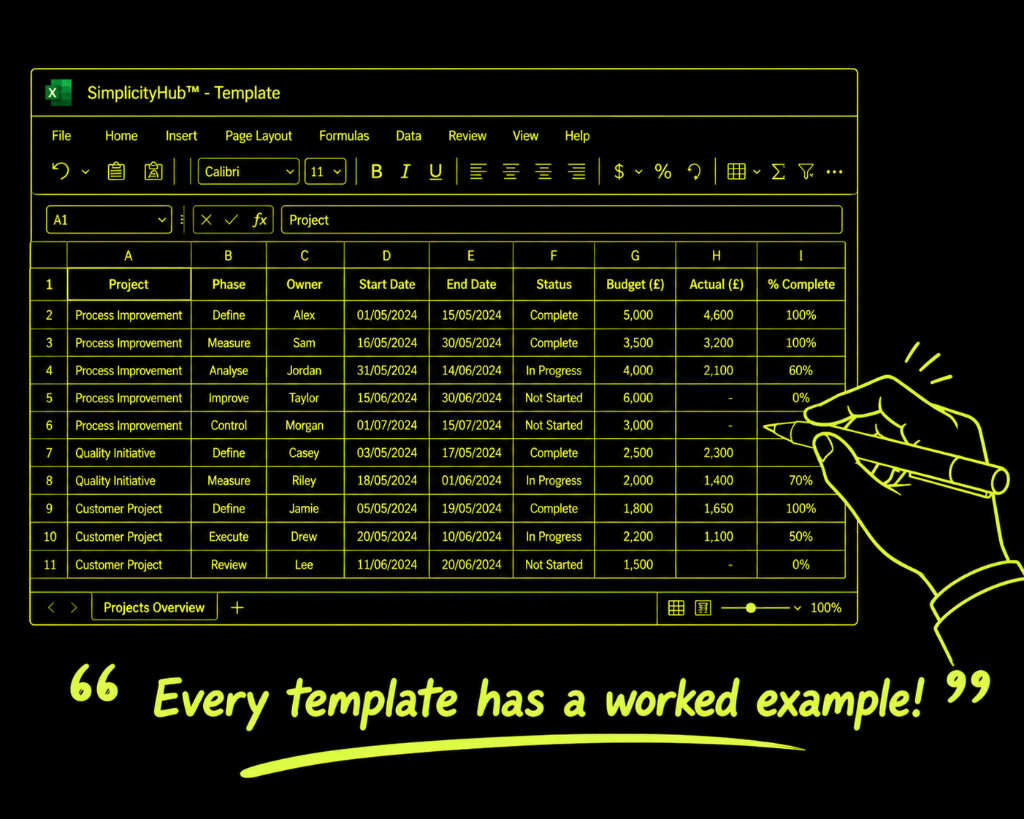
A clean, editable Excel template for immediate use — structured, professional and ready to fill in.
Frequently asked questions
What is a value stream map?
A visual showing the entire flow of materials and information to deliver a product or service from start to finish.
VSM vs process map?
A process map shows steps. A VSM adds time data, inventory levels, and information flows to make waste visible.
What is a future state map?
The target process with waste removed and flow improved. The gap defines the improvement roadmap.
Can VSM be used for services?
Yes. Adapt the notation to fit service-relevant steps. The principles apply equally.
Advanced Toolkit Packs — available now
Structured, ready-to-use template packs designed for real improvement work. Pick the pack that matches your project and get started straight away.
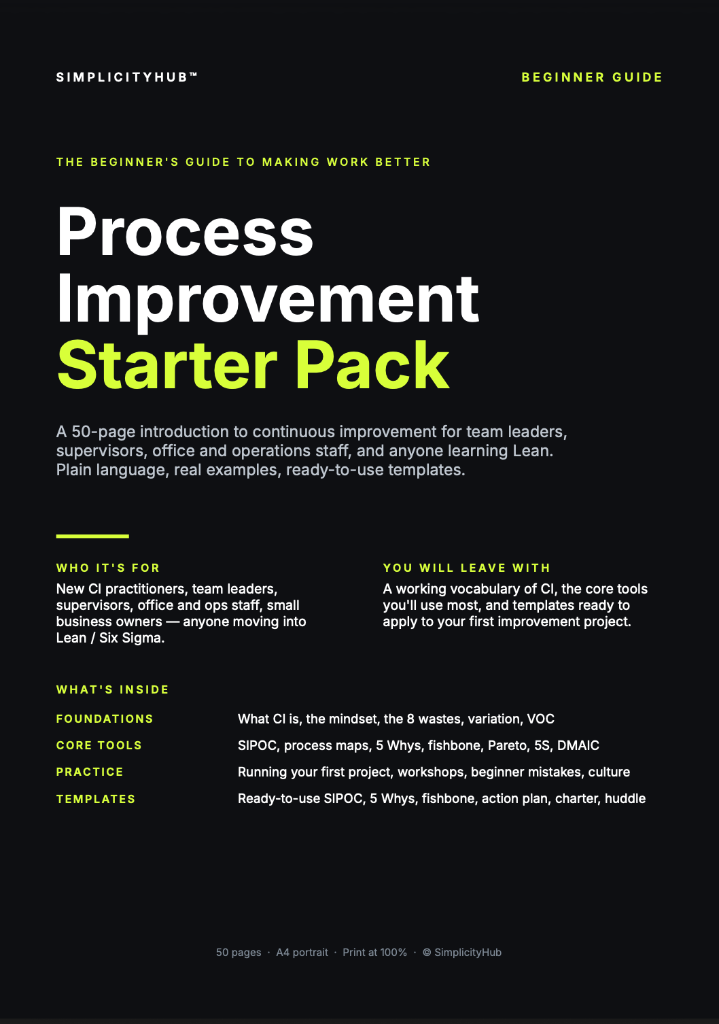
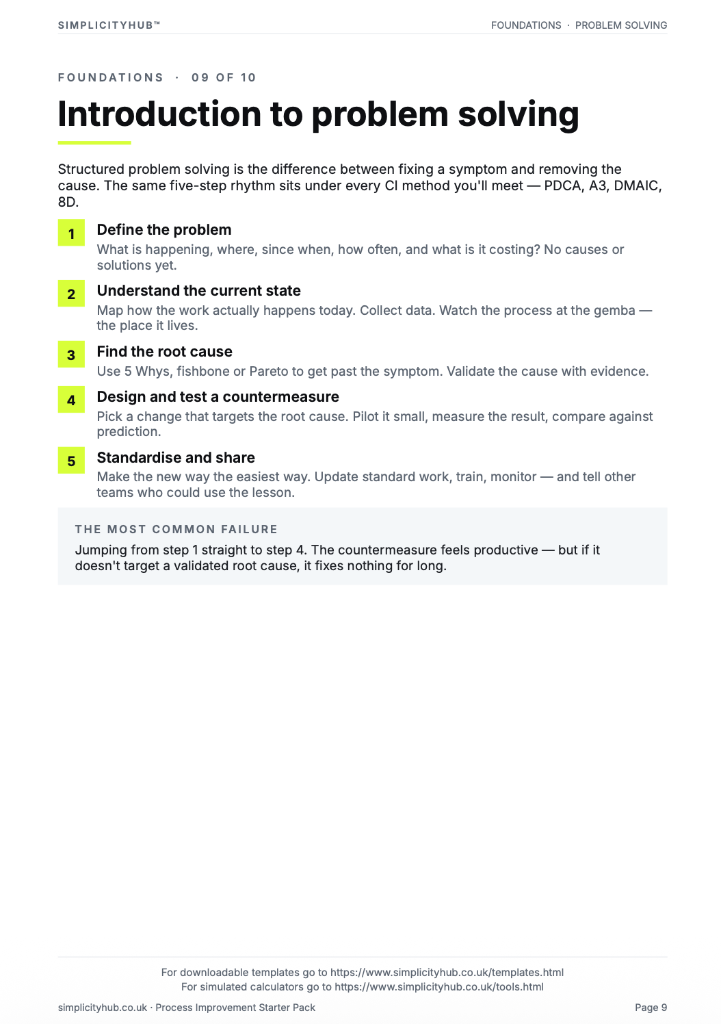
Process Improvement Starter Pack
A starter pack for identifying improvement opportunities, measuring baselines and planning action.
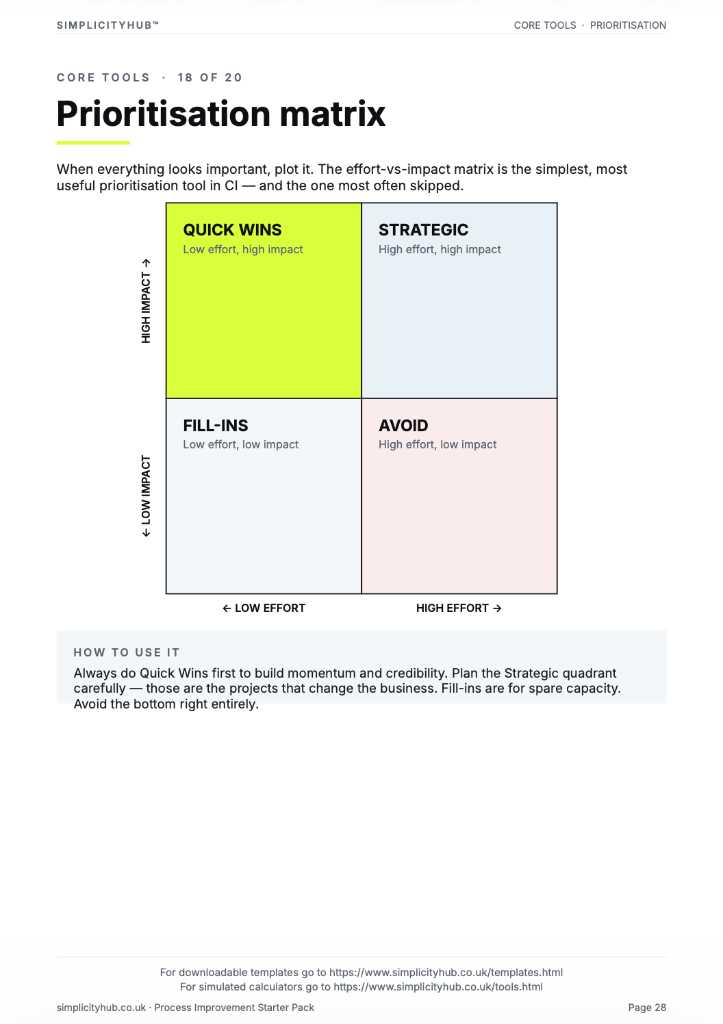
Root Cause Analysis Toolkit
A practical RCA toolkit for defining problems, finding causes, validating evidence and creating action.
A3 Template Pack
A clean A3 problem-solving pack for concise, visual improvement thinking and follow-through.