
What is a 5 Whys Template?
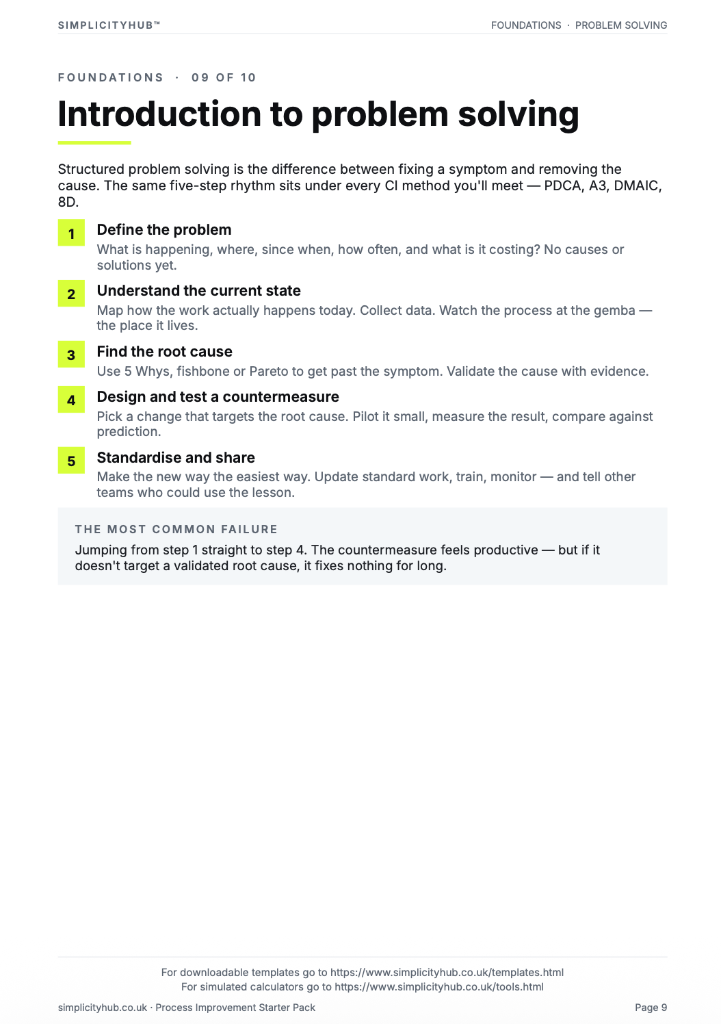
A 5 Whys Template provides a structured framework for conducting root cause analysis by repeatedly asking 'Why?' until the underlying systemic cause of a problem is identified. It was developed at Toyota and is one of the most widely used Lean Six Sigma problem-solving tools.
When to use a 5 Whys Template
Use it in the Analyse phase of DMAIC, after the problem has been confirmed with data and you need to identify the root cause before designing solutions. It works best for focused problems with a single or small number of root causes.
How to get the most from this template
- Stop when you reach a systemic or process cause, not when you find a person to blame
- Use data or observation to validate each “why” — do not guess the next level
- If you reach a different root cause depending on the starting problem statement, run both branches
Common mistake: stopping at three or four whys because the answer feels obvious — the fifth why often reveals a management or system gap that the earlier answers miss.
Who should use a 5 Whys Template
- All belt levels — the 5 Whys is one of the most accessible tools in the CI toolkit and works at every level
- Team leaders and supervisors — for rapid root cause analysis of day-to-day quality or operational problems
- Quality teams — during CAPA processes and non-conformance investigations
- Green Belts and Black Belts — as part of a broader Analyse phase toolkit alongside statistical analysis
Watch: a quick explainer
New to this? This short video walks you through getting to the real root cause — a helpful primer before you download and use the template.
How to use a 5 Whys — step by step
- 1Write the problem statement at the top
Start with a clear, factual, data-backed problem statement. 'Defect rate is 4.2%' not 'quality is poor'.
- 2Ask Why 1 — what caused this?
Write down the first-level cause. This is usually a symptom or direct cause — not yet the root.
- 3Ask Why 2 — what caused Why 1?
Challenge the first answer. Keep the team focused on causes, not blame.
- 4Continue to Why 3, 4 and 5
Keep going until you reach a systemic cause — a missing process, failed control or design gap.
- 5Check the logic upward
Read the chain back: 'Because of X, Y happened, which caused Z.' If the logic holds, you have a valid chain.
- 6Identify the actionable root cause
The deepest level where a corrective action can prevent recurrence is the root cause. Document it clearly.
- 7Validate before acting
Check whether data or observation supports the root cause before committing to a solution.
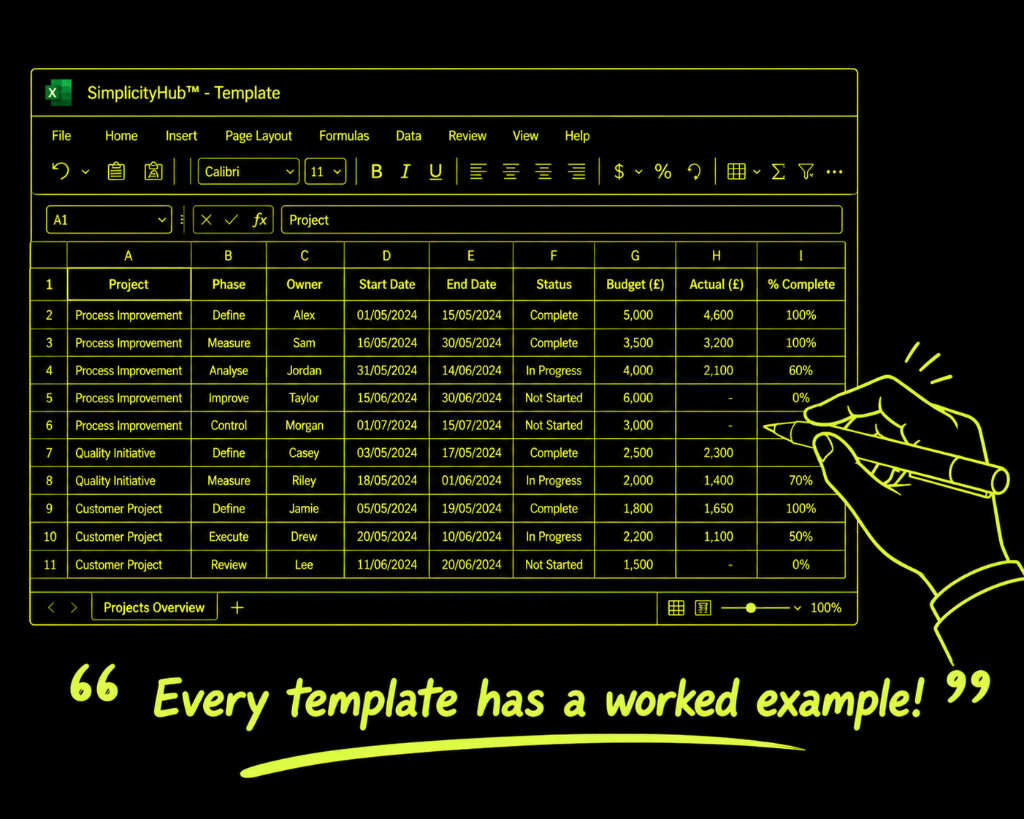
Worked example — Machine Downtime Investigation
A maintenance team traced a recurring machine stoppage through five 'Why' levels — from 'machine overheated' to a missing entry in the preventive maintenance schedule caused by an undocumented handover process.
Common mistakes — and how to avoid them
Stopping at symptom level. The first or second 'why' is rarely the root cause — it is usually a symptom. Keep going until you reach a systemic failure.
Jumping to solutions. Each answer should be a cause, not a fix. 'Because we need better training' is a solution in disguise.
Asking leading questions. 'Was it because the machine was old?' is a leading question. Ask open-ended whys.
Doing it alone. The 5 Whys requires people who know the process. A desk exercise by someone outside the process produces theories, not root causes.
Tips for getting better results
Use it after the Fishbone, not instead of it. For complex problems, use a Fishbone to identify all possible cause categories first, then use the 5 Whys to drill into the most likely causes.
Draw it as a tree, not just a list. Sometimes a problem has two root causes. Draw branches where a 'why' has more than one answer.
Validate the root cause with data. Before moving to Improve, check whether data supports the root cause you have identified.
Frequently asked questions
Do I always need exactly five whys?
No — five is a guideline. Stop when you reach a cause that is actionable and would prevent recurrence if fixed.
How do I know I have reached the root cause?
Ask: if we fix this will the problem definitely not recur, and is the fix within our control? If yes to both, you are likely there.
Can there be multiple root causes?
Yes. Real problems often have more than one. Run parallel chains and address all validated root causes.
Most common mistake?
Stopping too early — arriving at a symptom rather than root cause and building a solution around it.
Advanced Toolkit Packs — available now
Structured, ready-to-use template packs designed for real improvement work. Pick the pack that matches your project and get started straight away.
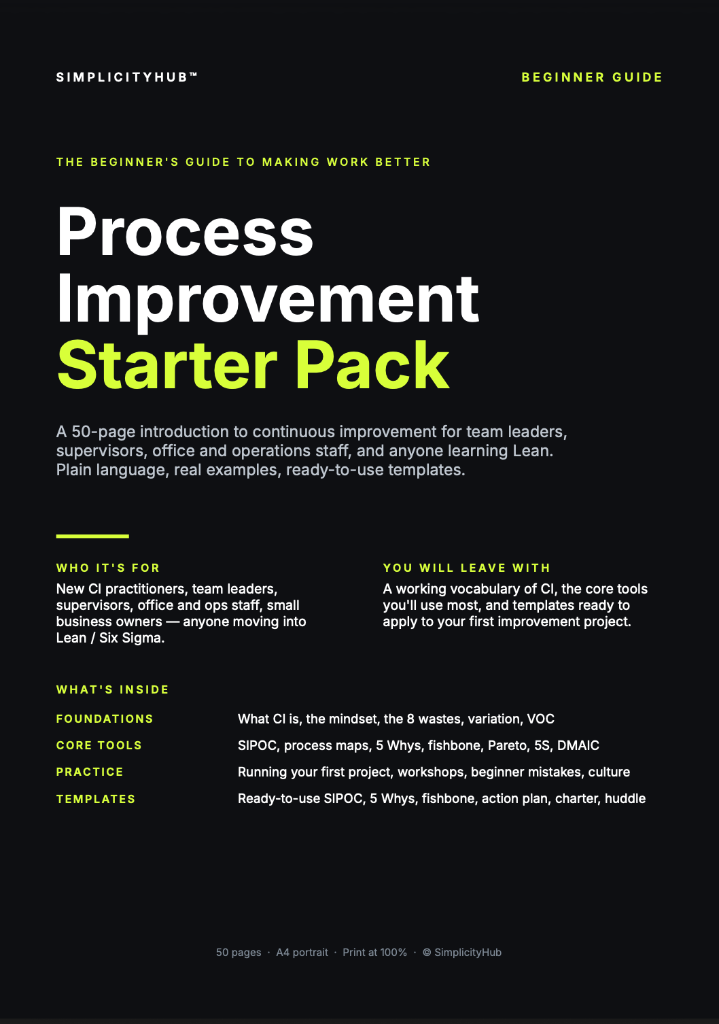
Process Improvement Starter Pack
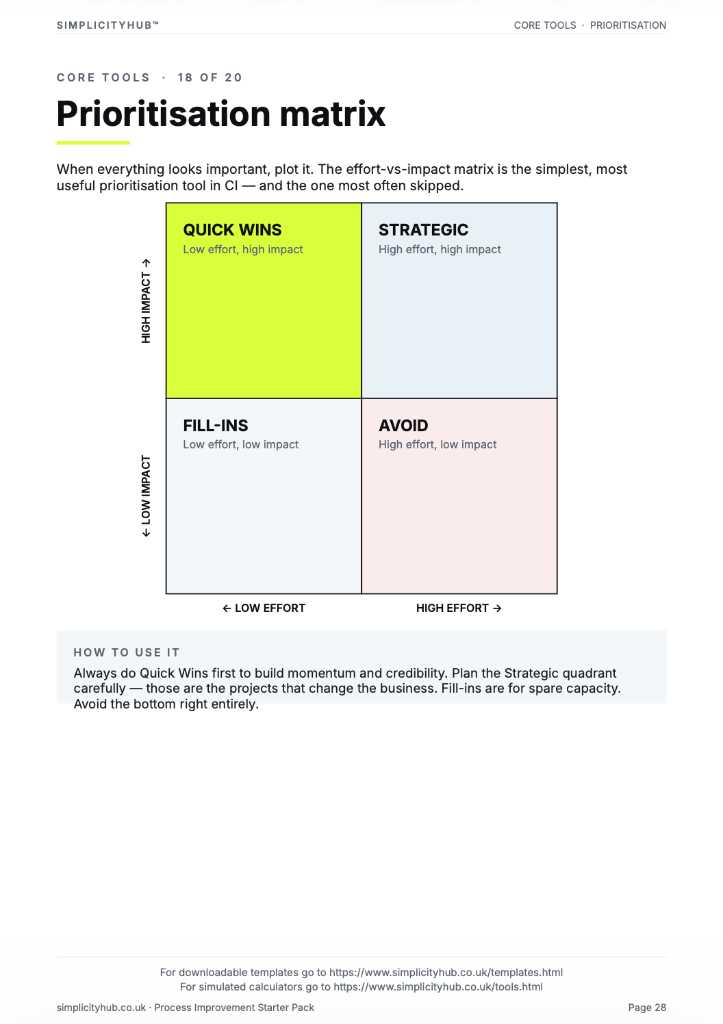
A starter pack for identifying improvement opportunities, measuring baselines and planning action.
Root Cause Analysis Toolkit
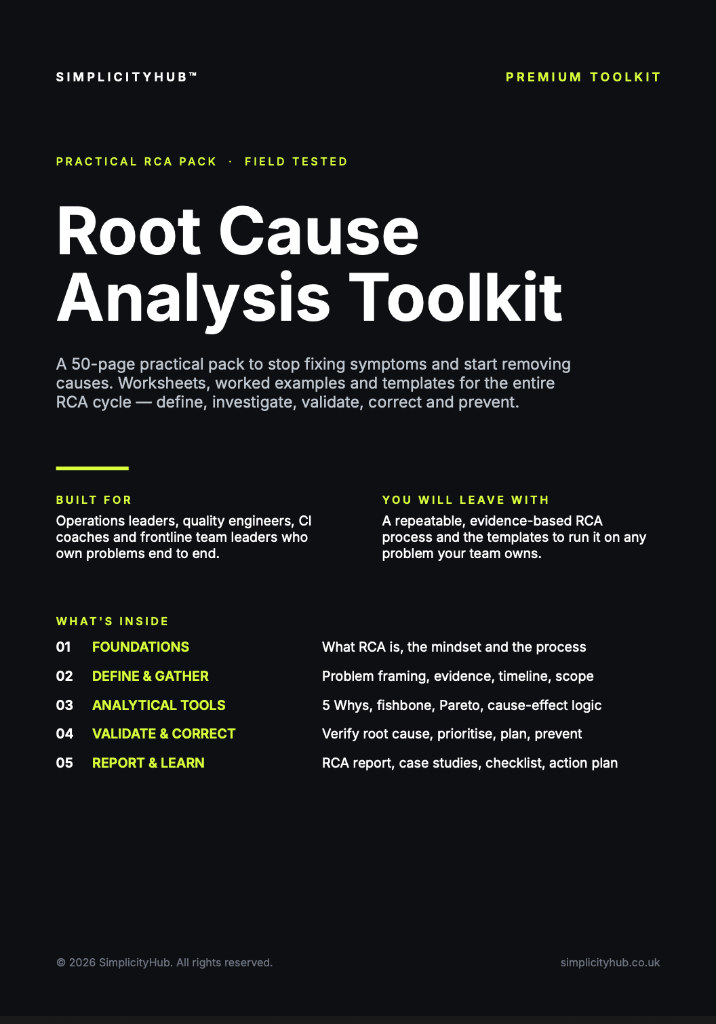
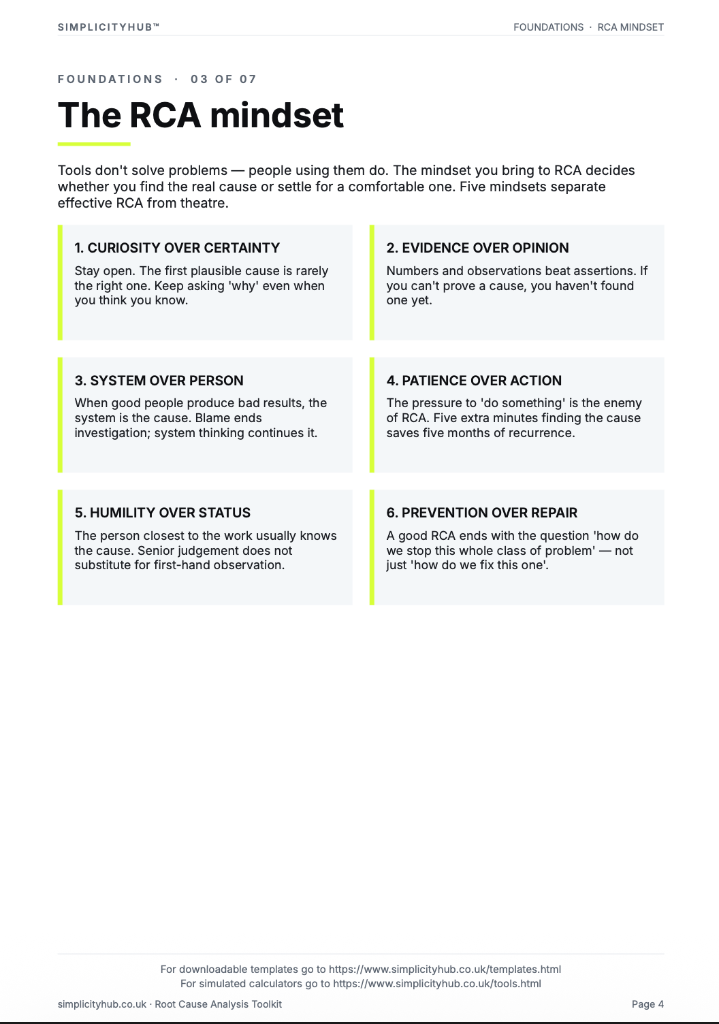
A practical RCA toolkit for defining problems, finding causes, validating evidence and creating action.
A3 Template Pack
A clean A3 problem-solving pack for concise, visual improvement thinking and follow-through.