What is a SIPOC Template?
A SIPOC diagram is a high-level process map that captures five elements in a single view: Suppliers, Inputs, Process, Outputs and Customers. It is usually one page and shows only the top-level steps — typically five to seven — without drilling into sub-steps or decision points.
The SIPOC exists to align the team on process boundaries before any detailed mapping begins. It answers three questions at once: where does the process start and end, who feeds it and who receives the output, and what are we actually improving?
It is the standard first tool in the Define phase of DMAIC and is typically completed in a team workshop before the Project Charter is finalised.
When to use a SIPOC Template
Use a SIPOC at the very start of a project — before you draw detailed process maps, before you collect data, and before you agree scope with your sponsor. Use it when:
- The team has different views on where the process starts and ends
- You need to identify who the customers of the process actually are
- Stakeholders from multiple functions need a shared picture of the process
- You are preparing for a more detailed value stream map or process map
How to get the most from this template
- Start with the process column — map the 4 to 8 high-level steps before adding suppliers or customers
- List specific suppliers and customers by name or department, not generic categories like “the business”
- Include the output requirements for each customer — what they actually need, not what you think they should get
Common mistake: making the process map too detailed — a SIPOC is a scoping tool, not a full process flowchart. If you need more than 8 steps, you probably need to narrow your scope.
Who should use a SIPOC Template
- Green Belts and Black Belts — as the first Define phase deliverable on any DMAIC project
- Process Improvement Facilitators — to run the opening workshop of a Kaizen event
- Operations Managers — to get a quick picture of a process before commissioning work
- CI Students — practising Define phase tools as part of Lean Six Sigma training
Watch: a quick explainer
New to this? This short video walks you through mapping a process end-to-end with SIPOC — a helpful primer before you download and use the template.

How to build a SIPOC diagram
Fill the SIPOC from the middle out — start with the Process column, then work left to Inputs and Suppliers, then right to Outputs and Customers. Do not start with Suppliers — it leads to scope creep.
How to build a SIPOC diagram — step by step
-
1Map the high-level process steps
Write five to seven steps that describe the process at the highest level. These are verb-noun pairs: 'Receive order', 'Check credit', 'Pick items', 'Pack order', 'Despatch'. No sub-steps at this stage.
-
2Identify the Outputs
What does the process produce? This could be a physical product, a document, a decision or a service. List the primary outputs of the last process step.
-
3Identify the Customers
Who receives the outputs? These are your customers — they could be internal (another team) or external (end consumers). List every customer type.
-
4Identify the Inputs
What does the process need to function? Materials, information, systems, data. List the key inputs required for the first process step.
-
5Identify the Suppliers
Who or what provides each input? These are your suppliers — internal departments, external vendors, systems or customers themselves.
-
6Agree the process boundaries
The first process step defines the start. The last step defines the end. Make these explicit — this becomes your scope statement.
-
7Review with the sponsor
Walk through the completed SIPOC with your sponsor to confirm scope and identify any stakeholders or customers not yet captured.
Worked example — Order Fulfilment SIPOC
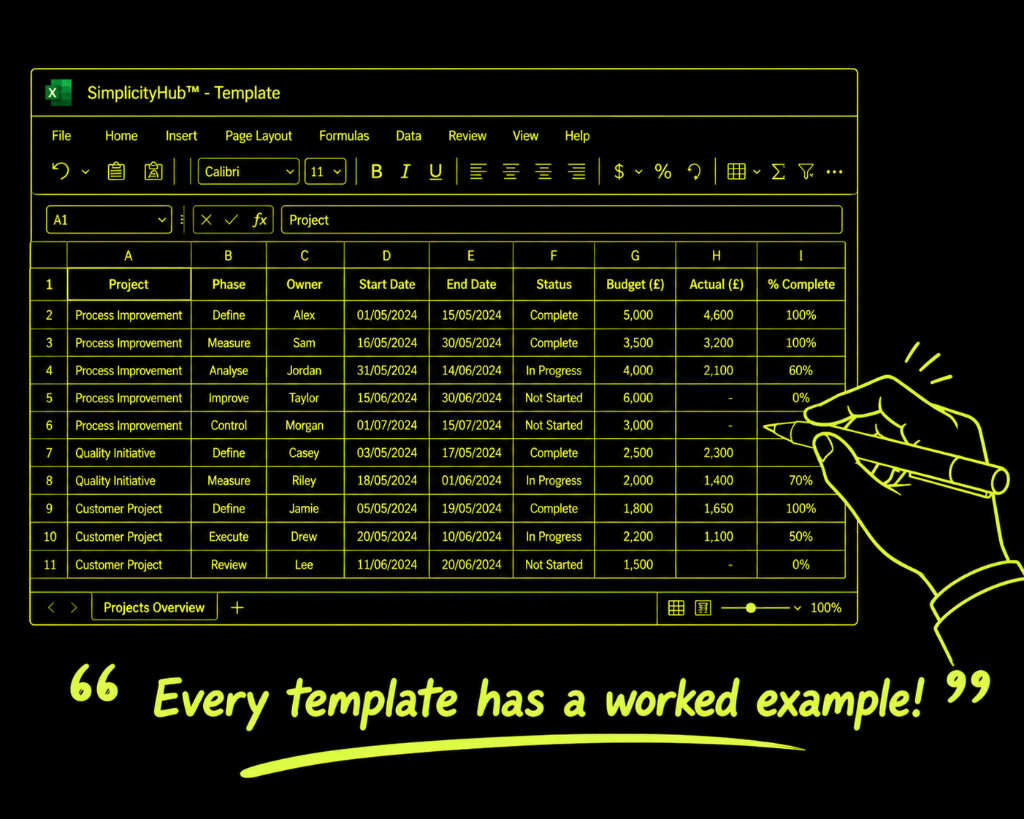
A completed SIPOC for an order fulfilment process, showing the five columns filled from a team workshop in the Define phase.
Common mistakes — and how to avoid them
Starting with Suppliers instead of the Process. This leads to an endless list of inputs and misses the point. Always define the process steps first, then work outwards.
Too many process steps. A SIPOC is not a detailed process map. If you have more than eight steps, you are mapping at the wrong level. Group steps into higher-level activities.
Listing internal teams as Customers without checking. Your customer is whoever receives and cares about the output. Just because another department receives your output does not make them the voice of the customer.
Confusing Inputs with Process steps. Inputs feed the process — they are not steps within it. 'Customer order form' is an input. 'Receive the order form' is a process step.
Tips for getting better results
Do it on a whiteboard first. Use sticky notes, one per column. It takes 30 minutes and the team will challenge each other's assumptions. Transfer to the template after the session.
Use the SIPOC to define your data collection scope. The Inputs column tells you what to measure in the Measure phase. The Outputs column tells you what your CTQs are.
Keep customer requirements separate. Add a sixth column — Requirements — to capture what each customer needs from the output. This becomes your CTQ list.
Download the SIPOC Template
A clean, editable Excel template for immediate use — structured, professional and ready to fill in.
Frequently asked questions
How many rows should a SIPOC have?
There is no fixed number, but aim for 5 to 7 process steps. If you have more than 10, you are mapping at too low a level of detail — zoom out and combine steps. A SIPOC should fit on one page and give a helicopter view of the process, not a step-by-step workflow.
What comes first — suppliers or customers?
Start with customers and outputs, then work backwards to define inputs and suppliers. Most teams find it easier to agree what the process produces before deciding what it needs. Fill in the process steps last — they connect inputs to outputs.
What is the difference between a SIPOC and a process map?
A SIPOC is a high-level overview — it shows the boundary and context of a process in a single page. A process map (swimlane or flowchart) shows every step, decision and handover in detail. You complete the SIPOC first in Define, then create the detailed process map in Measure once scope is agreed.
Can one supplier appear multiple times?
Yes — the same supplier can provide different inputs to different steps. List them each time they appear rather than trying to consolidate, so the connections stay visible. The SIPOC is about clarity, not brevity.
Do customers have to be external?
No — customers in a SIPOC can be internal (another department or team) or external (end customers, regulators). The key is identifying who receives the output and what they need from it. Internal customers are just as important as external ones in process improvement.
Advanced Toolkit Packs — available now
Structured, ready-to-use template packs designed for real improvement work. Pick the pack that matches your project and get started straight away.
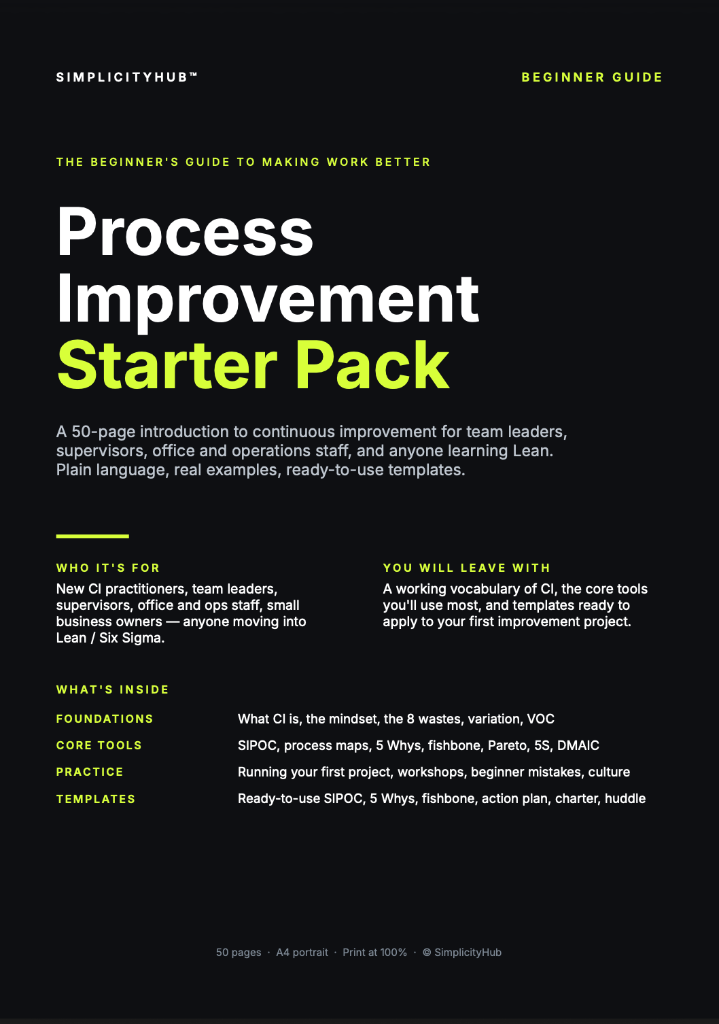
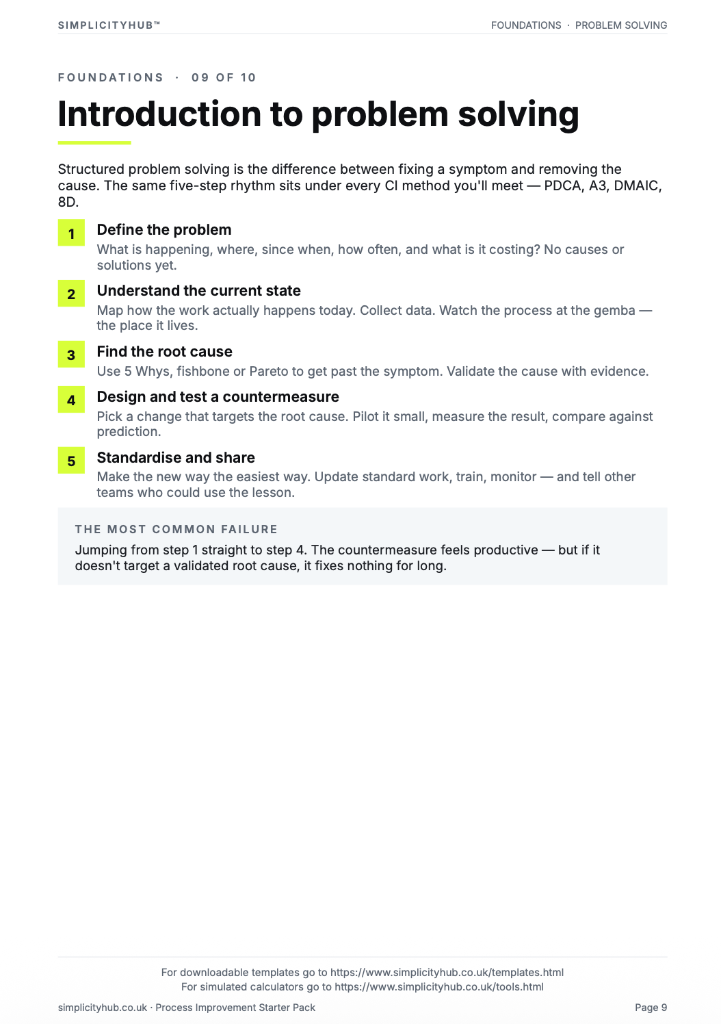
Process Improvement Starter Pack
A starter pack for identifying improvement opportunities, measuring baselines and planning action.
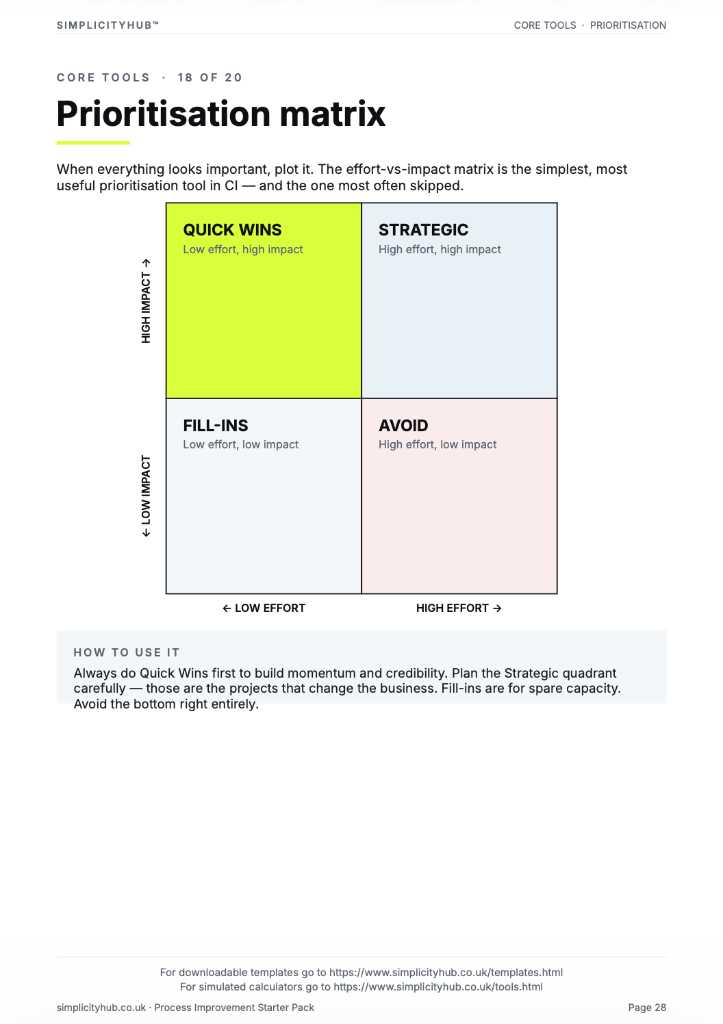
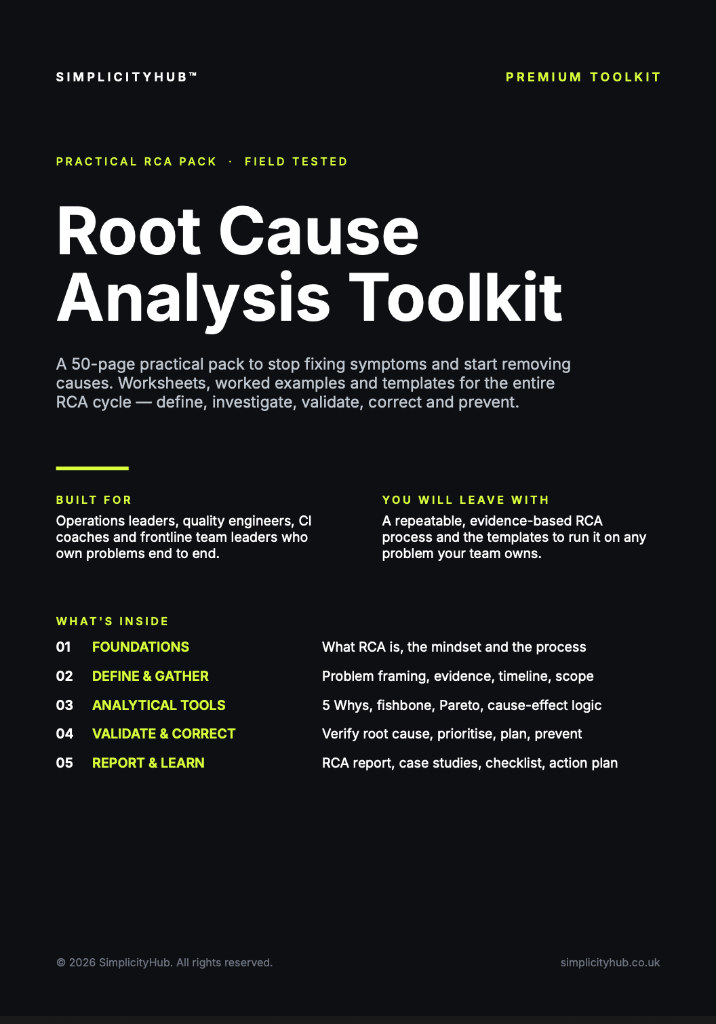
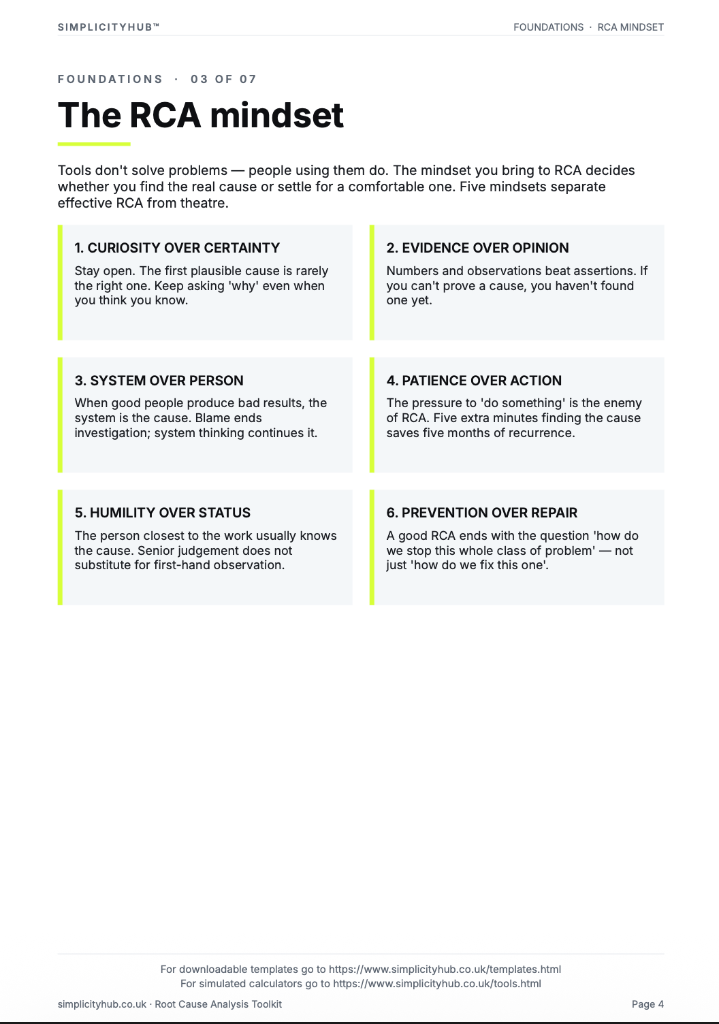
Root Cause Analysis Toolkit
A practical RCA toolkit for defining problems, finding causes, validating evidence and creating action.
A3 Template Pack
A clean A3 problem-solving pack for concise, visual improvement thinking and follow-through.