
What is a Fishbone Diagram Template?
A Fishbone diagram — also called an Ishikawa diagram or cause-and-effect diagram — is a visual tool for exploring all possible causes of a problem across six standard categories: Man, Machine, Method, Material, Measurement and Mother Nature (environment).
The problem is written at the head (right side) of the diagram. The six cause categories form the main 'bones', and specific causes are added as sub-branches. The result is a structured picture of every contributing factor the team can think of.
It is used in the Analyse phase of DMAIC to ensure root cause analysis covers all possible causes, not just the obvious ones, before data is used to validate which causes are real.
When to use a Fishbone Diagram Template
Use the Fishbone when you want to explore all possible causes of a problem before committing to data collection or solutions. It is particularly effective when:
- The root cause is unknown and multiple theories exist within the team
- You want to ensure no cause category is overlooked
- You are running a team brainstorm and need a structured framework
- A problem has resisted previous attempts to fix it and you want to think more broadly
How to get the most from this template
- Use the 6Ms (Man, Machine, Method, Measurement, Material, Environment) as your category framework
- Ask “why could this happen?” for each branch, not just “what could go wrong”
- Prioritise the identified causes with a quick dot-voting exercise before validating them with data
Common mistake: treating the diagram as the end of the analysis — it is the start. Every potential cause on the diagram needs to be validated with data before action is taken.
Who should use a Fishbone Diagram Template
- All belt levels — the Fishbone is a universal tool used in every sector and at every level of CI experience
- Quality teams — during CAPA and non-conformance investigations
- Green Belts and Black Belts — as a core Analyse phase tool before statistical validation
- Process improvement facilitators — to run structured brainstorm sessions with operational teams
Watch: a quick explainer
New to this? This short video walks you through using cause analysis to fix problems for good — a helpful primer before you download and use the template.


How to build a Fishbone diagram
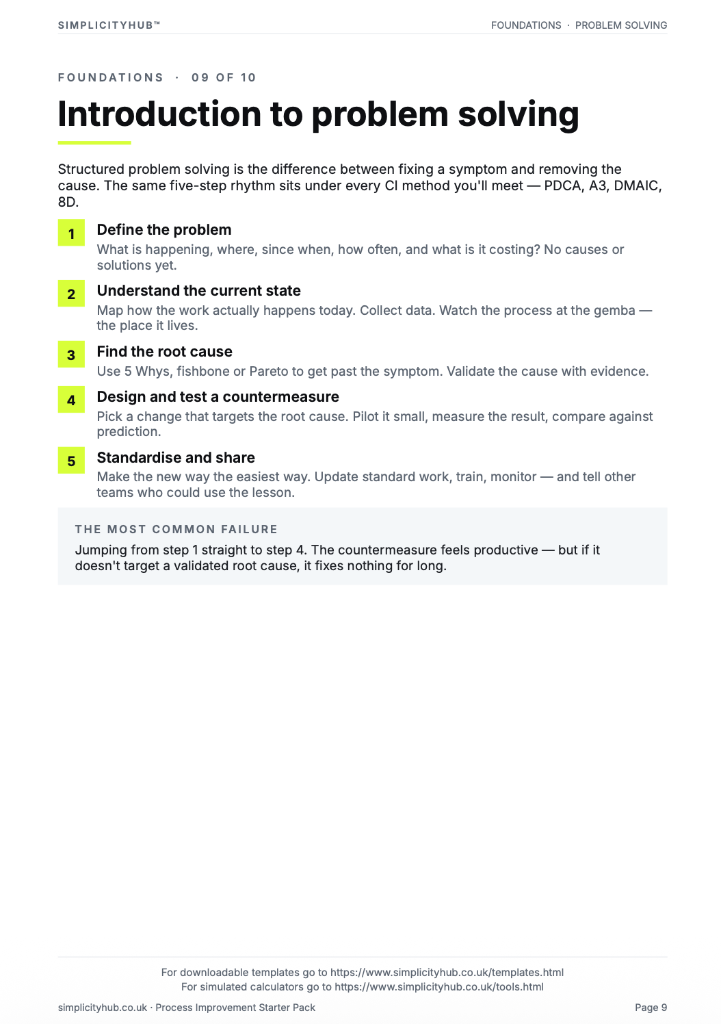
Build the Fishbone in a team session — never alone at a desk. The value comes from the team's collective process knowledge, not from one person's interpretation of the problem.
How to build a Fishbone diagram — step by step
-
1Write the problem at the head
State the problem clearly and specifically on the right-hand side of the diagram. Use the same wording as your problem statement. Be precise — a vague problem produces vague causes.
-
2Draw the main bones — the 6Ms
Draw six diagonal lines ('bones') leading into the central spine: Man (People), Machine, Method, Material, Measurement, Mother Nature. These are your cause categories.
-
3Brainstorm causes in each category
For each bone, ask: 'In this category, what could cause this problem?' Capture every idea without filtering. Quantity first, quality second.
-
4Add sub-causes as smaller bones
For each cause, ask 'Why might this happen?' and add the answer as a smaller branch. This starts to connect causes to root causes.
-
5Look for causes that appear in multiple categories
A cause that appears across more than one category is likely to be significant. Mark these for prioritisation.
-
6Shortlist the most likely causes
As a team, vote on which causes are most likely to be contributing to the problem based on evidence and process knowledge. Circle the top three to five.
-
7Validate with data
Take the shortlisted causes into the data. Can you confirm that the cause correlates with the problem? Use the Measure phase data or collect new targeted observations.
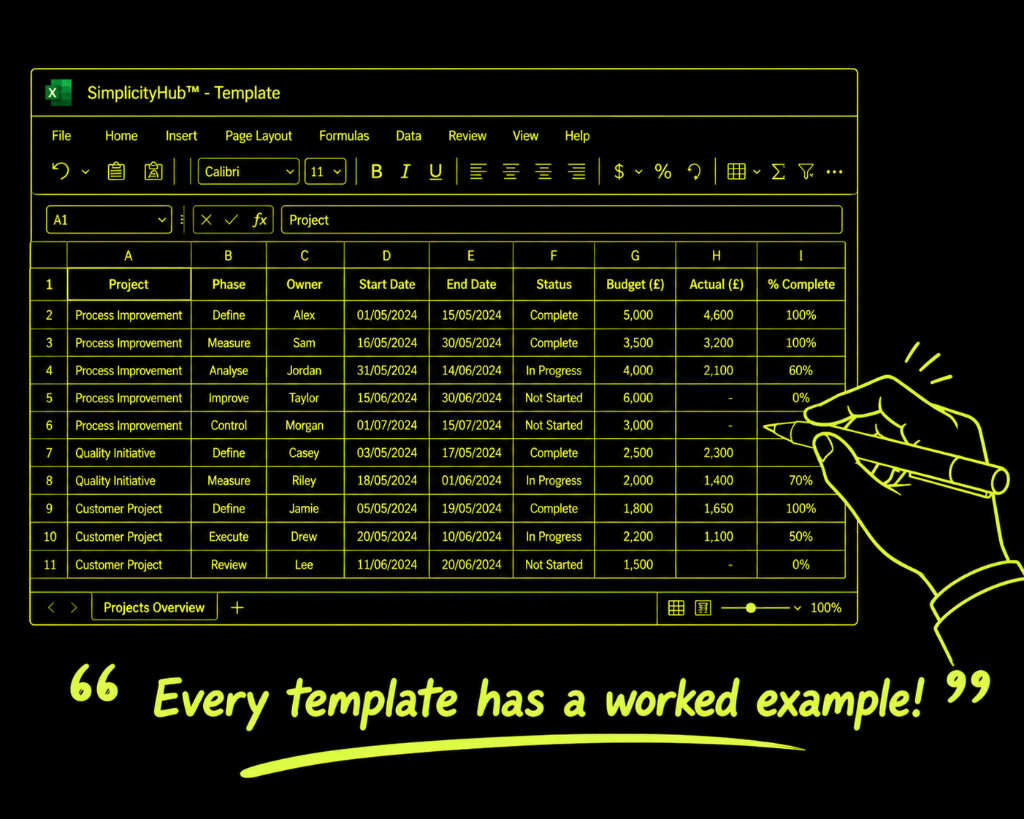
Worked example — High Defect Rate — Assembly Line
A completed Fishbone diagram for a high defect rate problem, with causes populated across all six categories including people, machine, method and material factors.
Common mistakes — and how to avoid them
Using it as a desk exercise. The Fishbone is a team tool. Doing it alone produces one person's theory, not a comprehensive cause analysis. Get the people who actually work in the process into the room.
Stopping at the first level of causes. A cause like 'operator error' is not a root cause — it is a symptom. Ask 'why' for each cause and add sub-branches to get to something actionable.
Ignoring causes that are uncomfortable. Teams often avoid causes that implicate management decisions, system failures or their own department. Encourage honesty by making the session blame-free.
Never validating the output. A Fishbone shows what could cause a problem. It does not tell you what does cause it. Always follow up with data to confirm which causes are real.
Tips for getting better results
Use sticky notes on a whiteboard. Write each cause on a sticky note. This makes it easy to move causes between categories and add sub-branches without redrawing.
Time-box the brainstorm. Give the team 20 minutes per bone, strictly timed. Without a time limit, discussions drift. With one, ideas flow faster.
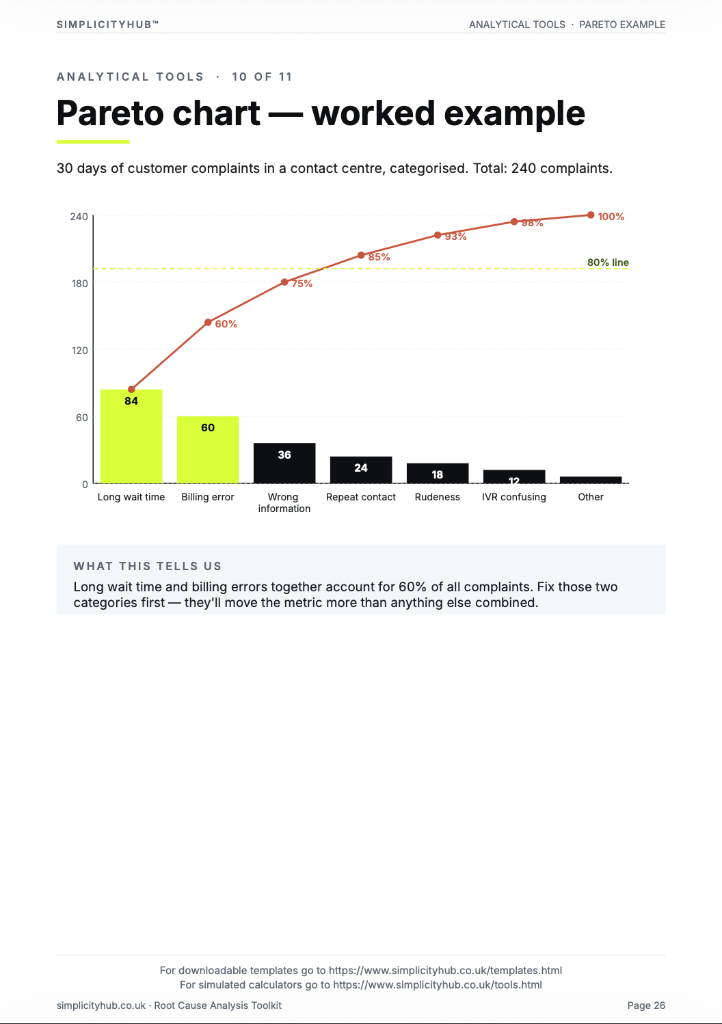
Feed the output into a Pareto chart. Count how many causes fall into each category. The category with the most causes is often — but not always — where the root cause lies. A Pareto chart of the shortlisted causes helps prioritise.
Download the Fishbone Diagram Template
A clean, editable Excel template for immediate use — structured, professional and ready to fill in.
Frequently asked questions
What are the standard categories?
6Ms for manufacturing: Man, Machine, Method, Material, Measurement, Mother Nature. For transactional: People, Process, Policy, Place.
How many causes should it have?
No fixed number. A well-run workshop might generate 40-60 potential causes across all branches.
Can I use a fishbone alone?
No — it generates hypotheses. Always follow with data analysis or a cause validation matrix.
How do I run a fishbone workshop?
State the effect clearly on the right. Work through each category asking why it could cause the problem. Timebox each category.
Advanced Toolkit Packs — available now
Structured, ready-to-use template packs designed for real improvement work. Pick the pack that matches your project and get started straight away.
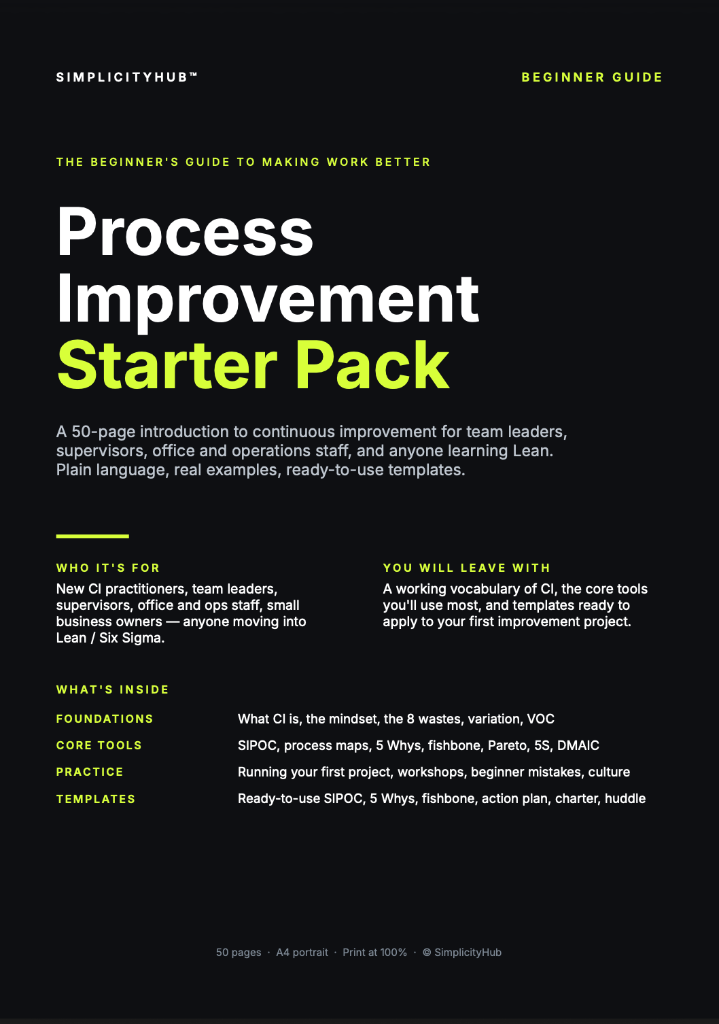
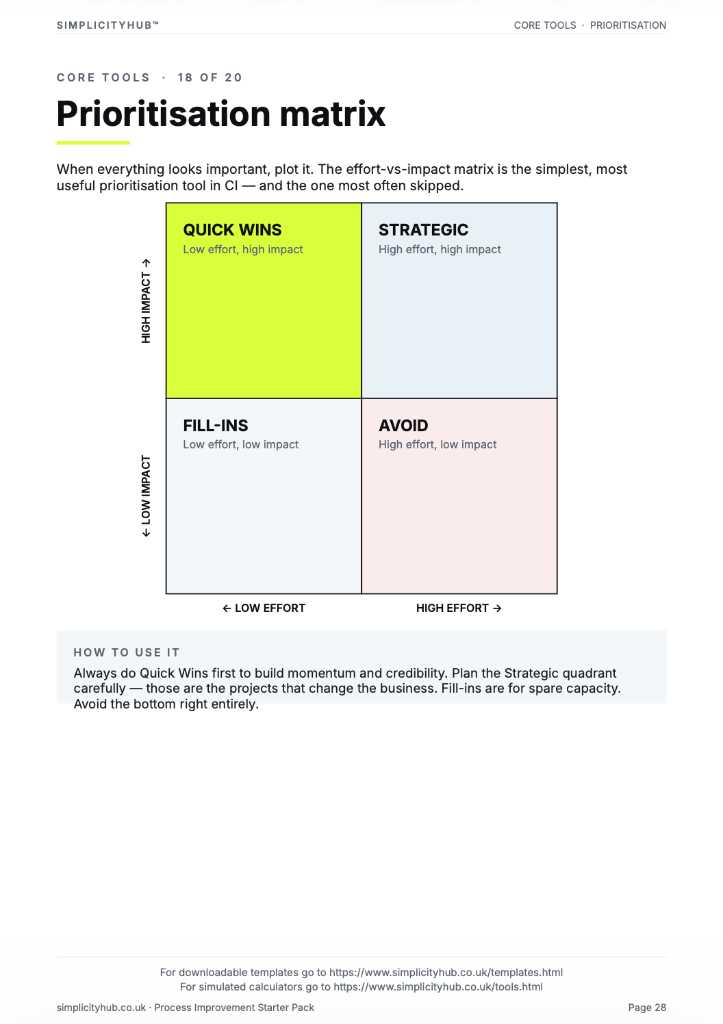
Process Improvement Starter Pack
A starter pack for identifying improvement opportunities, measuring baselines and planning action.
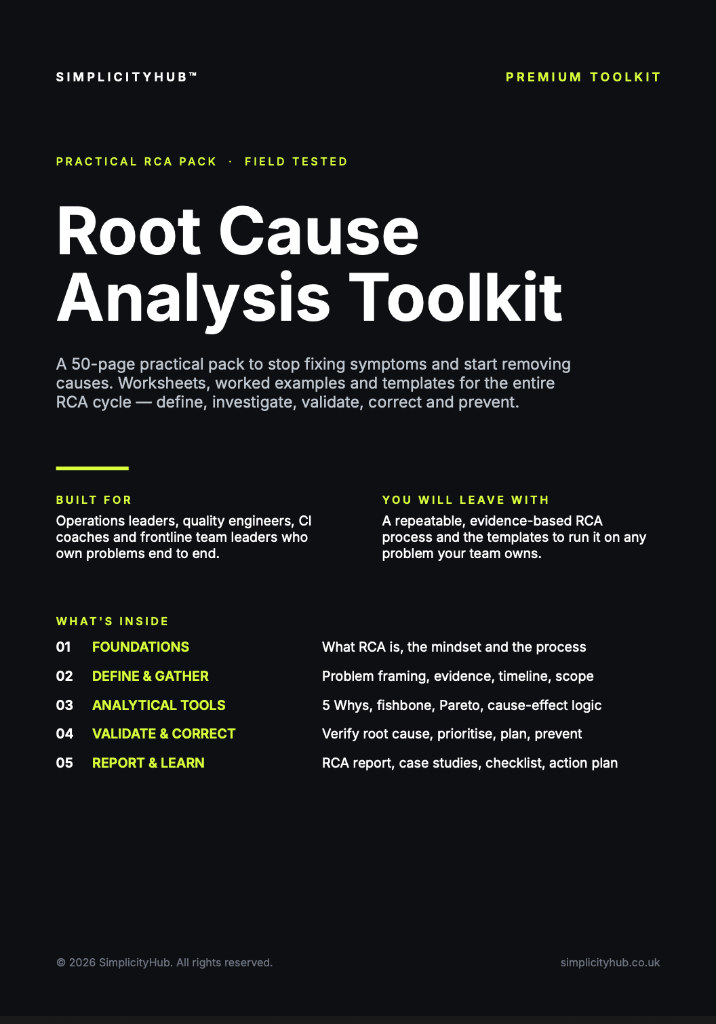
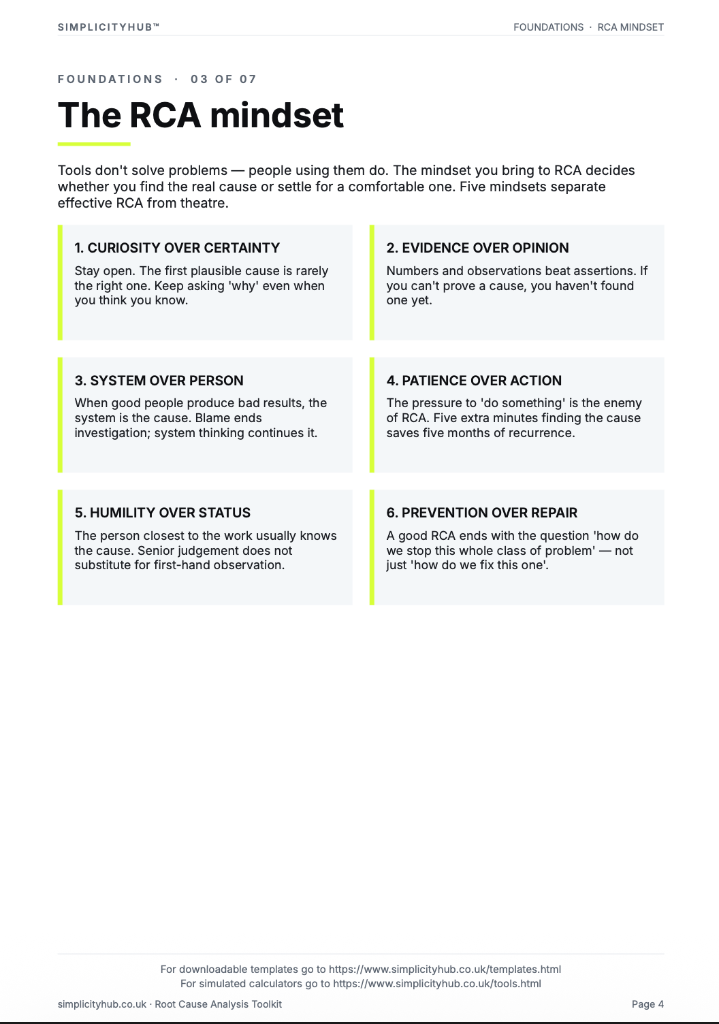
Root Cause Analysis Toolkit
A practical RCA toolkit for defining problems, finding causes, validating evidence and creating action.
A3 Template Pack
A clean A3 problem-solving pack for concise, visual improvement thinking and follow-through.