Change Management Plan Template
Plan how a change will be introduced, who it affects and how resistance will be managed so improvements actually stick.


What is a Change Management Plan Template?
A Change Management Plan Template provides a structured approach to preparing, supporting and guiding people through a process change. It covers stakeholder impact, communication, training and resistance management.
When to use a Change Management Plan Template
Use it in the Improve phase, before implementation begins. Build it in parallel with your implementation plan so the people and process changes happen together.
Who should use a Change Management Plan Template
- Black Belts and project leads — planning the people and behaviour change that accompanies process improvements
- HR and organisational development professionals — supporting large-scale change programmes with structured planning tools
- Operations managers — managing their team through process transitions with minimal disruption
- Sponsors and senior leaders — understanding their role in visible leadership of the change
Vote yes and we’ll prioritise a quick walkthrough showing you exactly how to use it.
How to use a Change Management Plan — step by step
-
1Write the problem statement at the top
Start with a clear, factual problem statement. 'Machine stopped' or 'Customer received wrong item' — specific, observable, factual. Vague problems produce vague root causes.
-
2Ask 'Why did this happen?' — Why 1
Write down the first-level cause. This is usually a symptom or a direct cause — not yet the root. Examples: 'Machine overheated', 'Wrong item was picked'.
-
3Ask 'Why did that happen?' — Why 2
Challenge the previous answer. Keep the team focused on causes, not blame. If the answer is 'human error', push further — why did the human make the error?
-
4Continue to Why 3, 4 and 5
Keep going until you reach a cause that is systemic — a missing process, a failed control, a gap in training or a design flaw. The number five is a guide, not a rule.
-
5Check the logic by reading upward
Read the chain back to front: 'Because of X, Y happened, which caused Z.' If the logic holds, you have a valid chain. If it breaks, revisit the step where it breaks.
-
6Identify the actionable root cause
The root cause is the deepest level where a corrective action can prevent recurrence. Document it clearly — this feeds your Improve phase solution design.
-
7Validate before acting
Do not jump to solution immediately. Check whether data or observation confirms the root cause is real and significant before committing resource to fixing it.
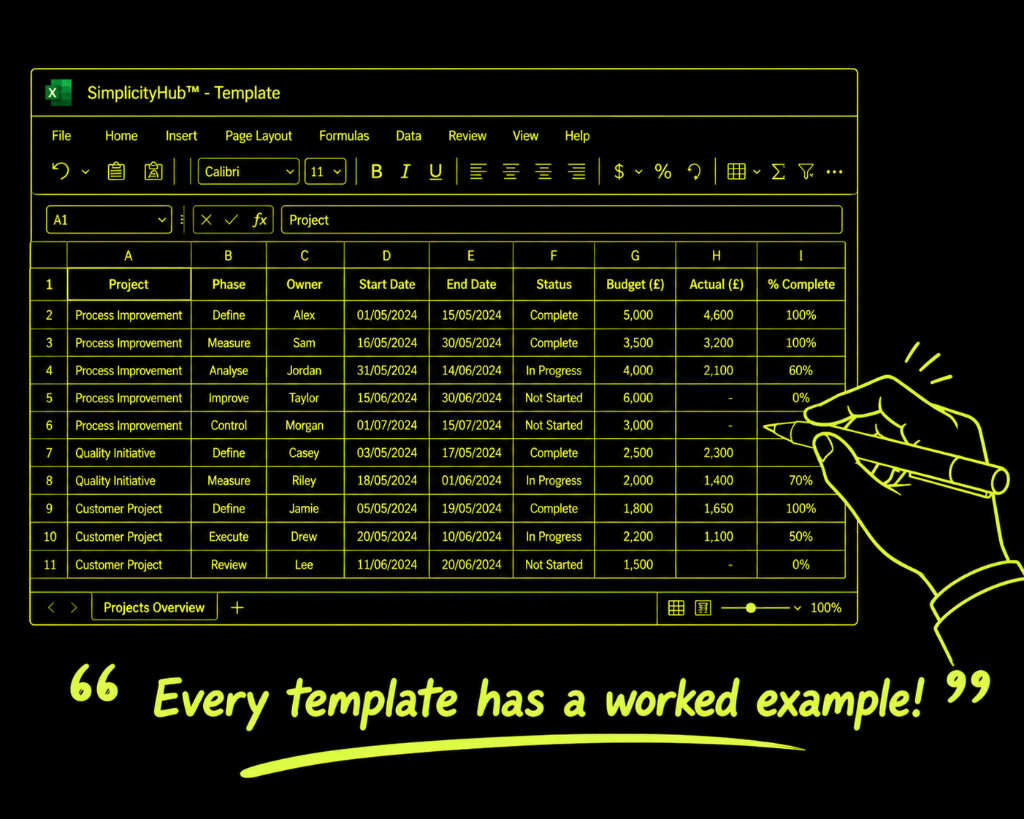
Worked example — Implementing a New Quality System
A quality team used this plan to manage the rollout of a new inspection system across 3 sites and 140 staff — identifying 4 resistance hotspots in advance and building targeted engagement activities that reduced rejection from 40% to under 5%.
Common mistakes — and how to avoid them
Treating change management as a communications plan. Communication is part of change management — not all of it. You also need training, stakeholder engagement, resistance management and leadership alignment.
Starting the plan after implementation begins. Change management needs to start in the Improve phase, not on go-live day. By then it is too late to build the necessary stakeholder readiness.
Underestimating resistance. Resistance is a normal, predictable response to change. Plan for it proactively — identify where it will come from and what you will do about it.
No success measures for the change. How will you know the change has landed? Define adoption and behaviour metrics before go-live, not after.
Tips for getting better results
Involve resistors early. The people most likely to resist are often the most influential. Bring them into the design process early — they become your strongest advocates.
Communicate the why before the what. People accept change much more readily when they understand why it is necessary. Lead with the problem, not the solution.
Sustain leadership visibility throughout. Visible sponsor engagement after go-live is one of the strongest predictors of change sustainability. Don't let leaders go quiet once implementation starts.
Frequently asked questions
Why is change management important in DMAIC?
Most improvement projects fail not because the solution is wrong but because the people affected by the change do not adopt it. A change management plan addresses resistance, builds buy-in and ensures training and communication happen at the right time.
What should a change management plan include?
It should include stakeholder groups affected, their current sentiment, the key messages needed, communication channels, training requirements, a timeline and named owners for each action.
Who owns the change management plan?
The project leader owns it, but the content should be developed with input from HR, line managers and the people actually doing the work. Senior sponsor engagement is critical for high-resistance changes.