Training Needs Analysis Template
Map the skills your team has against what the process needs so training closes real gaps, not guessed ones.


What is a Training Needs Analysis Template?
A Training Needs Analysis (TNA) Template identifies gaps between current team competencies and the skills required to operate the improved process. It produces a prioritised training plan to close those gaps.
When to use a Training Needs Analysis Template
Use it in the Control phase before go-live, after SOPs and the To-Be process map are finalised. Identify every role affected by the change and assess their training needs against the new requirements.
Who should use a Training Needs Analysis Template
- Black Belts and project leads — identifying and closing training gaps before a new process goes live
- HR and learning and development teams — planning and scheduling training programmes for process changes
- Process owners — ensuring their team has the skills to operate and sustain the improved process
- Team leaders — assessing individual competency gaps and supporting development plans
Vote yes and we’ll prioritise a quick walkthrough showing you exactly how to use it.
How to use a Training Needs Analysis — step by step
-
1Write the problem statement at the top
Start with a clear, factual problem statement. 'Machine stopped' or 'Customer received wrong item' — specific, observable, factual. Vague problems produce vague root causes.
-
2Ask 'Why did this happen?' — Why 1
Write down the first-level cause. This is usually a symptom or a direct cause — not yet the root. Examples: 'Machine overheated', 'Wrong item was picked'.
-
3Ask 'Why did that happen?' — Why 2
Challenge the previous answer. Keep the team focused on causes, not blame. If the answer is 'human error', push further — why did the human make the error?
-
4Continue to Why 3, 4 and 5
Keep going until you reach a cause that is systemic — a missing process, a failed control, a gap in training or a design flaw. The number five is a guide, not a rule.
-
5Check the logic by reading upward
Read the chain back to front: 'Because of X, Y happened, which caused Z.' If the logic holds, you have a valid chain. If it breaks, revisit the step where it breaks.
-
6Identify the actionable root cause
The root cause is the deepest level where a corrective action can prevent recurrence. Document it clearly — this feeds your Improve phase solution design.
-
7Validate before acting
Do not jump to solution immediately. Check whether data or observation confirms the root cause is real and significant before committing resource to fixing it.
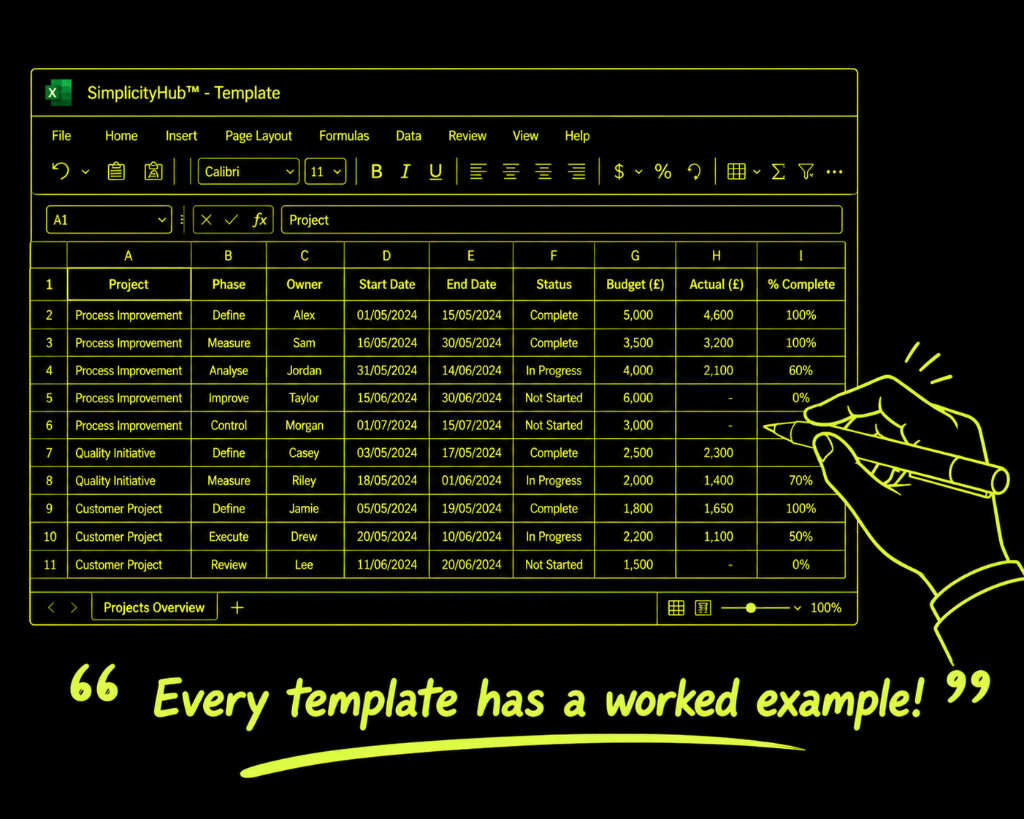
Worked example — New CRM System Rollout
Before launching a new CRM system, a project team assessed all 18 affected roles against 9 required competencies — identifying 34 training gaps and building a 3-week training schedule that closed all critical gaps before go-live.
Common mistakes — and how to avoid them
Assuming existing staff are already competent. Familiarity with the old process does not mean competency in the new one. Assess every role, even experienced team members.
Training too early. Training delivered 4+ weeks before go-live loses retention. Schedule training as close to the go-live date as practical.
No competency verification. Completing training is not the same as being competent. Include an observation, test or supervisor sign-off for each critical competency.
Not updating the TNA when the process changes. If the process changes post-go-live, the training needs change too. Keep the TNA as a live document.
Tips for getting better results
Prioritise by go-live risk. Focus first on competencies that, if missing, would cause the process to fail or create a safety issue from day one.
Use on-the-job training for procedural tasks. Watching someone do it, then doing it with supervision, then doing it independently is far more effective than classroom training for process tasks.
Keep the records. Training completion records are an audit requirement in many regulated industries. Store them systematically.
Frequently asked questions
What is a training needs analysis?
A training needs analysis (TNA) identifies the gap between the current skills and knowledge of your team and what is required to perform the new or improved process. It specifies who needs training, on what, by when and in what format.
When should I do a training needs analysis?
Complete it in the Improve phase, once the to-be process is designed and before the pilot. This ensures training is planned early enough to be ready for go-live rather than scrambled together at the last minute.
What happens if training needs are not identified?
Without a TNA, teams often implement a process change without ensuring the people doing the work actually know how to do it correctly. This leads to workarounds, errors and reversion to old habits — which undermines the entire improvement.