Mistake Proofing Log Template
Log every error-proofing (poka-yoke) idea with before-and-after detail so defects are designed out for good.


What is a Mistake Proofing Log Template?
A Mistake Proofing Log (Poka-Yoke Log) records each identified error type, its root cause, the mistake-proofing device or method applied, and verification of its effectiveness. It is a core Improve phase deliverable.
When to use a Mistake Proofing Log Template
Use it after root cause analysis confirms the failure modes you need to prevent. Complete it alongside your control plan to ensure every key defect has a prevention mechanism documented.
Who should use a Mistake Proofing Log Template
- Green Belts and Black Belts — documenting poka-yoke solutions during the Improve phase of a DMAIC project
- Quality engineers — systematically eliminating defect causes from processes and products
- Process owners — maintaining a record of all error-prevention mechanisms in their process
- Audit teams — verifying that mistake-proofing devices are in place and functioning during process audits
Vote yes and we’ll prioritise a quick walkthrough showing you exactly how to use it.
How to use a Mistake Proofing Log — step by step
-
1Write the problem statement at the top
Start with a clear, factual problem statement. 'Machine stopped' or 'Customer received wrong item' — specific, observable, factual. Vague problems produce vague root causes.
-
2Ask 'Why did this happen?' — Why 1
Write down the first-level cause. This is usually a symptom or a direct cause — not yet the root. Examples: 'Machine overheated', 'Wrong item was picked'.
-
3Ask 'Why did that happen?' — Why 2
Challenge the previous answer. Keep the team focused on causes, not blame. If the answer is 'human error', push further — why did the human make the error?
-
4Continue to Why 3, 4 and 5
Keep going until you reach a cause that is systemic — a missing process, a failed control, a gap in training or a design flaw. The number five is a guide, not a rule.
-
5Check the logic by reading upward
Read the chain back to front: 'Because of X, Y happened, which caused Z.' If the logic holds, you have a valid chain. If it breaks, revisit the step where it breaks.
-
6Identify the actionable root cause
The root cause is the deepest level where a corrective action can prevent recurrence. Document it clearly — this feeds your Improve phase solution design.
-
7Validate before acting
Do not jump to solution immediately. Check whether data or observation confirms the root cause is real and significant before committing resource to fixing it.
Worked example — Eliminating Data Entry Errors
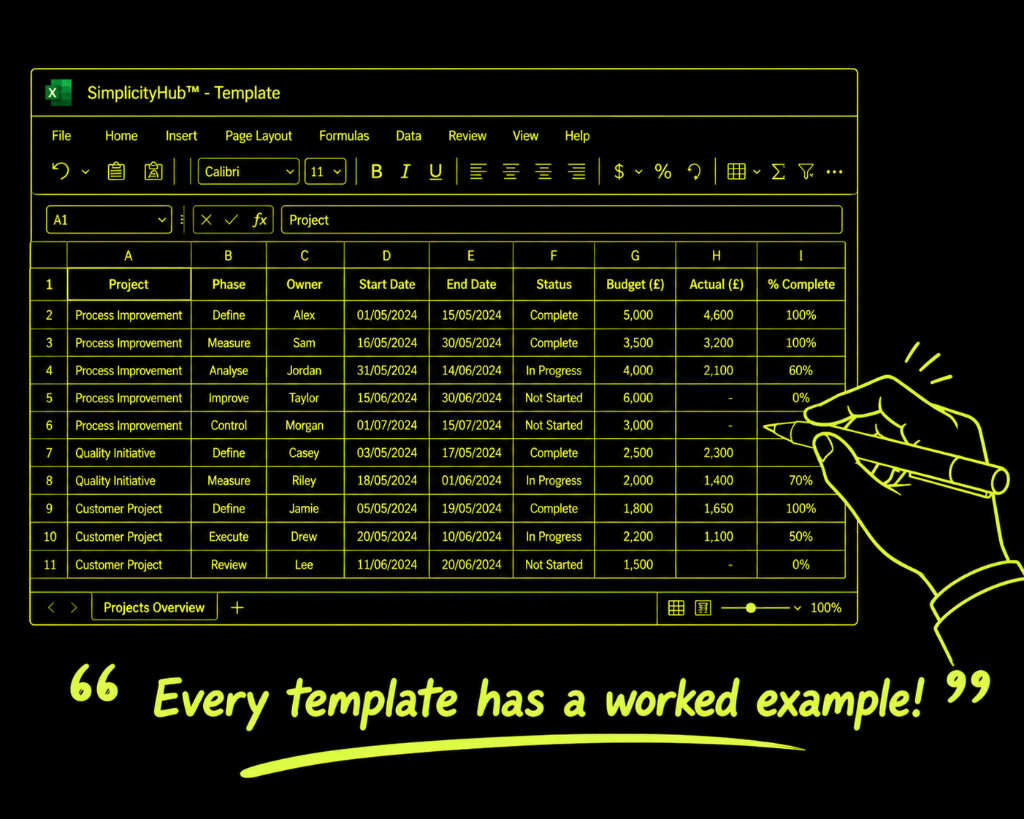
A finance team used the log to document six poka-yoke solutions for a data entry process — from mandatory field validation to dual-entry verification — reducing error rate from 4.2% to 0.1%.
Common mistakes — and how to avoid them
Designing detection instead of prevention. Detection poka-yokes catch errors after they occur. Prevention poka-yokes stop them happening. Always aim for prevention first.
Not testing before closing. A poka-yoke that hasn't been tested hasn't been proven. Test every device under real operating conditions before marking it complete.
Forgetting to update the control plan. Poka-yoke devices must be listed in the control plan so they are maintained and checked in audits. Don't treat them as one-off fixes.
Over-engineering simple solutions. The best poka-yokes are simple, obvious and hard to bypass. Complex solutions get worked around or disabled.
Tips for getting better results
Involve the operators in design. Frontline staff know where errors happen and why. Their input produces more practical poka-yoke solutions than desk-based analysis.
Start with the highest-frequency defects. Focus poka-yoke effort on defects with the highest occurrence rate first — this maximises impact per hour invested.
Check poka-yokes in routine audits. Mistake-proofing devices can be bypassed or broken without anyone noticing. Include them in your regular audit checklist.
Frequently asked questions
What is mistake proofing (poka-yoke)?
Mistake proofing — or poka-yoke — is the practice of designing a process or product so that errors are impossible or immediately obvious. The goal is to prevent defects at the source rather than detecting them downstream.
What are the three types of poka-yoke?
The three types are: prevention (makes the error physically impossible), detection (signals when an error has occurred) and correction (automatically fixes the error). Prevention is always preferable to detection or correction.
How do I document a mistake-proofing solution?
Record the step where the error occurs, the type of error, the root cause, the poka-yoke device or method applied, who implemented it, the date and the before/after error rate. This log becomes an input to your control plan.