What is a Standard Operating Procedure Template?
A Standard Operating Procedure (SOP) is a step-by-step written description of how to perform a process — the one best method that has been agreed, tested and standardised for a specific task or workflow.
In Lean Six Sigma, SOPs are created or updated in the Control phase to lock in the improved method and prevent operators from reverting to the old way of working. Without an SOP, process improvement is fragile — it depends on memory and individual habit rather than a documented standard.
A good SOP is written for the operator who performs the process, not for the person who designed it. It uses plain language, numbered steps and visual aids wherever they help clarity.
When to use a Standard Operating Procedure Template
Create or update an SOP whenever a process changes due to improvement work. You need an SOP when:
- A new or improved process is being handed over from a project team to operations
- Multiple people perform the same task and inconsistency is causing errors or variation
- A process needs to be audited and there is no documented standard to audit against
- New starters need to be trained and a written reference is required
Who should use a Standard Operating Procedure Template
- Green Belts and Black Belts — to document the improved process before project handover in the Control phase
- Process Owners and Operations Managers — to maintain standards and train new team members
- Quality Teams — to create the documented standards against which audits are conducted
- Frontline Team Leaders — to standardise how their team performs critical tasks
Watch: a quick explainer
New to this? This short video walks you through writing procedures people actually follow — a helpful primer before you download and use the template.

How to write an effective SOP
Write the SOP with the person who does the job, not just about them. The best SOPs are written by the operator and reviewed by the supervisor — not the other way round.
How to write an effective SOP — step by step
-
1Define the process and its boundaries
State clearly what process the SOP covers, where it starts and where it ends. Include the process name, the department and the version number.
-
2List the materials, systems and equipment needed
What does the operator need before starting? Systems to log into, materials to have ready, equipment to check. This goes at the top as a 'before you start' checklist.
-
3Write each step as a clear verb-noun instruction
Each step starts with an action verb: 'Log in to...', 'Select...', 'Enter...', 'Check...', 'Click...'. One action per step. No combined steps.
-
4Add decision points where relevant
If a step requires a decision ('If X, do Y; if not, do Z'), write it explicitly. Do not assume the operator will know which path to take.
-
5Include time standards where applicable
For time-critical steps, state the expected time. 'Respond within 1 working hour' or 'Complete the check in under 5 minutes' sets a clear standard.
-
6Add visuals for complex steps
A screenshot, diagram or photo eliminates ambiguity for steps that are hard to describe in words. This is especially important for system-based or technical steps.
-
7Test it with a new user
Ask someone who does not know the process to follow the SOP as written. Every point of confusion is a gap in the document. Fix before publishing.
Worked example — Complaint Logging SOP
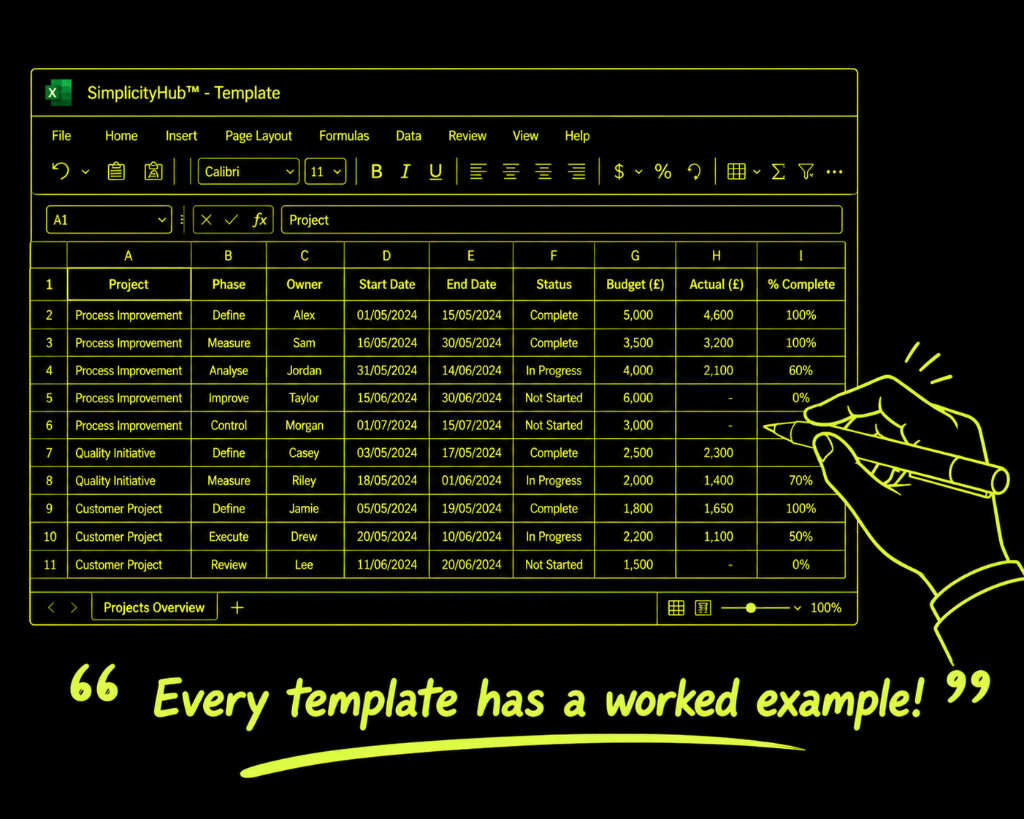
A completed SOP for the complaint logging process, showing numbered steps with system navigation instructions, time standards and decision points.
Common mistakes — and how to avoid them
Writing in passive voice. 'The form should be completed' — by whom? Write in active voice: 'You must complete the form' or 'The agent completes the form'. Passive voice creates ambiguity about who is responsible.
Describing the ideal, not the actual. An SOP should document what currently works best — not an aspirational process that nobody actually follows. If operators routinely deviate from a step, investigate why before standardising.
Making it too long. An SOP that runs to 20 pages will not be used. Break complex processes into sub-procedures. Each SOP should cover one process and be readable in under 10 minutes.
Never reviewing or updating it. An SOP for a process that changed six months ago is worse than no SOP — it trains people in the wrong method. Review SOPs whenever the process changes and at minimum annually.
Tips for getting better results
Number every step. Numbered steps make it easy to refer to a specific step in training, audits or troubleshooting conversations. 'In step 4...' is clearer than 'in the part where you check...'
Include the 'why' for critical steps. For steps where the operator might be tempted to skip or shortcut, briefly explain why the step matters. Understanding the reason increases compliance.
Store it where the work happens. An SOP stored on a shared drive that requires three clicks to find will not be used at the point of need. Post it on the team board, laminate it at the workstation or link it from the system screen.
Download the Standard Operating Procedure Template
A clean, editable Excel template for immediate use — structured, professional and ready to fill in.
Frequently asked questions
What should an SOP include?
Purpose, scope, step-by-step process, required inputs and outputs, roles, quality checks, and what to do if something goes wrong.
How long should it be?
As short as possible while remaining complete. A one-page SOP beats a ten-page document nobody reads.
Who should write it?
The people who do the work. An SOP written only by management rarely reflects how work is actually done.
How often should it be reviewed?
Annually at minimum, and immediately whenever the process changes.
Advanced Toolkit Packs — available now
Structured, ready-to-use template packs designed for real improvement work. Pick the pack that matches your project and get started straight away.
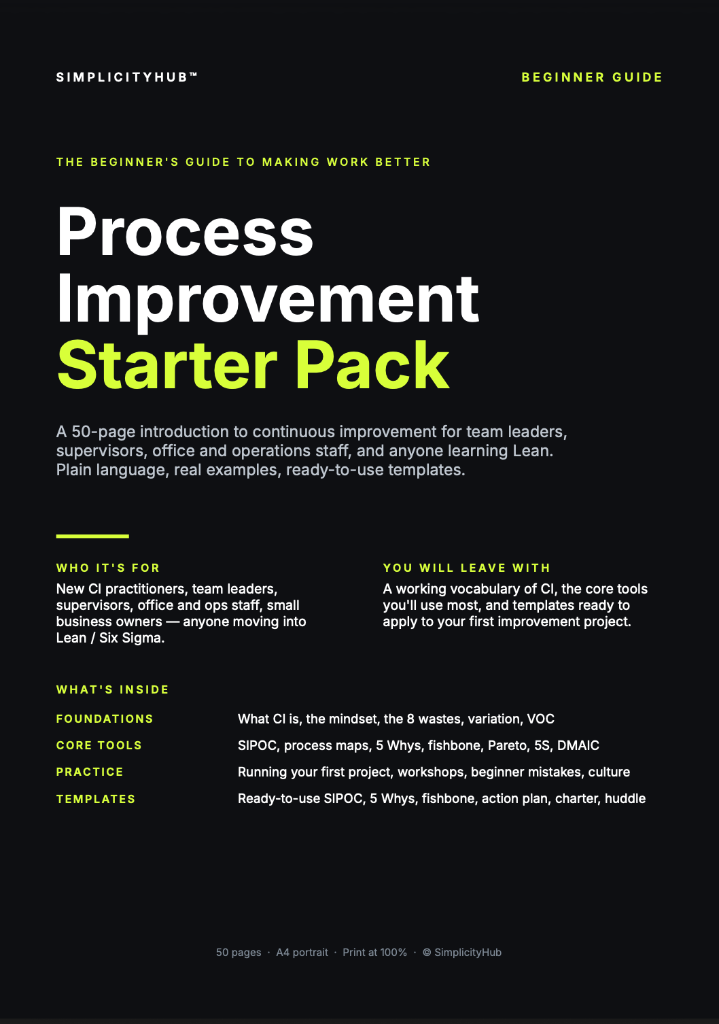
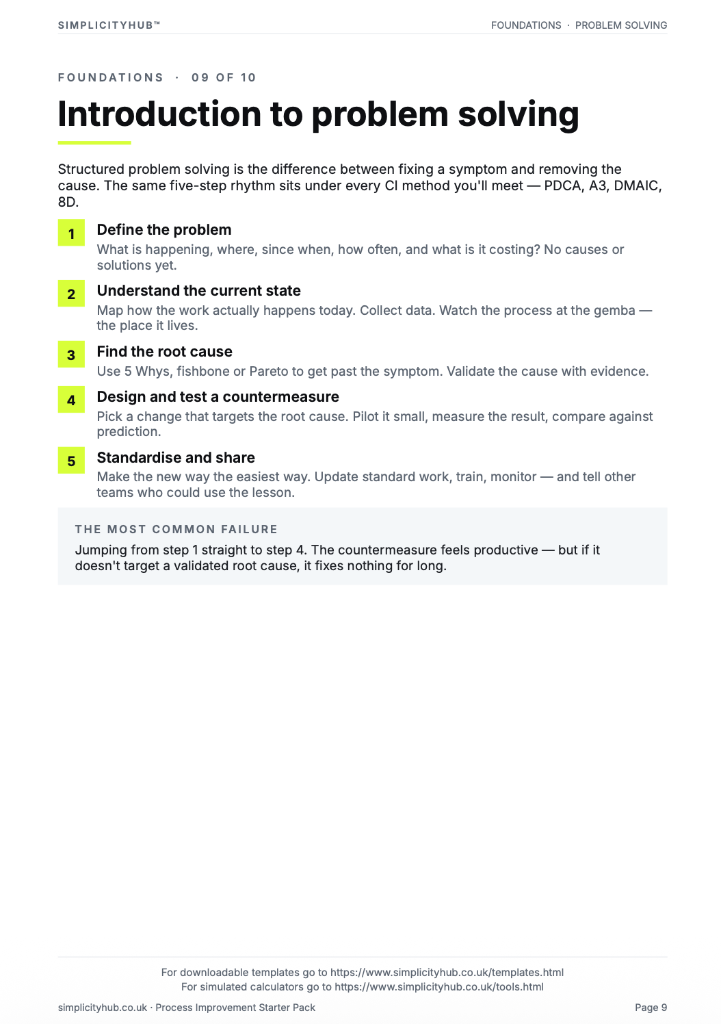
Process Improvement Starter Pack
A starter pack for identifying improvement opportunities, measuring baselines and planning action.
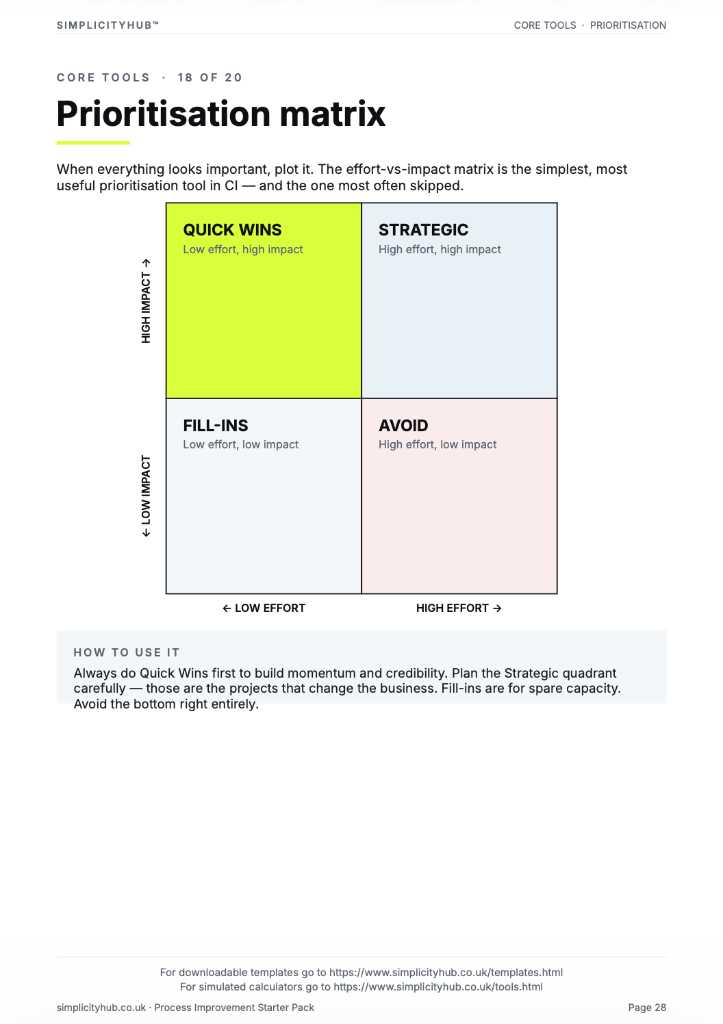
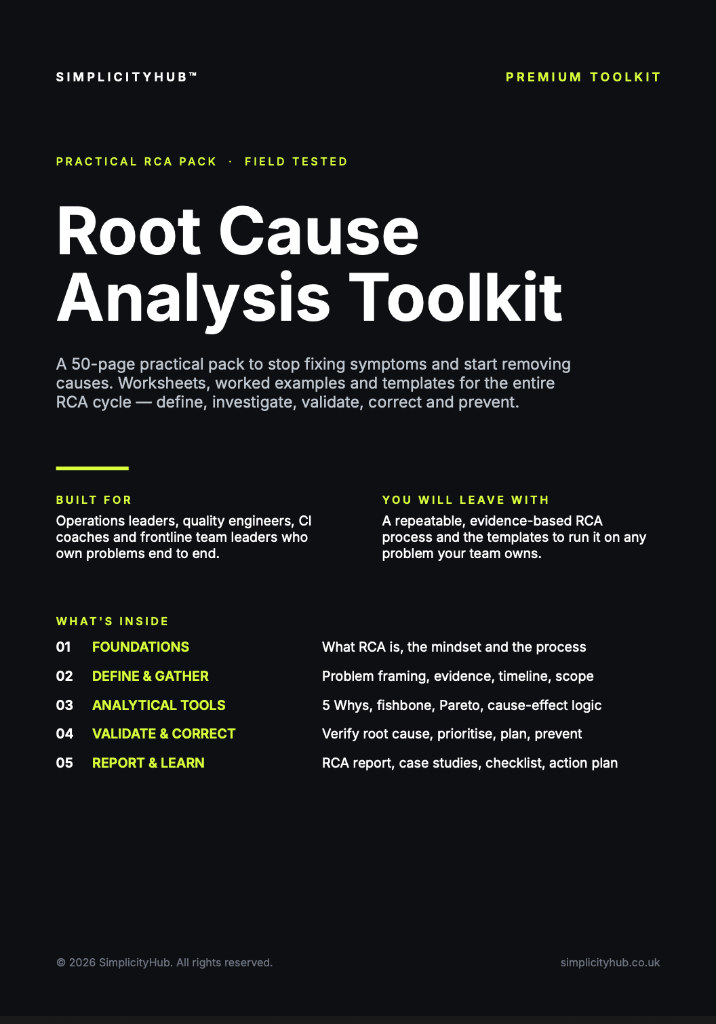
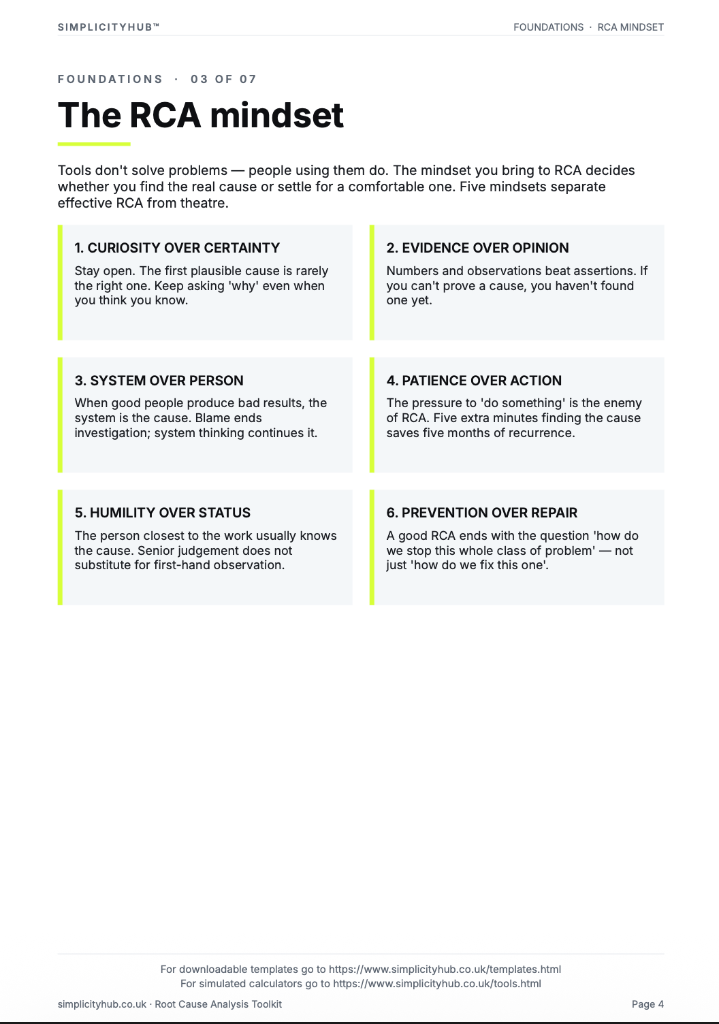
Root Cause Analysis Toolkit
A practical RCA toolkit for defining problems, finding causes, validating evidence and creating action.
A3 Template Pack
A clean A3 problem-solving pack for concise, visual improvement thinking and follow-through.