
What is a Failure Mode Identification Template?
Failure Mode Identification — the first stage of a Failure Mode and Effects Analysis (FMEA) — is a structured approach to systematically identifying all the ways a process or product could fail, the effects of each failure on the customer, and the potential causes before any failures actually occur.
It shifts quality management from reactive (finding and fixing failures after they happen) to proactive (identifying and preventing failures before they reach the customer). This is especially powerful for new processes, process changes and high-risk operations.
Used in the Analyse phase of DMAIC, failure mode identification feeds directly into risk scoring and mitigation planning.
When to use a Failure Mode Identification Template
Use failure mode identification when you want to proactively prevent failures in a process before they occur. Use it when:
- A new or redesigned process is being implemented and failure prevention is preferable to failure detection
- A high-risk process is being improved and you want to anticipate what could go wrong
- Root cause analysis has identified a failure mode that was previously unknown
- A customer or regulator requires FMEA documentation as part of quality or compliance requirements
Who should use a Failure Mode Identification Template
- Green Belts and Black Belts — when analysing process risk in the Analyse or Improve phase
- Quality and Process Engineers — as part of new process design and design for quality work
- Operations Teams — when implementing process changes that carry significant failure risk
- Risk and Compliance Teams — when documenting process risks for regulatory or audit purposes
Watch: a quick explainer
New to this? This short video walks you through identifying and quantifying failure modes — a helpful primer before you download and use the template.

How to identify Failure Modes
Failure mode identification is a team exercise — no single person knows all the ways a process can fail. Bring together the process operators, the quality team, the supervisor and anyone who has seen or investigated failures in this process.
How to identify Failure Modes — step by step
-
1Map the process
Start with a process map or SIPOC. Every process step is a potential source of failure. The map ensures you systematically consider every step rather than jumping to the obvious failure points.
-
2For each step, ask: how could this step fail?
A failure mode is the way a step fails to perform its intended function. 'Item picked incorrectly', 'Form not completed', 'Data not entered' — describe failures in process terms, not in outcome terms.
-
3Identify the effect of each failure
For each failure mode, ask: if this failure occurs, what does the customer experience? Effects should be described from the customer's perspective: 'customer receives wrong item', 'payment is delayed', 'compliance requirement is breached'.
-
4Identify potential causes
For each failure mode, ask: what could cause this to happen? Use the 5 Whys or Fishbone to generate possible causes. One failure mode can have multiple causes.
-
5Identify existing controls
What controls currently exist to prevent or detect each failure? An approval step, a system check, a visual inspection? Document current controls honestly — gaps in controls are where the highest risks lie.
-
6Score severity, occurrence and detection
Rate each failure mode on three scales (1–10): Severity (impact on the customer), Occurrence (how often it occurs), Detection (how likely the current controls are to catch it before the customer is affected).
-
7Calculate the Risk Priority Number (RPN)
RPN = Severity × Occurrence × Detection. Rank failure modes from highest to lowest RPN. The highest-RPN failure modes are your priority for additional controls or process redesign.
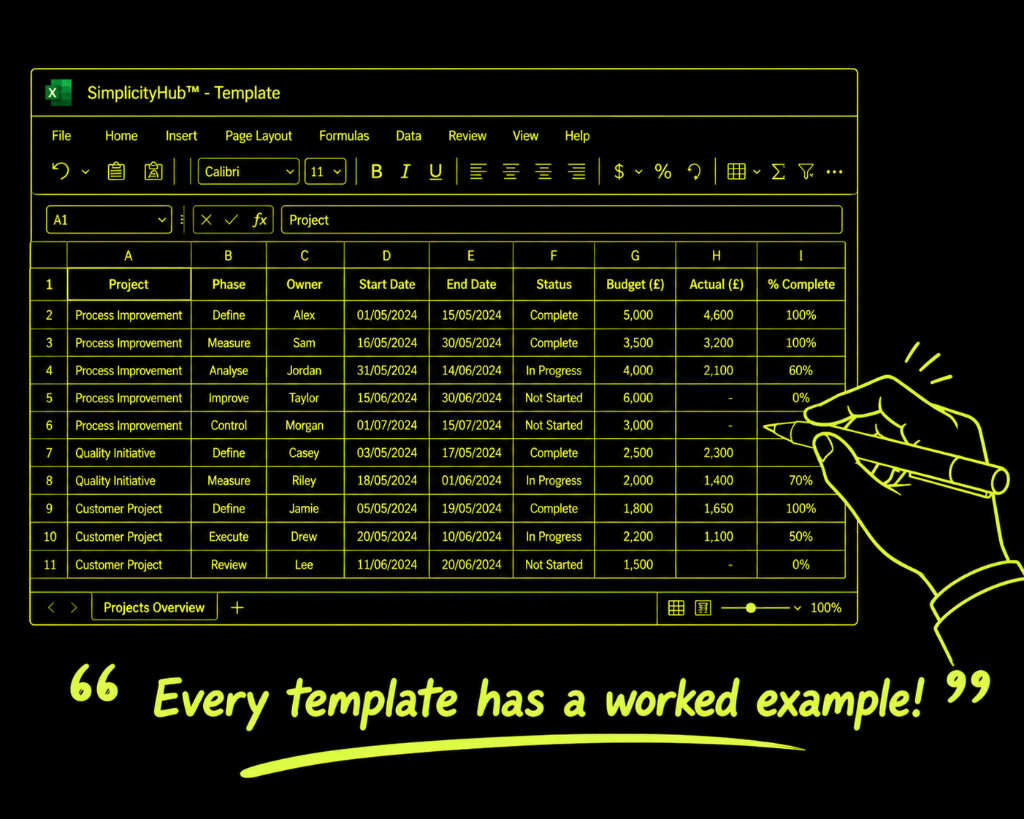
Worked example — Order Picking Process FMEA
A completed failure mode identification for an order picking process, showing failure modes, effects, causes, current controls, severity/occurrence/detection scores and RPNs.
Common mistakes — and how to avoid them
Only identifying obvious failures. Teams with operational experience can easily list the failures that happen every day. The most dangerous failures are the high-severity, low-frequency ones that nobody has seen recently — but which have catastrophic consequences when they occur.
No existing controls column. Documenting failure modes without documenting existing controls gives an incomplete picture. Controls reduce detection scores. Processes with no controls have the highest detection scores (10) — meaning failures are likely to reach the customer.
Ignoring high-severity, low-occurrence failures. A low RPN can result from low severity, low occurrence or high detection. A failure with high severity, low occurrence and good detection has a low RPN — but the severity score should make it a priority regardless of the overall RPN.
Never actioning the RPN rankings. An FMEA that identifies failures but produces no improvement actions is a documentation exercise. Every high-RPN failure mode needs a specific mitigation action to reduce severity, occurrence or detection.
Tips for getting better results
Prioritise severity over detection. A failure with severity 10 (safety or regulatory breach) needs a mitigation regardless of how low occurrence or detection make the RPN. Never allow a high-severity failure to be de-prioritised by a low overall RPN.
Review the FMEA after implementation. After implementing mitigations, recalculate the RPN to confirm the risk has been reduced. An FMEA is a living document — update it whenever the process or its controls change.
Use the FMEA to design the control plan. Failure modes with high severity should have controls specified in the control plan. The FMEA and control plan are complementary: the FMEA identifies what could fail; the control plan specifies how failures will be prevented and detected.
Download the Failure Mode Identification Template
A clean, editable Excel template for immediate use — structured, professional and ready to fill in.
Frequently asked questions
What is a failure mode?
Any way a process step could fail to perform its intended function. For each step ask: what could go wrong here?
How is this different from an FMEA?
This template identifies failure modes. A full FMEA adds severity, occurrence, and detection ratings to calculate Risk Priority Numbers.
Who should be involved?
Everyone with process knowledge — operators, supervisors, quality, and maintenance.
What do I do once failure modes are identified?
Prioritise by impact and likelihood, then design controls or error-proofing solutions.
Advanced Toolkit Packs — available now
Structured, ready-to-use template packs designed for real improvement work. Pick the pack that matches your project and get started straight away.
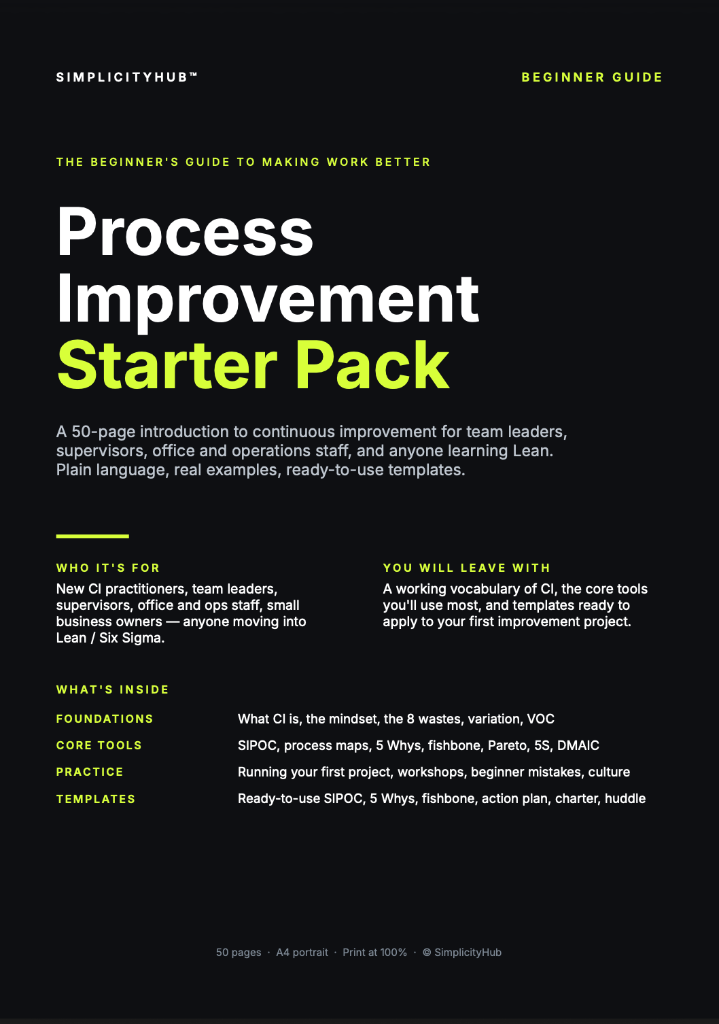
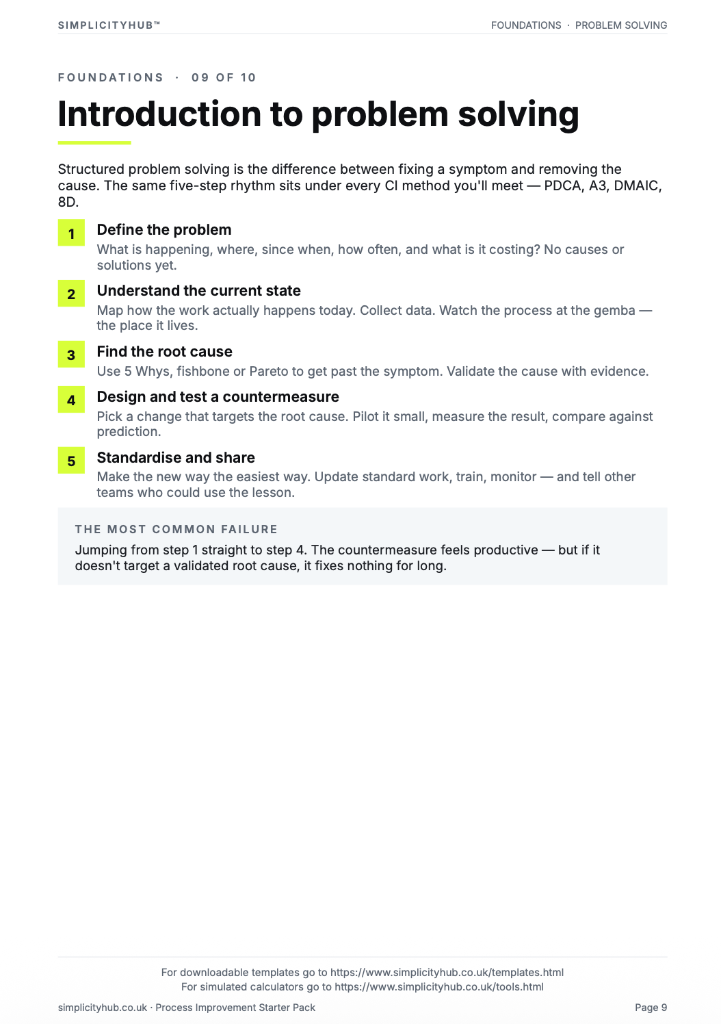
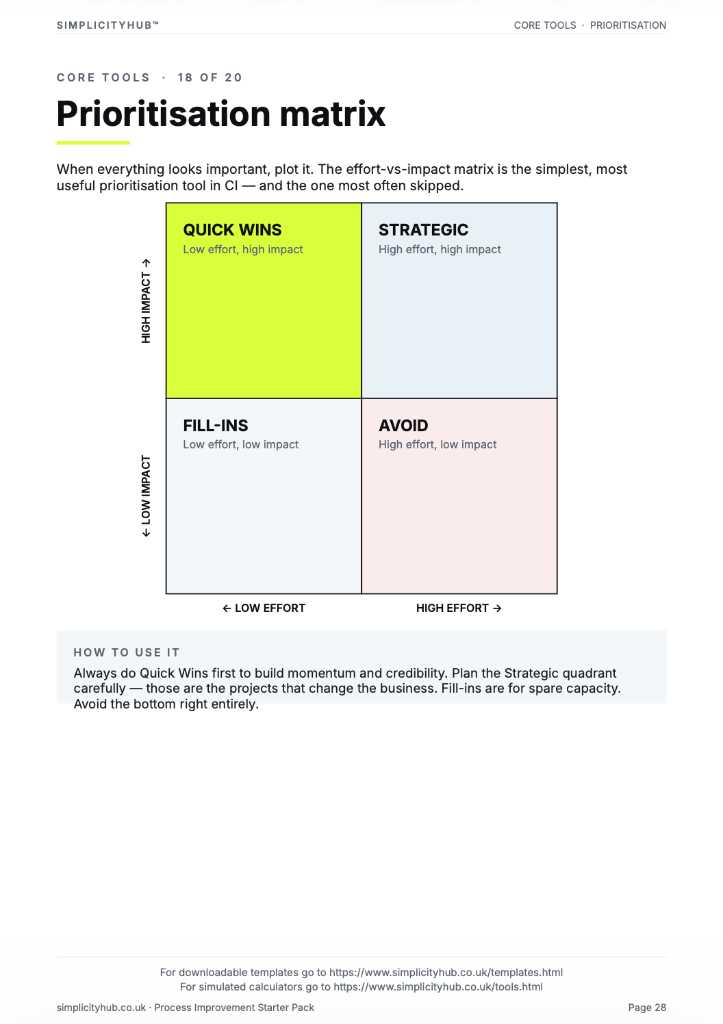
Process Improvement Starter Pack
A starter pack for identifying improvement opportunities, measuring baselines and planning action.

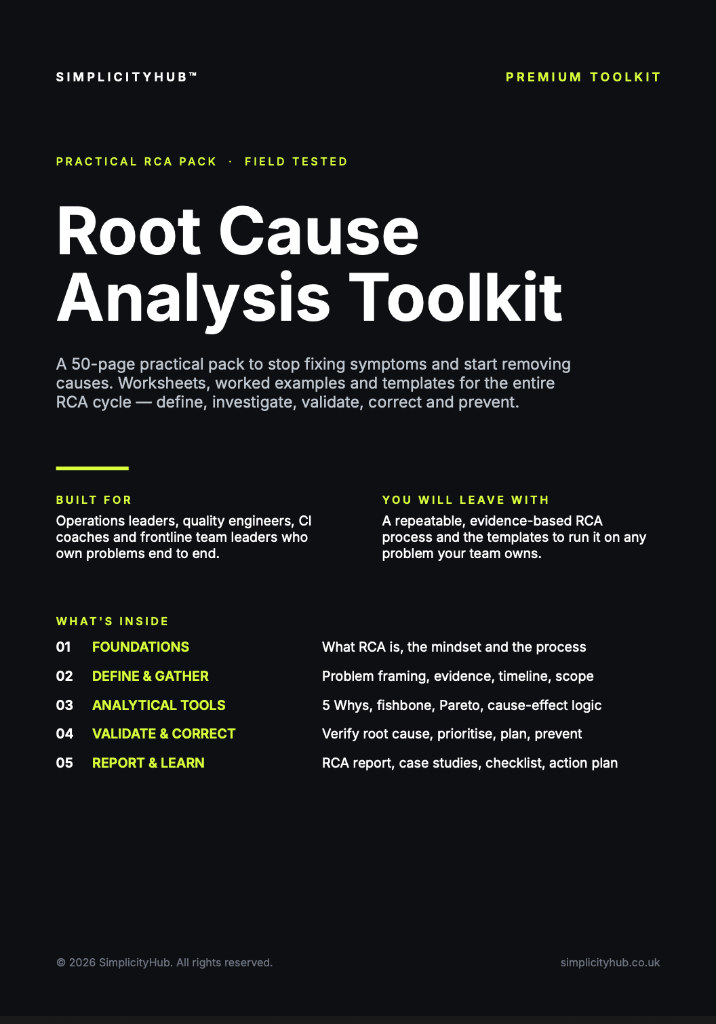
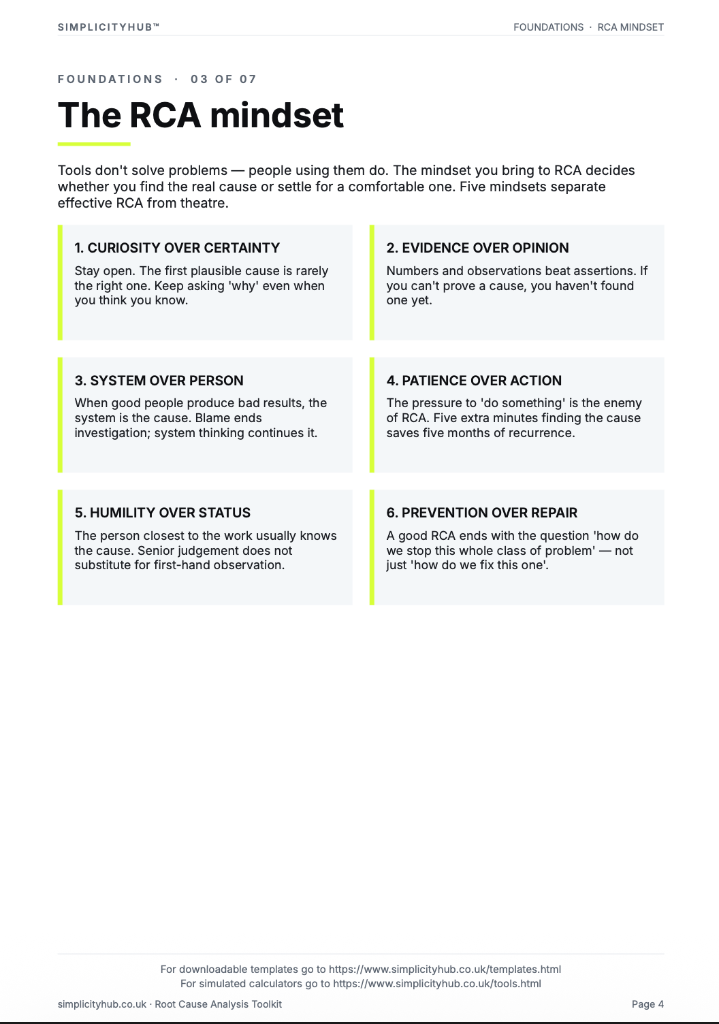
Root Cause Analysis Toolkit
A practical RCA toolkit for defining problems, finding causes, validating evidence and creating action.
A3 Template Pack
A clean A3 problem-solving pack for concise, visual improvement thinking and follow-through.