Project Status Report Template
Report project progress, milestones, risks and next steps on one page so stakeholders always know where things stand.


What is a Project Status Report Template?
A Project Status Report Template provides a structured one-page summary of project progress for sponsor and stakeholder updates. It covers phase completion, RAG status, key achievements, issues, risks and upcoming milestones.
When to use a Project Status Report Template
Use it throughout the project lifecycle for regular sponsor updates — weekly or fortnightly is typical. Keep it to one page and lead with the key message, not the detail.
Who should use a Project Status Report Template
- Black Belts and Green Belts — providing regular progress updates to their sponsor and steering group
- Project managers — communicating project health to senior stakeholders in a concise, consistent format
- Programme offices — collecting standardised status information across a portfolio of improvement projects
- Sponsors — reviewing project progress against plan and identifying where decisions or support are needed
Vote yes and we’ll prioritise a quick walkthrough showing you exactly how to use it.
How to use a Project Status Report — step by step
-
1Write the problem statement at the top
Start with a clear, factual problem statement. 'Machine stopped' or 'Customer received wrong item' — specific, observable, factual. Vague problems produce vague root causes.
-
2Ask 'Why did this happen?' — Why 1
Write down the first-level cause. This is usually a symptom or a direct cause — not yet the root. Examples: 'Machine overheated', 'Wrong item was picked'.
-
3Ask 'Why did that happen?' — Why 2
Challenge the previous answer. Keep the team focused on causes, not blame. If the answer is 'human error', push further — why did the human make the error?
-
4Continue to Why 3, 4 and 5
Keep going until you reach a cause that is systemic — a missing process, a failed control, a gap in training or a design flaw. The number five is a guide, not a rule.
-
5Check the logic by reading upward
Read the chain back to front: 'Because of X, Y happened, which caused Z.' If the logic holds, you have a valid chain. If it breaks, revisit the step where it breaks.
-
6Identify the actionable root cause
The root cause is the deepest level where a corrective action can prevent recurrence. Document it clearly — this feeds your Improve phase solution design.
-
7Validate before acting
Do not jump to solution immediately. Check whether data or observation confirms the root cause is real and significant before committing resource to fixing it.
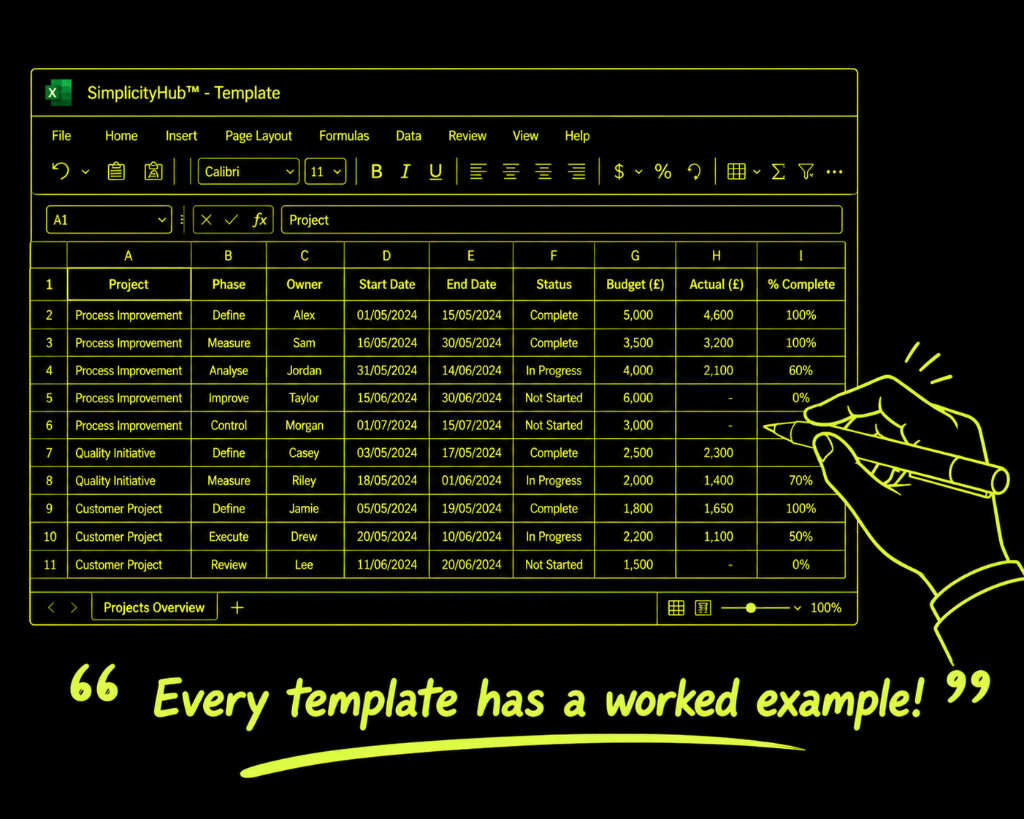
Worked example — DMAIC Project Fortnightly Update
A Green Belt used this template for fortnightly sponsor updates throughout a 4-month DMAIC project — maintaining amber status transparency when analysis took longer than planned and clearly flagging the one decision needed from the sponsor.
Common mistakes — and how to avoid them
Green-washing a struggling project. Reporting amber as green destroys trust when the problem eventually surfaces. Sponsors respect honest reporting far more than false reassurance.
Reporting activity instead of progress. Listing what you did is not the same as reporting progress. Focus on outcomes and milestones achieved, not tasks completed.
Not stating decisions needed. The status report must clearly identify what the sponsor or steering group needs to decide or approve. A report with no ask is a missed opportunity.
Sending without a brief verbal summary. For high-stakes projects, follow up a written report with a 5-minute verbal summary. Written reports get misread or not read at all.
Tips for getting better results
Lead with the RAG status and headline message. Busy sponsors read the top of the page first. Put the most important information — overall status and key message — at the top.
Keep it to one page. A status report that requires scrolling will not be read in full. If you can't fit it on one page, you haven't been selective enough.
Archive every report. A file of fortnightly status reports is a complete project narrative. It is invaluable for lessons learned, project reviews and future reference.
Frequently asked questions
What should a project status report include?
A good status report includes the current phase, RAG status (Red/Amber/Green), key achievements since the last update, upcoming milestones, risks and issues, and any decisions needed from the sponsor.
How often should a project status report be issued?
For most DMAIC projects, weekly or fortnightly during active phases. The cadence should match the sponsor's needs and the speed of the project. Always issue one before gate reviews.
What is a RAG status?
RAG stands for Red, Amber, Green — a traffic light system for reporting project health. Green means on track, Amber means at risk but manageable, Red means off track and requiring intervention.