What is a Project Summary One-Pager Template?
A Project Summary One-Pager Template provides a concise, single-page overview of an improvement project — covering the problem, approach, key findings, solutions implemented and benefits achieved. It is designed for senior stakeholders who need the full story in under two minutes.
When to use a Project Summary One-Pager Template
Use it at project closure to communicate results to senior leadership, and to build a searchable library of completed improvement projects. It is also useful as a progress update format at major phase gate reviews.
Who should use a Project Summary One-Pager Template
- Black Belts and Green Belts — presenting project results to sponsors and senior leadership at project closure
- CI programme managers — building a portfolio record of completed improvement work
- Sponsors and directors — reviewing project outcomes and benefits claimed across the improvement programme
- New project teams — reviewing past project summaries as a reference when scoping similar improvement work
Watch: a quick explainer
New to this? This short video walks you through writing up a Lean project on a single page (A3 style) — a helpful primer before you download and use the template.
How to use a Project Summary One-Pager — step by step
- 1Write the problem and opportunity statement
One or two sentences: what was wrong, why it mattered and what the quantified opportunity was.
- 2Summarise the approach
State the methodology used (DMAIC, Kaizen, A3) and the project timeline. Three to four lines maximum.
- 3State the root cause
What did the analysis reveal? One clear sentence about the primary root cause found.
- 4Describe the solutions implemented
Three to five bullet points of what was changed — specific, concrete, action-oriented.
- 5Quantify the results
Before vs after for every key metric. Financial benefit, quality improvement, time saving. Use real numbers.
- 6State the sustainability mechanism
How will the improvement be sustained? Control plan, SOP update, dashboard, audit schedule — be specific.
- 7Add a visual
A before/after chart, a run chart showing the improvement or a process map comparison makes the one-pager compelling.
Worked example — Procurement Lead Time Reduction
A Black Belt used a one-pager to present a procurement improvement project to the board — summarising the problem (14-day average lead time vs 5-day target), root cause (manual approval routing), solution (automated approval workflow) and result (4.2-day average, £180k cost avoidance) in a single page.
Common mistakes — and how to avoid them
More than one page. If it needs two pages, it is not a one-pager. Edit ruthlessly — every word must earn its place.
Burying the results. The results are the headline. Put them at the top or in a prominent position — don't make the reader find them.
Using internal jargon. The one-pager may be read by leaders who don't know DMAIC, CTQ or sigma level. Write in plain business language.
No visual element. A one-pager with no chart or diagram is a wall of text. One well-chosen visual makes it far more memorable and persuasive.
Tips for getting better results
Lead with the financial benefit. Senior leaders read financials first. Put the headline saving or revenue impact at the very top.
Use the same template for every project. Consistent formatting makes the portfolio of project summaries easy to compare and search.
Keep a digital library. A searchable archive of completed project one-pagers is a strategic asset — it shows CI capability and informs future project scoping.
Frequently asked questions
What should go on it?
Problem statement, goal, key findings, improvement implemented, results achieved, and current status with one compelling chart.
Who is it for?
Senior stakeholders who need the story without the detail.
Can I use it before the project closes?
Yes — a mid-project version is useful for sponsor updates.
How to handle sensitive data?
Create two versions — full financial for internal use, percentages or ranges for broader communication.
Advanced Toolkit Packs — available now
Structured, ready-to-use template packs designed for real improvement work. Pick the pack that matches your project and get started straight away.
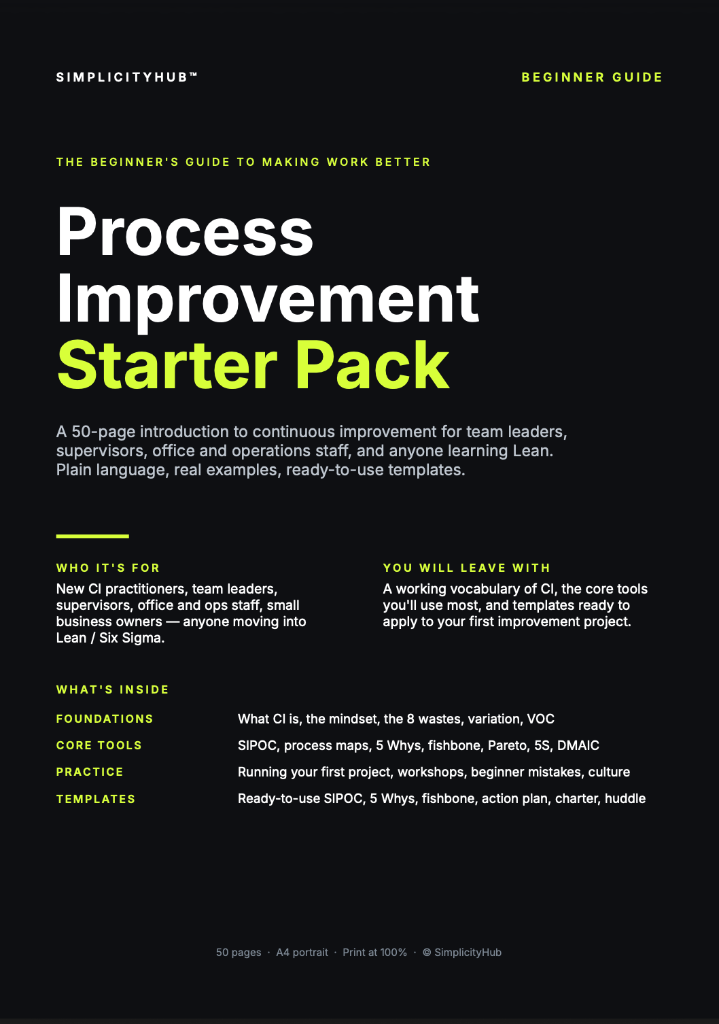
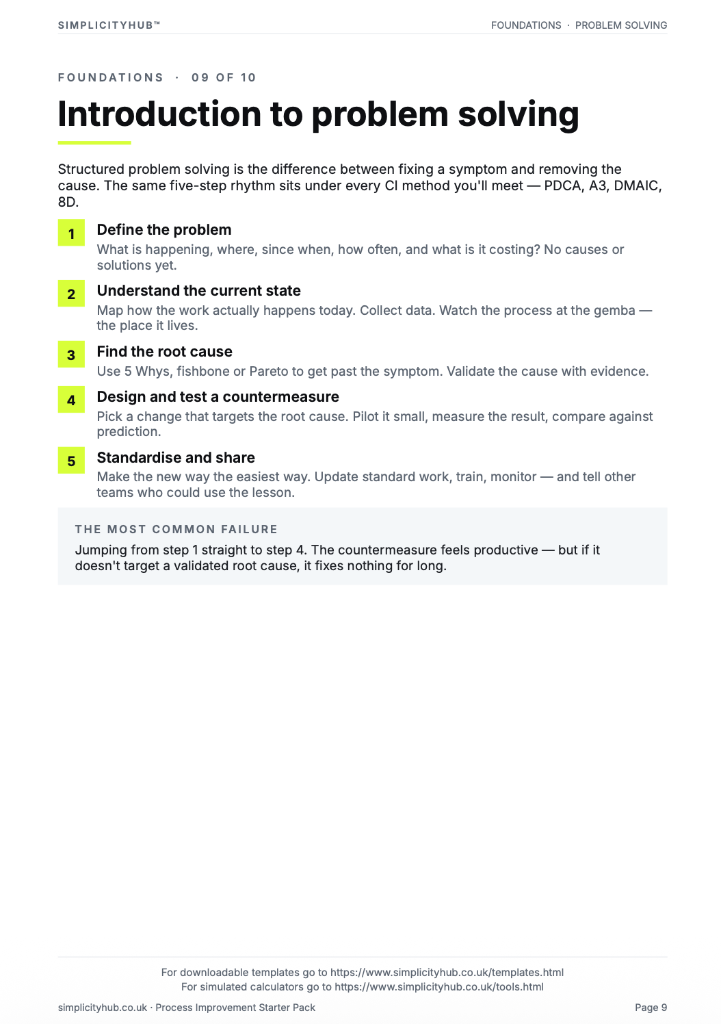
Process Improvement Starter Pack
A starter pack for identifying improvement opportunities, measuring baselines and planning action.
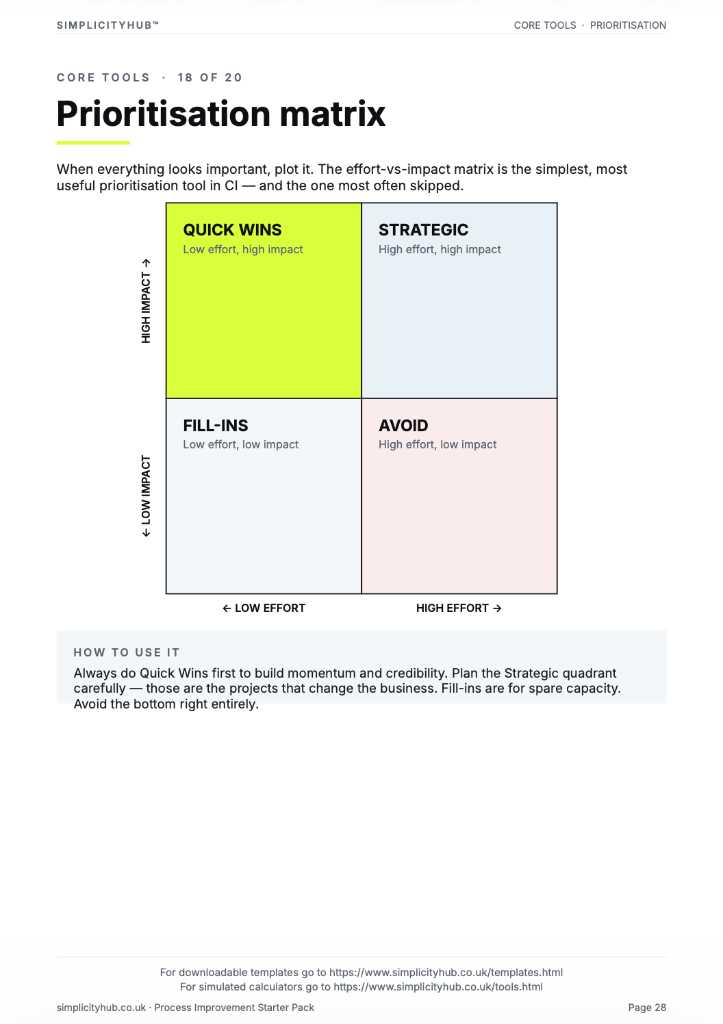
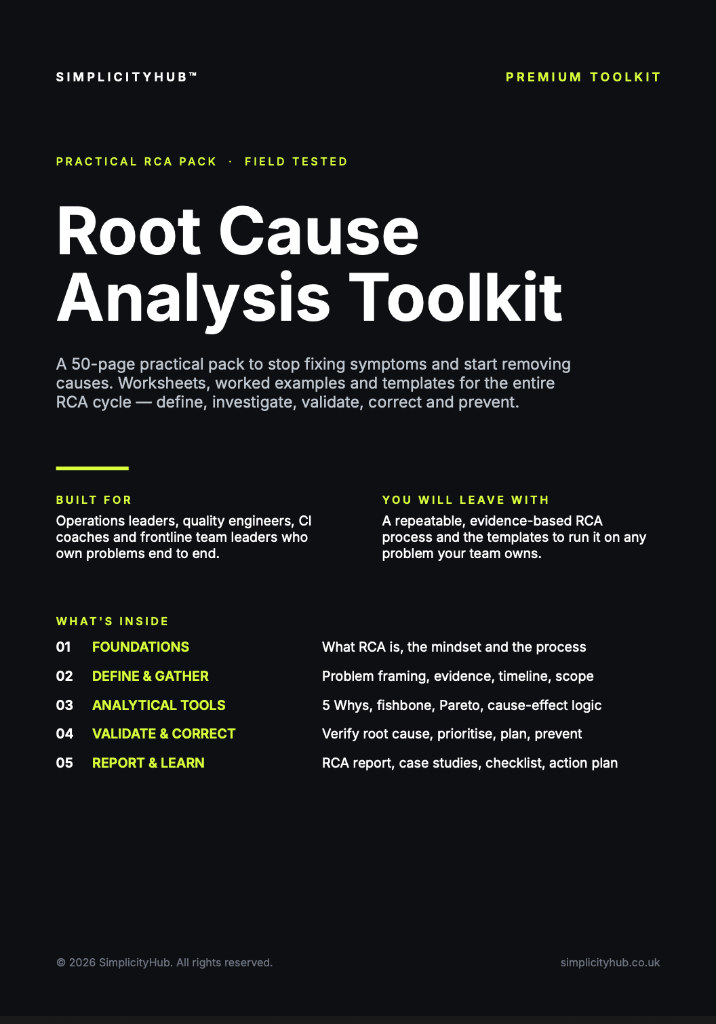
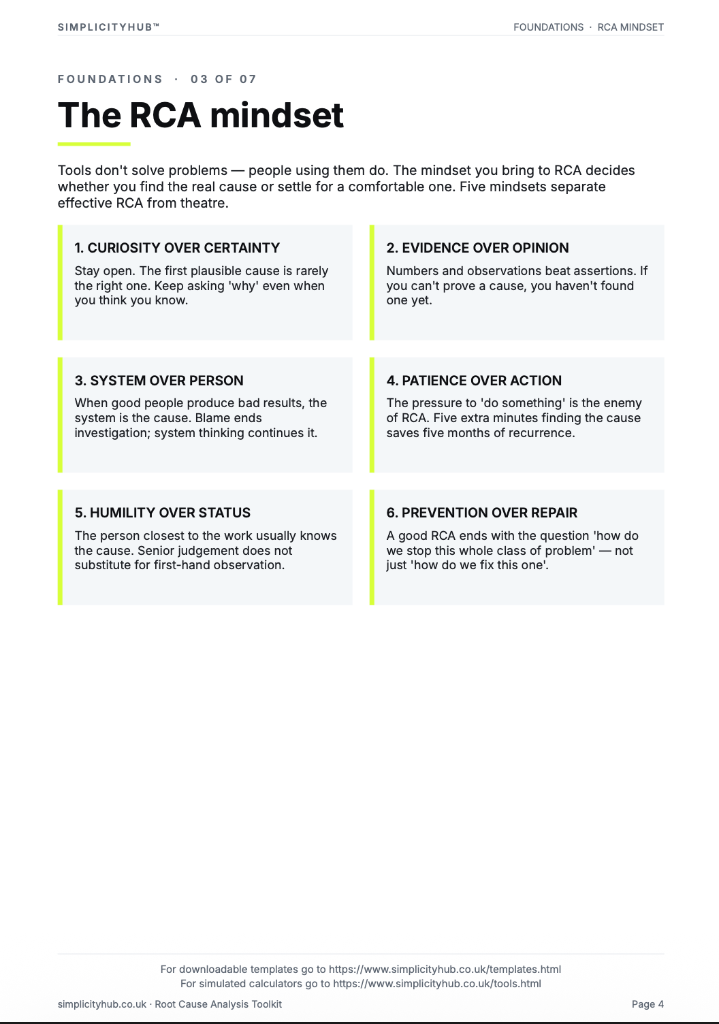
Root Cause Analysis Toolkit
A practical RCA toolkit for defining problems, finding causes, validating evidence and creating action.
A3 Template Pack
A clean A3 problem-solving pack for concise, visual improvement thinking and follow-through.