To-Be Process Map Template
Design the improved future-state process so everyone can see how work should flow once waste is removed.


What is a To-Be Process Map Template?
A To-Be Process Map is a visual representation of the redesigned process after improvements have been applied. It contrasts with the As-Is map to show what has been removed, added or changed.
When to use a To-Be Process Map Template
Use it in the Improve phase after validating root causes and selecting your solutions. Build the To-Be map before piloting so the team agrees on exactly what the new process looks like.
Who should use a To-Be Process Map Template
- Green Belts and Black Belts — defining the redesigned future state process before piloting solutions
- Process owners — validating the new process design before implementation and staff training
- Operations and design teams — translating improvement decisions into a clear, documented process flow
- Training developers — using the To-Be map as the basis for updated SOPs and operator training materials
Vote yes and we’ll prioritise a quick walkthrough showing you exactly how to use it.
How to use a To-Be Process Map — step by step
-
1Write the problem statement at the top
Start with a clear, factual problem statement. 'Machine stopped' or 'Customer received wrong item' — specific, observable, factual. Vague problems produce vague root causes.
-
2Ask 'Why did this happen?' — Why 1
Write down the first-level cause. This is usually a symptom or a direct cause — not yet the root. Examples: 'Machine overheated', 'Wrong item was picked'.
-
3Ask 'Why did that happen?' — Why 2
Challenge the previous answer. Keep the team focused on causes, not blame. If the answer is 'human error', push further — why did the human make the error?
-
4Continue to Why 3, 4 and 5
Keep going until you reach a cause that is systemic — a missing process, a failed control, a gap in training or a design flaw. The number five is a guide, not a rule.
-
5Check the logic by reading upward
Read the chain back to front: 'Because of X, Y happened, which caused Z.' If the logic holds, you have a valid chain. If it breaks, revisit the step where it breaks.
-
6Identify the actionable root cause
The root cause is the deepest level where a corrective action can prevent recurrence. Document it clearly — this feeds your Improve phase solution design.
-
7Validate before acting
Do not jump to solution immediately. Check whether data or observation confirms the root cause is real and significant before committing resource to fixing it.
Worked example — Redesigning Customer Onboarding
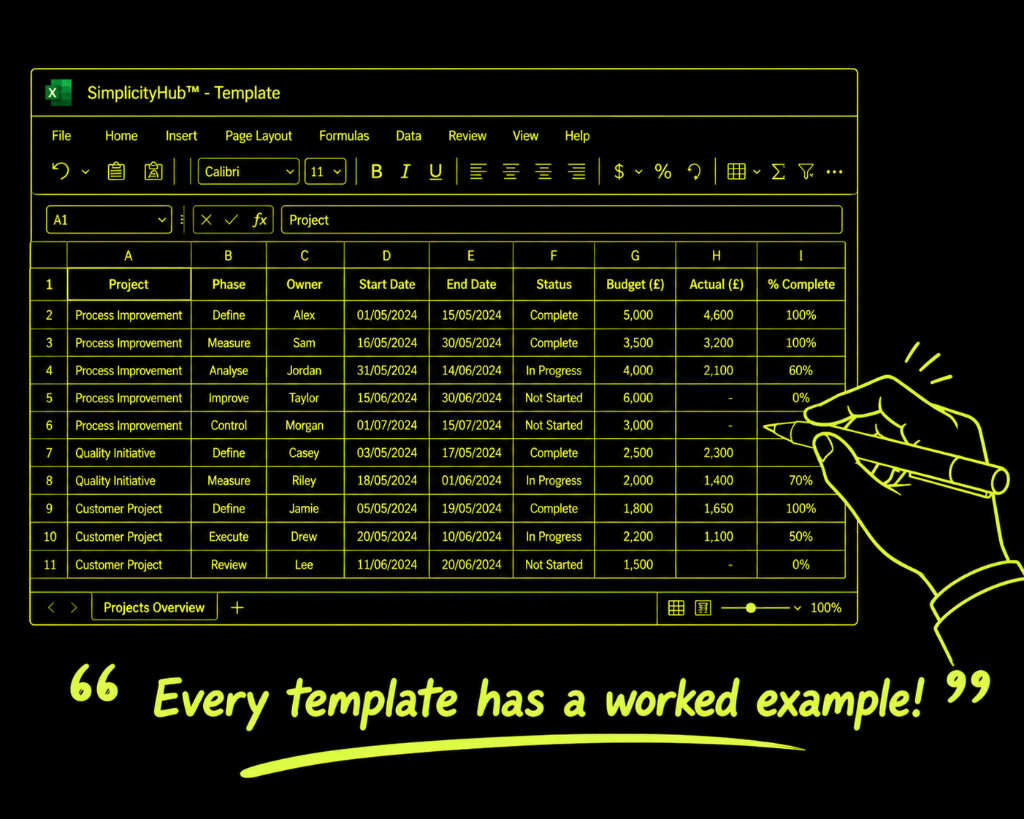
A project team used the To-Be map to eliminate 6 of 14 process steps, reduce handoffs from 5 to 2 and cut the target cycle time from 8 days to 2 days — agreed and signed off before piloting began.
Common mistakes — and how to avoid them
Building the To-Be map without the process team. A map built by the project team alone will have gaps the people who do the work would immediately spot. Always validate with frontline staff.
Designing the ideal state, not the achievable state. The To-Be map should reflect what you can implement and sustain now — not the theoretical perfect process. Save the ideal state for the next project cycle.
Skipping the As-Is vs To-Be comparison. The comparison is how you quantify the improvement and justify the investment. Never skip it.
Not updating SOPs to match. A To-Be map that doesn't result in updated SOPs will not be followed. The map and the SOPs must be consistent from day one.
Tips for getting better results
Use swimlane format for multi-functional processes. Swimlanes make handoffs between teams visible and highlight where delays and errors most often occur.
Number every step. Numbered steps make it easy to reference specific points in training, audits and reviews.
Keep one copy in the team's workspace. A printed To-Be map displayed at the workstation is a daily reminder of how the process should flow.
Frequently asked questions
What is a to-be process map?
A to-be process map documents the designed future state of a process after improvement. It is compared with the as-is (current state) map to make the changes explicit and serves as the blueprint for implementation and training.
Should the to-be map include waste?
No — the to-be map should represent the ideal improved process with non-value-adding steps removed. If some waste cannot be eliminated immediately, mark it as a future improvement item rather than embedding it in the new standard.
When do I create the to-be map?
Create it in Improve once you have selected your solution and before you pilot it. The to-be map is a key deliverable for your Improve gate review and becomes the basis for your standard operating procedure and training materials.