
What is a Standard Work Template?
A Standard Work Template provides a structured document that defines the most efficient, repeatable method for completing a process task — specifying the sequence of steps, cycle time, takt time and quality check points. It is the foundation of process stability and continuous improvement.
When to use a Standard Work Template
Use it in the Improve phase to document the new process standard after improvements are confirmed, and in the Control phase to sustain the improvement. Standard work should be updated every time the process is improved.
Who should use a Standard Work Template
- Process owners and team leaders — defining and maintaining the current best method for operating the process
- Black Belts and Lean practitioners — establishing process stability as a foundation for further improvement
- Frontline operators — following and improving the standard through daily work
- Training and quality teams — using standard work as the basis for operator training and process audits
Watch: a quick explainer
New to this? This short video walks you through making standard work that people actually follow — a helpful primer before you download and use the template.
How to use a Standard Work — step by step
- 1Observe the current best method
Watch the most experienced operator perform the task. Identify the sequence, timing and quality points they use.
- 2Define the sequence of steps
List every step in the exact sequence it should be performed. Number each step. No ambiguity.
- 3Record the cycle time for each step
Time each step. Identify which are value-added and which are necessary but non-value-added. Eliminate pure waste.
- 4Set the takt time
Calculate the takt time from customer demand. The standard work cycle must fit within takt.
- 5Identify quality check points
At which steps must the operator verify quality before proceeding? Mark these explicitly.
- 6Document safety and risk points
Any step with a safety or quality risk must be highlighted and include the correct action.
- 7Validate with the team
The people who do the work must review, challenge and agree the standard before it is finalised.
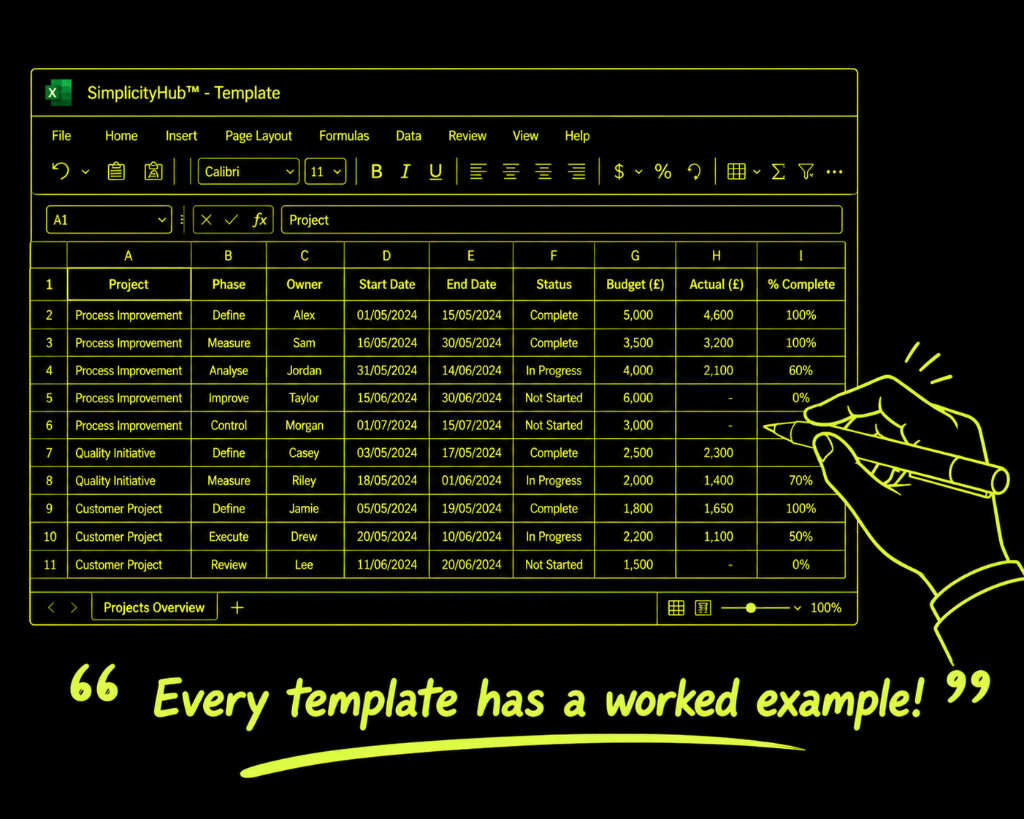
Worked example — Inbound Call Handling Standard Work
A contact centre team developed standard work for inbound call handling — defining a 7-step sequence with a 4.5-minute target cycle time (matching takt), two quality verification points and a clear escalation trigger — reducing call handling time variation from ±3.2 minutes to ±0.8 minutes.
Common mistakes — and how to avoid them
Writing standard work from the SOP, not from observation. The SOP documents the intended process. Standard work must reflect what actually happens when the process is performed optimally.
Setting the cycle time to the best case, not the achievable case. Standard work cycle times should be achievable by a competent operator under normal conditions — not only by the fastest operator on a good day.
Not updating it when the process improves. Standard work that reflects yesterday's process is worse than no standard work — it locks in obsolete methods. Update it every time the process changes.
Filing it instead of posting it. Standard work is only effective if it is visible at the point of work. Post it at the workstation — not in a quality manual.
Tips for getting better results
Include photographs for critical steps. A photograph of the correct method or the correct output standard is worth a paragraph of description.
Make updating the standard easy. A complex approval process for standard work updates prevents teams from keeping it current. Define a lightweight update process.
Involve operators in writing it. Standard work written by engineers and handed to operators breeds resistance. Standard work written by operators is owned and followed.
Frequently asked questions
Standard work vs SOP?
An SOP describes what to do. Standard work describes how to do it to the highest quality in the right sequence and time.
Can it apply to knowledge work?
Yes. In knowledge work it defines decision criteria, information inputs, sequence, and expected outputs.
Who sets the standard?
The team who does the work, based on observation and analysis of the best current method.
How do you improve standard work?
When someone finds a better method, update the standard. It evolves as knowledge grows.
Advanced Toolkit Packs — available now
Structured, ready-to-use template packs designed for real improvement work. Pick the pack that matches your project and get started straight away.
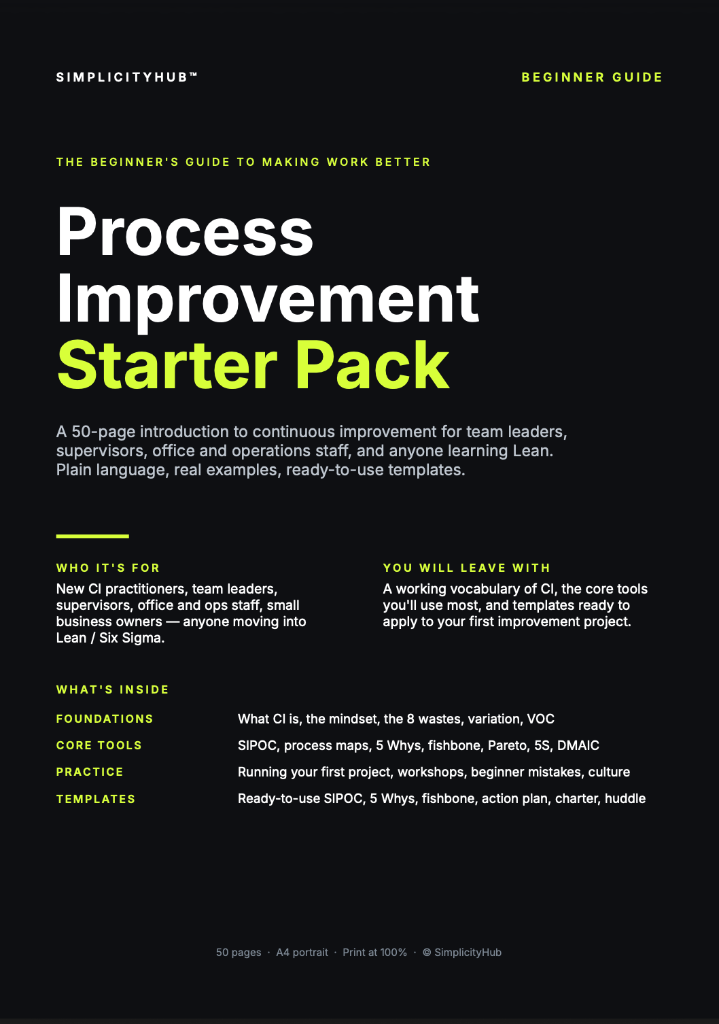
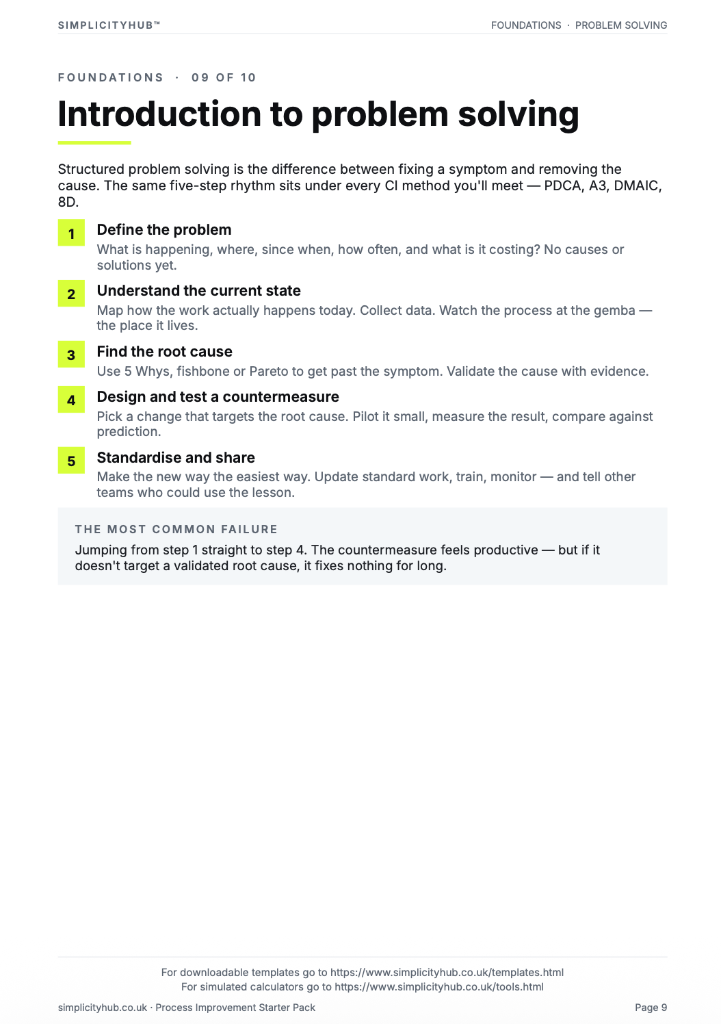
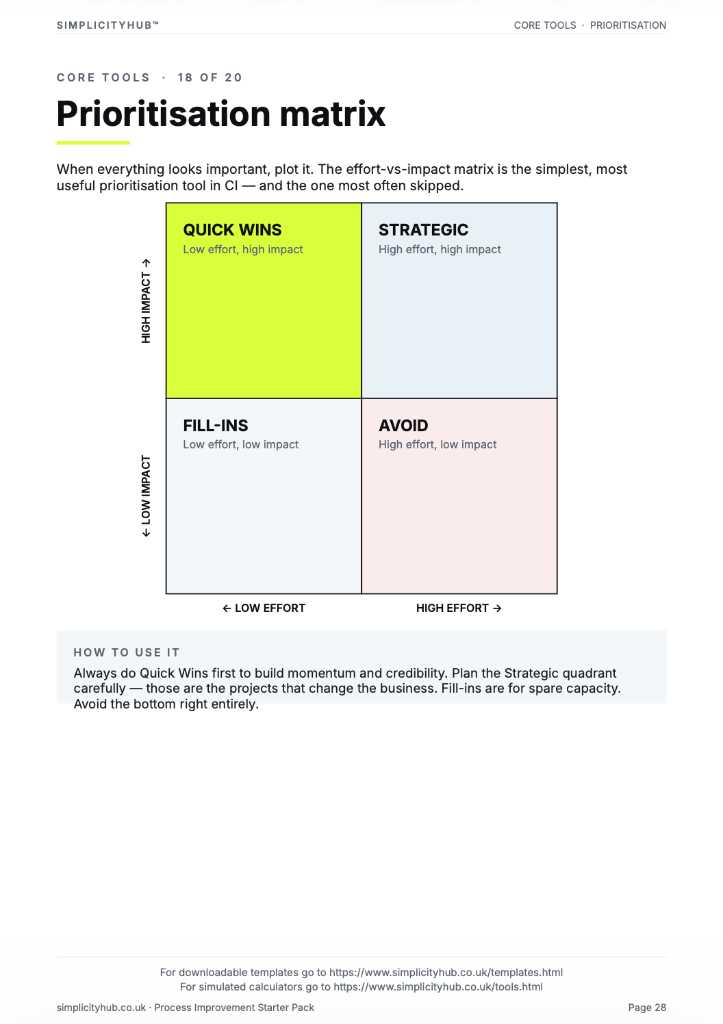
Process Improvement Starter Pack
A starter pack for identifying improvement opportunities, measuring baselines and planning action.

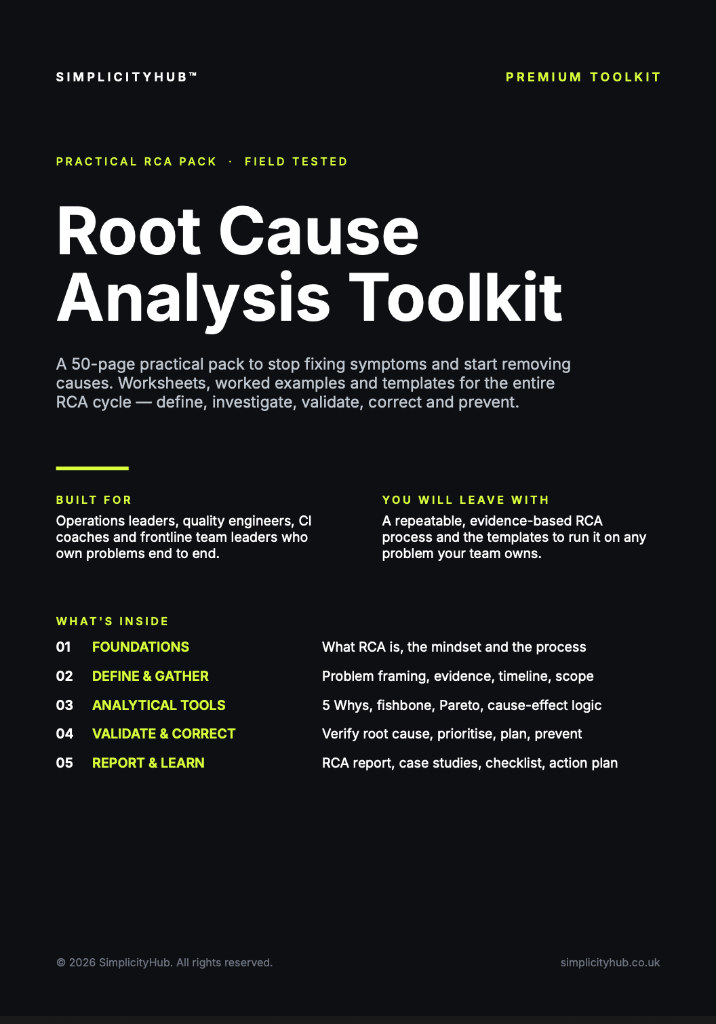
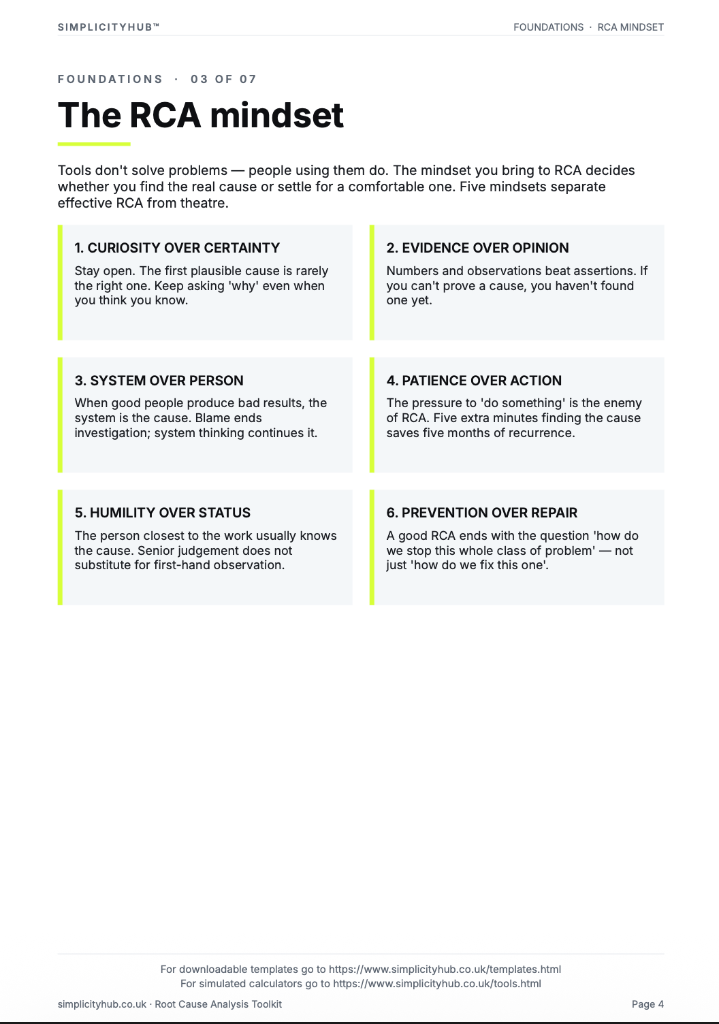
Root Cause Analysis Toolkit
A practical RCA toolkit for defining problems, finding causes, validating evidence and creating action.
A3 Template Pack
A clean A3 problem-solving pack for concise, visual improvement thinking and follow-through.