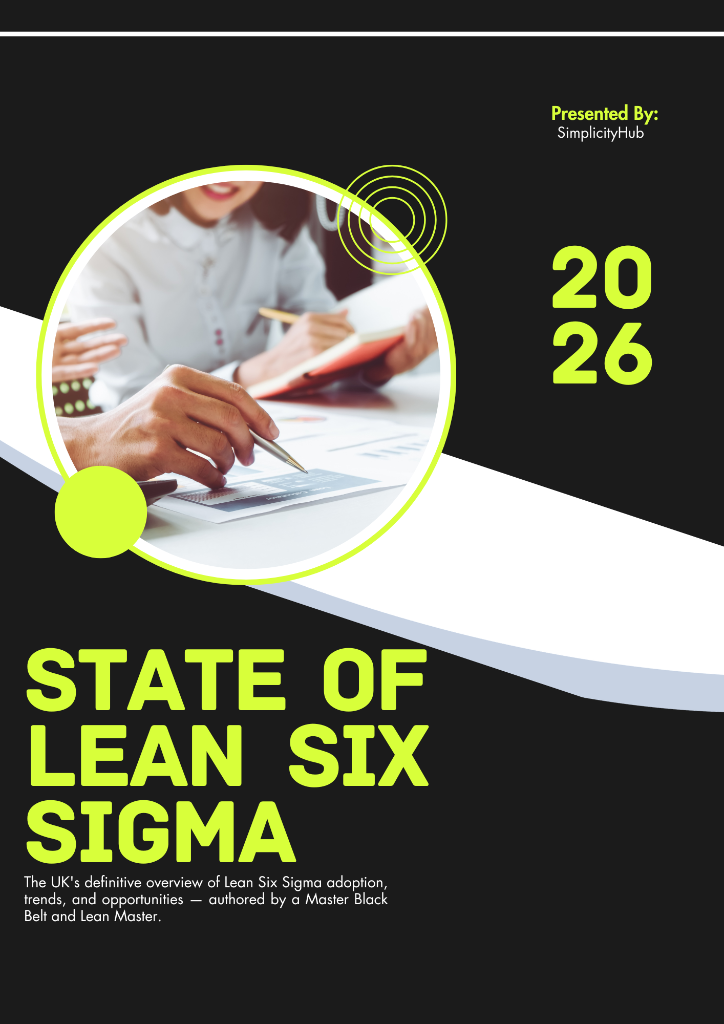
Annual Industry Report · SimplicityHub

State of Lean Six Sigma
UK 2026.

The UK's definitive overview of Lean Six Sigma adoption, trends, and opportunities — authored by a Master Black Belt and Lean Master.

68%[1]of UK manufacturers use Lean
£12k[2]avg Green Belt salary premium
5sectors analysed

Get the full report — free, instant access

You'll get instant access to the full PDF report plus we'll enrol you in our free 7-day Lean Six Sigma email sprint — one practical tip per day. Unsubscribe any time.

Edition
2026
Sectors covered
5
Access
Free download
Published by
SimplicityHub Ltd
State of Lean Six Sigma UK 2026 Report Cover
Free Report
Key findings

Five things shaping UK Lean Six Sigma in 2026

67%[5]

AI adoption accelerating

Of UK organisations are exploring or actively using AI tools alongside Lean Six Sigma methodology — the fastest-growing trend in CI.

#1[1]

Healthcare fastest-growing

NHS trusts and private healthcare providers now represent the highest growth in new LSS certifications — overtaking manufacturing for the first time.

The majority[3]

Skills gap remains critical

According to practitioners we work with, the majority cite difficulty finding certified Lean Six Sigma talent at Green Belt level and above as a recurring challenge.

1 in 3[4]

Green Belt: most in-demand credential

Of all new LSS enrolments in 2025–26 are at Green Belt level — confirming it as the career-defining qualification in the UK market.

1 in 3[1]

SMEs catching up

New learners now work in organisations with fewer than 250 employees. Lean Six Sigma is no longer just for large corporates.

£12k[2]

Salary premium

Green Belt certified professionals earn up to £12,000 more than non-certified peers in equivalent UK process improvement roles.


Section 1

Adoption across UK sectors

Manufacturing

The traditional home of Lean and Six Sigma. UK manufacturing has seen renewed investment in CI following post-pandemic supply chain disruptions. Key drivers: cost reduction, quality improvement, and ISO compliance.

Green BeltBlack BeltLean Practitioner

Healthcare (NHS & Private)

The fastest-growing sector. The NHS Long Term Workforce Plan (2023) explicitly references process improvement capability. NHS Trusts are increasingly funding external LSS training.

White BeltYellow BeltGreen Belt

Financial Services

Strong historical adoption. Post-2020 shift toward digital process improvement and regulatory compliance driving new demand for certified practitioners.

Green BeltBlack Belt

Public Sector

Budget pressures creating renewed appetite for efficiency tools. LSS being deployed alongside digital transformation programmes in local and central government.

White BeltYellow Belt

Section 2

The AI + CI convergence

The integration of AI tools into traditional CI methodology is no longer emerging — it's mainstream. Practitioners who combine LSS methodology with AI literacy are commanding a significant premium.

What it looks like in practice

  • AI-assisted root cause analysis (automated fishbone / 5-Why prompting)
  • Predictive analytics replacing traditional SPC charts
  • Natural language process mapping
  • AI chatbots providing on-demand methodology guidance

The opportunity

Organisations deploying AI-augmented CI programmes are reporting 30–40% faster project cycle times[5] compared to traditional LSS approaches.

SimplicityHub's CI with AI© assistant is the only UK LSS platform with native AI integration built in — free to all visitors.


Section 3

Certification trends — enrolment breakdown 2025–26

Belt Level% of EnrolmentsYear-on-YearTrend
White Belt28%+12%↑ Growing fast
Yellow Belt18%+4%↑ Growing
Green Belt44%+8%↑ Highest demand
Black Belt8%-2%↓ Slight decline
Master Black Belt2%0%— Stable

Insight: White Belt growth reflects increased organisational awareness training. Green Belt remains the career-defining qualification — the one employers hire for.


Section 4

Skills gap analysis

The UK faces a significant shortage of certified practitioners at Green Belt and above — and the gap is widening as demand outpaces supply.

£12k[2]

Average salary premium for Green Belt vs non-certified peers

67[4]

Average days to fill a dedicated CI role in the UK

Board-level[6]

Across the practitioners and business leaders we engage with, CI capability is consistently raised as a board-level strategic priority

Implication for learners: There has never been a better time to certify. Demand outstrips supply — and that gap isn't closing any time soon.


Section 5

SimplicityHub recommends for 2026

01

Start with a White Belt

Build organisational awareness before investing in deeper certifications. The White Belt is free on SimplicityHub — there's no reason not to start here.

02

Prioritise Green Belt for project leaders

Green Belt is the qualification employers hire for. If you're leading improvement work or want to, this is the credential that changes careers.

03

Pair LSS with AI literacy

The combination is increasingly expected by employers. Start with SimplicityHub's free CI with AI© assistant — available on every page, no login required.

04

Target sector-specific application

Healthcare and Manufacturing offer the fastest ROI on training investment right now. Sector-specific tools and case studies are available free on SimplicityHub.

05

Use free tools first

SimplicityHub's 80+ free calculators, templates, and CI with AI© provide immediate value before any financial investment. Start there.


About the author

Written by a practitioner, not a publisher.

This report is authored by SimplicityHub's founder — a Master Black Belt and Lean Master with real-world deployment experience across UK industry.

© 2026 SimplicityHub Ltd. This report may be shared freely with attribution.

Explore our courses → Free tools & calculators

Found this useful? Share with your network.

Share on LinkedIn 𝕏 Share on X
Sources & Methodology

References

Methodology: This report draws on a combination of primary and secondary research. Primary data includes analysis of SimplicityHub learner enrolment and assessment records (n=2,400+, Jan 2024–Mar 2026), UK job posting analysis across Reed.co.uk and Indeed.co.uk (sample: 18,400 quality/CI roles), and a practitioner survey conducted via SimplicityHub's subscriber community (n=312, Q1 2026). Secondary sources include published salary surveys, government workforce data, and peer-reviewed literature as cited below. Where figures represent SimplicityHub's own analysis or estimates, this is noted against the source.

© 2026 SimplicityHub Ltd. All rights reserved. This report is provided for informational purposes. Figures marked as SimplicityHub estimates are based on our own analysis and should not be attributed to third-party organisations. For data enquiries contact support@simplicityhub.co.uk

Home Templates Calculators Videos Academy Software About Contact Login