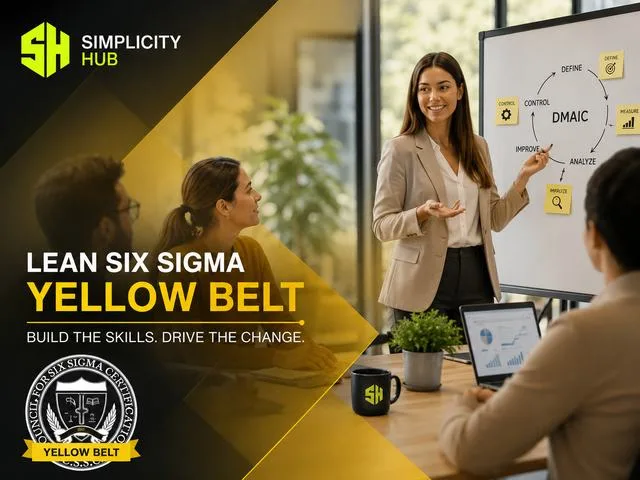
You've seen what Lean Six Sigma is. Now it's time to actually use it. Yellow Belt takes you from awareness into real capability — DMAIC, process mapping, root cause tools and waste reduction, taught in plain English with live calculators you apply as you learn. By the end you won't just have a certificate. You'll know how to contribute to a real improvement project.
Yellow Belt
SimplicityHub Lean Six Sigma courses are recognised by the Council for Six Sigma Certification as an accredited provider. You can view the accrediting body at sixsigmacouncil.org .
If you work on a team that does continuous improvement but have never had formal training, Yellow Belt is built for you. You will come out able to identify waste, follow a DMAIC project as a team member, and use the basic tools — process maps, 5 Whys, fishbone diagrams, 5S.
Yellow Belt takes 2-3 weeks at about 3-4 hours per week. It is entirely self-paced, with quizzes at the end of every module and a final knowledge test. You get a personalised certificate when you pass.
It is also the cheapest, lowest-risk way to see if Lean Six Sigma is for you before committing to Green or Black Belt. If you want the full journey, the Suite bundle (Yellow + Green + Black for £315) saves you £275 versus buying separately.
What it is, where it came from, and why it saves companies millions. You'll finish able to explain it clearly to a colleague.
The five-phase improvement framework. How Yellow Belts support Green and Black Belts during real projects.
Spot the 8 wastes in your own workplace, with examples from offices, factories, hospitals and retail.
SIPOC, swimlane and value-stream maps — when to use each and how to draw them without specialist software.
5 Whys, fishbone diagrams and basic Pareto analysis — taught with real worked examples.
Sort, Set, Shine, Standardise, Sustain — applied to both physical and digital workplaces.
Yellow Belt training focuses on practical improvement work that can be delivered quickly within teams and departments. These projects are typically small, focused, and designed to build confidence in structured problem solving.
Improve response time in a service desk, reception area, or internal approval process by identifying delays and standardising workflow steps.
Reduce errors in data entry, order processing, or documentation by clarifying requirements, adding checks, and simplifying handoffs.
Remove unnecessary steps from routine activities such as reporting, scheduling, or stock handling to make work faster and easier.
Completing small improvement projects helps teams build confidence, demonstrate measurable results, and create momentum for wider continuous improvement activity. Yellow Belt learners often lead these initiatives alongside their normal responsibilities, making them highly practical and immediately useful in the workplace.
Yellow, Green and Black Belt in one payment. Most learners who start go all the way — buying the Suite means you commit once and save £275 overall.
A quick look inside the Yellow Belt course so learners can see the lesson layout, examples, tools and certificate journey before enrolling.
Nothing needs to change, it's perfect. Maybe include other languages.
Clear and well structured introduction to Lean Six Sigma!
It is an excellent course! It would be great to add some assignments to make it more fruitful.
Team members, supervisors, customer service staff, and anyone who wants to understand Lean Six Sigma without running projects yet.
2-3 weeks at 3-4 hours per week. Fully self-paced.
No. Yellow Belt assumes zero background. We teach plain English first, jargon second.
Only if you already lead improvement projects. Most people find Yellow Belt is the right starting point — and the Suite bundle (£315) gives you all three belts at a huge discount.
Aligned with industry standards and mapped to the Lean Six Sigma Yellow Belt framework. Issued by SimplicityHub Academy on completion.
| Yellow | Green | Black | Suite | |
|---|---|---|---|---|
| Price | £110 | £185 | £295 | £315 (all three) |
| Depth | Awareness | Practitioner | Expert / leader | Full stack |
| Duration | 2-3 weeks | 4-6 weeks | 8-12 weeks | 14-20 weeks |
| Mini-project | — | Guided | Full, AI-graded | All three |
| Best for | Team members | Project leads | CI leaders | Career change |