Benefits Tracker Template
Log each improvement's expected and realised benefits so you can prove the value your projects actually delivered.

What is a Benefits Tracker Template?
A Benefits Tracker Template records the projected and actual benefits of an improvement project over time. It covers financial savings, cost avoidances, quality improvements, time savings and customer satisfaction gains.
When to use a Benefits Tracker Template
Use it from the Define phase (record projected benefits) through to project closure and the 6–12 month post-project review. Update it monthly and share it with your sponsor at every review.
Who should use a Benefits Tracker Template
- Black Belts and project leads — tracking and reporting the financial and non-financial value delivered by improvement projects
- Finance business partners — validating and signing off hard financial benefits before they are reported to leadership
- Sponsors — monitoring benefit realisation against the original business case throughout the project
- Programme managers — aggregating benefits across a portfolio of improvement projects for senior reporting
Vote yes and we’ll prioritise a quick walkthrough showing you exactly how to use it.
How to use a Benefits Tracker — step by step
-
1Write the problem statement at the top
Start with a clear, factual problem statement. 'Machine stopped' or 'Customer received wrong item' — specific, observable, factual. Vague problems produce vague root causes.
-
2Ask 'Why did this happen?' — Why 1
Write down the first-level cause. This is usually a symptom or a direct cause — not yet the root. Examples: 'Machine overheated', 'Wrong item was picked'.
-
3Ask 'Why did that happen?' — Why 2
Challenge the previous answer. Keep the team focused on causes, not blame. If the answer is 'human error', push further — why did the human make the error?
-
4Continue to Why 3, 4 and 5
Keep going until you reach a cause that is systemic — a missing process, a failed control, a gap in training or a design flaw. The number five is a guide, not a rule.
-
5Check the logic by reading upward
Read the chain back to front: 'Because of X, Y happened, which caused Z.' If the logic holds, you have a valid chain. If it breaks, revisit the step where it breaks.
-
6Identify the actionable root cause
The root cause is the deepest level where a corrective action can prevent recurrence. Document it clearly — this feeds your Improve phase solution design.
-
7Validate before acting
Do not jump to solution immediately. Check whether data or observation confirms the root cause is real and significant before committing resource to fixing it.
Worked example — Supply Chain Improvement Project
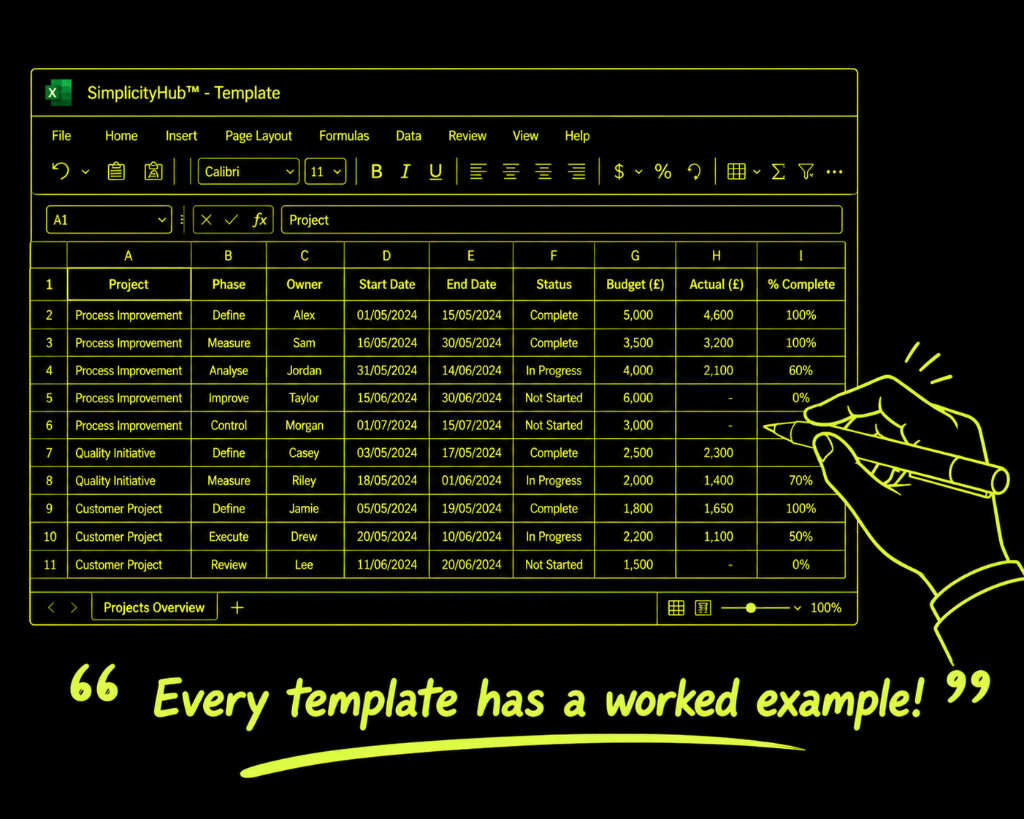
A supply chain project tracked £240k in hard savings (stock reduction), £85k in cost avoidance (overtime elimination) and a 3-day reduction in lead time over 12 months — all validated by the finance controller and reported monthly to the sponsor.
Common mistakes — and how to avoid them
Claiming benefits before they are realised. A projected saving is not a delivered saving. Only record actuals in the benefits column — projections go in the forecast column.
No finance validation for hard benefits. Financial benefits reported without finance sign-off are challenged or discounted by leadership. Get validation before reporting.
Stopping measurement at project closure. Many benefits take 6–12 months to fully materialise. Continue measuring for at least one year post-closure.
Mixing hard and soft benefits in the headline number. Report them separately. Combining them obscures the quality of the evidence and reduces stakeholder trust in the numbers.
Tips for getting better results
Establish baseline values on Day 1. You cannot measure improvement against a baseline you didn't record. Capture baseline values in the Define phase, before any changes are made.
Update the tracker monthly. Monthly updates keep the sponsor engaged and surface problems early if benefits are not materialising as expected.
Link each benefit to a specific process metric. Every benefit line should trace back to a measurable process change. If it can't be measured, it is an assumption, not a benefit.
Frequently asked questions
What should a benefits tracker include?
A benefits tracker should include the project name, the type of benefit (cost saving, revenue, efficiency, quality), the baseline measure, the target, the actual achieved, and the date benefits were realised. It should also note who validated the figures.
Who is responsible for tracking benefits?
Typically the project lead tracks benefits during and after the project, with finance validating hard savings. In larger organisations a CI Manager or PMO may maintain a central benefits register.
How long should benefits be tracked after project closure?
Best practice is to track benefits for at least 6–12 months after the control phase is completed to confirm sustainability and catch any regression to the mean.