
What is a Business Case Template?
A business case quantifies why the improvement project is worth doing — in financial or strategic terms. It translates the problem statement into a compelling reason to invest time, resource and money in solving it.
A strong business case includes the cost of the problem today (waste, rework, lost revenue, penalties), the estimated value of fixing it (savings, revenue protection, risk reduction) and any investment required to do so.
It is built in the Define phase and is what gets sponsor approval and budget. Without a credible business case, projects compete poorly for resource against day-to-day operational priorities.
When to use a Business Case Template
Build the business case before presenting the project to a sponsor for approval. You need one when:
- A sponsor needs financial justification before committing resource to the project
- The project requires investment (people's time, system changes, external support)
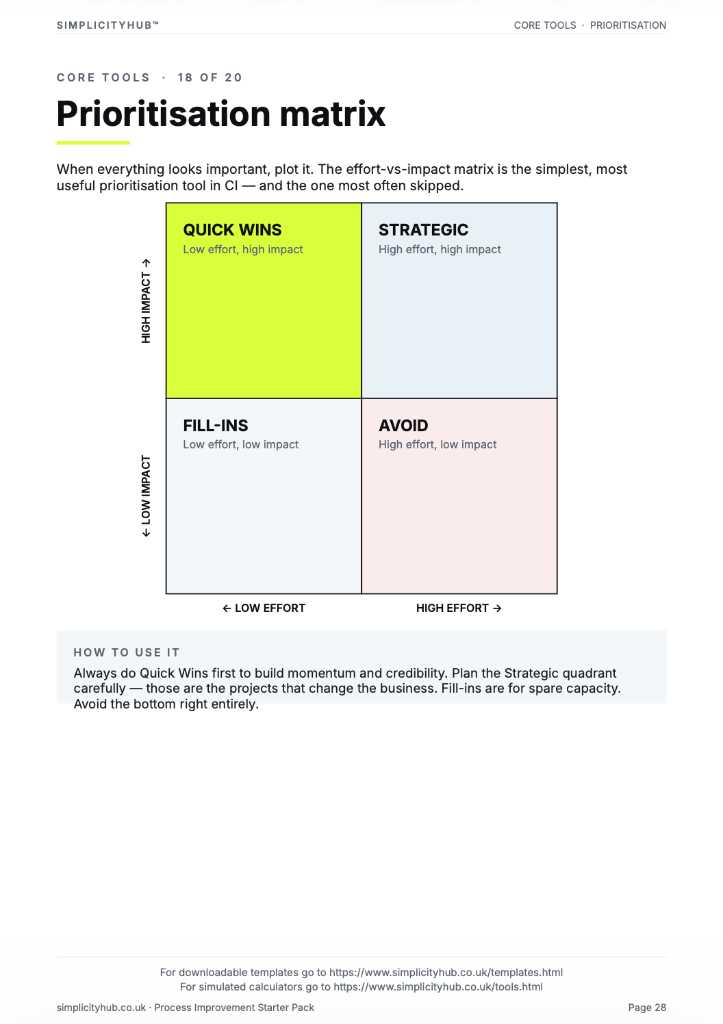
- You are prioritising between multiple improvement opportunities
- The project will be formally tracked as part of a CI savings programme
Who should use a Business Case Template
- Green Belts and Black Belts — to justify DMAIC projects to sponsors and senior leaders
- CI Managers — to build a portfolio business case for the improvement programme
- Operations Managers — when commissioning improvement work that requires budget
- Finance Partners — when validating claimed savings at project closure
Vote yes and we’ll prioritise a quick walkthrough showing you exactly how to use it.

How to build the business case
Ground the business case in data, not estimation. Every number should be traceable to a source. Sponsors who trust the data are more likely to support the project — and finance teams are more likely to validate the savings at closure.
How to build the business case — step by step
-
1Quantify the cost of the problem today
How much does the current problem cost? Include direct costs (rework, returns, penalties), indirect costs (management time, customer effort) and opportunity costs (lost revenue, churn).
-
2Calculate the annual run rate
Convert the cost to an annual figure. If the data covers one month, multiply by 12. Make the scale of the problem visible in yearly terms.
-
3Estimate the improvement value
If you hit the goal statement target, what is the financial value? Reduced waste, fewer complaints, lower error rate — translate each into a £ or % saving.
-
4Identify any implementation costs
What will it cost to make the improvement? People's time, training, system changes, external support? Be realistic — optimistic cost estimates undermine credibility.
-
5Calculate payback period and ROI
Divide the implementation cost by the annual saving to get payback in months. Calculate 3-year ROI: (3-year saving minus implementation cost) divided by implementation cost.
-
6Identify non-financial benefits
Customer satisfaction, regulatory compliance, staff morale, brand reputation — quantify where possible, qualify where not. These matter to sponsors even when they cannot be put in a spreadsheet.
-
7Get finance sign-off on key assumptions
Before presenting, validate your key assumptions with finance. A business case signed off by finance is far harder for a sceptical stakeholder to dismiss.
Worked example — SLA Breach Cost Business Case
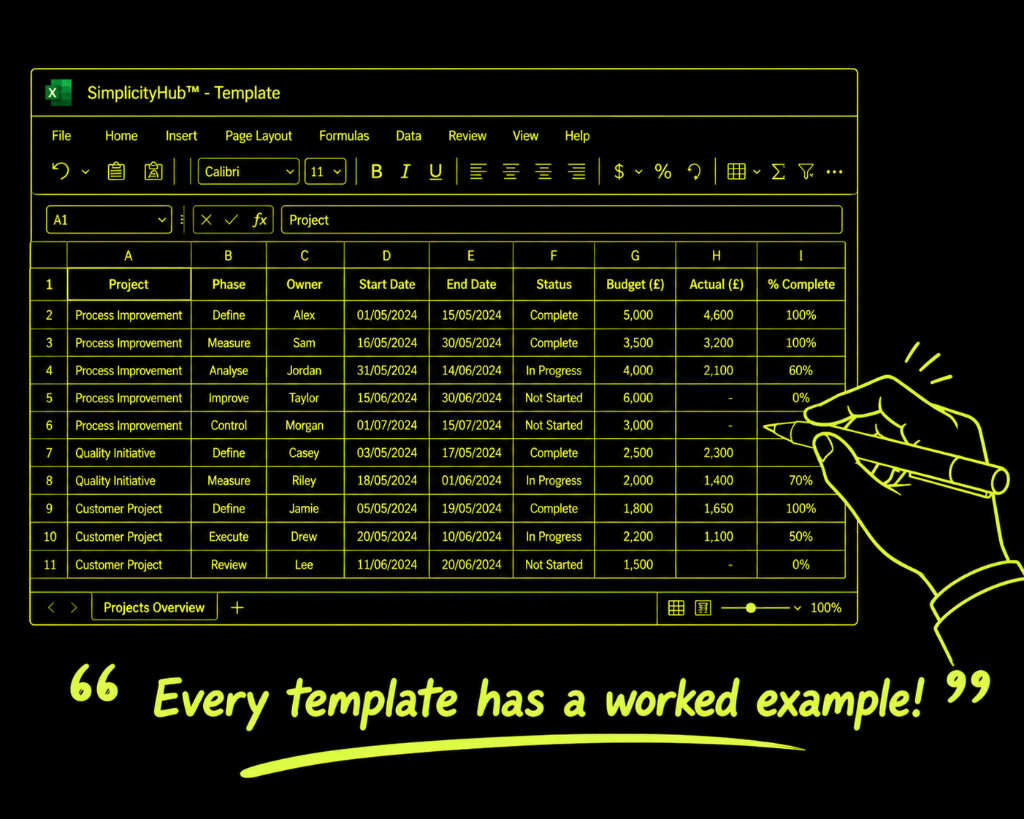
A completed business case for a complaint response improvement showing cost of the problem, annual saving, implementation cost and 3-year ROI.
Common mistakes — and how to avoid them
Inflating the numbers to get approval. Overstated savings that cannot be validated at closure damage your credibility for every future project. Be conservative and transparent about your assumptions.
Ignoring implementation costs. A business case that shows £50k savings but omits £40k of implementation cost is misleading. Include all costs — people's time is a real cost even if it does not appear on an invoice.
No link to strategic priorities. Every organisation has priority areas. Link the business case to at least one: cost reduction, customer satisfaction, compliance, growth. Projects that align to strategic priorities get resource; those that do not get deferred.
Copying numbers from a previous project. Every project is different. Do not reuse savings calculations from a similar previous project — build from the actual data for this process.
Tips for getting better results
Use a sensitivity analysis. Show the saving at best, base and worst case. This demonstrates rigour and gives the sponsor a range to work with rather than a single number that may feel arbitrary.
Express savings in headcount equivalent. £18,000 saving sounds small. '1.5 FTE of wasted time recovered' lands differently with an operations director. Express the same number in different units for different audiences.
Revisit at project closure. The business case is the benchmark for measuring what was actually delivered. Update it at closure with actual results and get finance to validate. This builds credibility for future projects.
Download the Business Case Template
Choose your preferred format — all versions are free, fully editable and ready to use immediately.
Frequently asked questions
What should a business case include?
A business case should include the cost of the current problem, the estimated value of fixing it, the investment required, the payback period and any non-financial benefits. It should be supported by data and validated with finance where possible.
How accurate does the business case need to be in Define?
In Define, a business case is an estimate — it does not need to be exact. ±20% accuracy is typical at this stage. The important thing is that the order of magnitude is correct and the assumptions are documented.
Who validates the savings at project closure?
Ideally finance validates the savings at closure using actual data from the period after the improvement. In some organisations, this is done by the CI Manager or an independent reviewer rather than the project team.