Process Review Template
Review a process against its standard so gaps, drift and improvement opportunities are captured in one structured pass.


What is a Process Review Template?
A Process Review Template provides a structured format for conducting periodic reviews of a process to assess whether improvements have been sustained, KPIs are on track and new problems have emerged.
When to use a Process Review Template
Use it at 30, 60 and 90 days after project implementation, and then at least annually thereafter. The process owner leads it; the Black Belt or Green Belt supports the first review.
Who should use a Process Review Template
- Process owners — conducting scheduled reviews of their process to check that improvements are sustaining
- Black Belts and Green Belts — supporting the first post-implementation review before handing over to the process owner
- Operations managers — reviewing process health across their area as part of regular governance
- Quality and continuous improvement teams — assessing whether implemented improvements are delivering their intended benefits
Vote yes and we’ll prioritise a quick walkthrough showing you exactly how to use it.
How to use a Process Review — step by step
-
1Write the problem statement at the top
Start with a clear, factual problem statement. 'Machine stopped' or 'Customer received wrong item' — specific, observable, factual. Vague problems produce vague root causes.
-
2Ask 'Why did this happen?' — Why 1
Write down the first-level cause. This is usually a symptom or a direct cause — not yet the root. Examples: 'Machine overheated', 'Wrong item was picked'.
-
3Ask 'Why did that happen?' — Why 2
Challenge the previous answer. Keep the team focused on causes, not blame. If the answer is 'human error', push further — why did the human make the error?
-
4Continue to Why 3, 4 and 5
Keep going until you reach a cause that is systemic — a missing process, a failed control, a gap in training or a design flaw. The number five is a guide, not a rule.
-
5Check the logic by reading upward
Read the chain back to front: 'Because of X, Y happened, which caused Z.' If the logic holds, you have a valid chain. If it breaks, revisit the step where it breaks.
-
6Identify the actionable root cause
The root cause is the deepest level where a corrective action can prevent recurrence. Document it clearly — this feeds your Improve phase solution design.
-
7Validate before acting
Do not jump to solution immediately. Check whether data or observation confirms the root cause is real and significant before committing resource to fixing it.
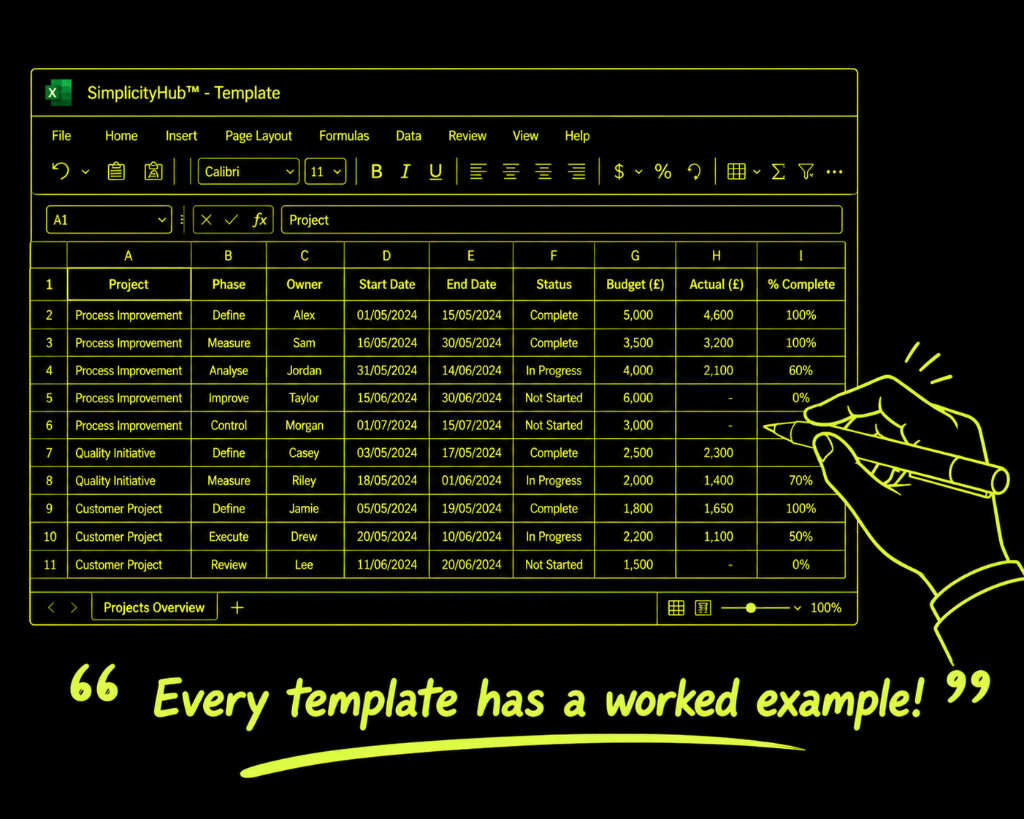
Worked example — 30-Day Post-Implementation Review
A process owner conducted the 30-day review of an accounts payable improvement project — confirming 4 of 5 improvements were sustaining, identifying one control that had been bypassed and raising a corrective action before regression set in.
Common mistakes — and how to avoid them
Cancelling the review when the project is going well. A green status is not a reason to skip the review — it is a reason to do a quick one and confirm the green is real.
Reviewing documents instead of the process. Process reviews require observation of the actual process, not just a check of whether the SOP folder is updated.
No corrective action for identified gaps. A review that identifies drift but raises no corrective actions is a record of failure, not a management tool. Every gap needs an owner and a date.
Only reviewing at 30 days. One review is not enough. Build in reviews at 30, 60 and 90 days, then annually. Most regression occurs in the first 90 days.
Tips for getting better results
Take the control plan to the review. Use the control plan as your review checklist. Every monitoring mechanism and poka-yoke listed should be verified as in place and working.
Interview frontline staff, not just supervisors. Supervisors see what they are shown. Frontline staff know what is actually happening. Talk to both.
Track improvement vs baseline, not just target. Even if performance hasn't reached target yet, confirm it has improved from baseline. Partial improvement is worth recognising.
Frequently asked questions
What is the purpose of a process review?
A process review checks whether a process is performing as designed, whether standards are being followed and whether the gains from an improvement project have been sustained over time.
How often should I conduct a process review?
Initially monthly for the first 3–6 months after project closure, then quarterly. High-risk processes may need weekly reviews. The frequency should reduce as confidence in sustainability grows.
Who should attend a process review?
The process owner, team leader, relevant operators and the CI lead or project sponsor. For processes with customer impact, a representative from quality or customer service may also be included.