Pugh Matrix Template
Compare solution concepts against a baseline using weighted criteria so the strongest option wins on evidence, not opinion.


What is a Pugh Matrix Template?
A Pugh Matrix (Concept Selection Matrix) is a structured comparison tool that evaluates multiple design or solution concepts against a reference concept using a set of criteria. Scores are +, – or S (same) for each criterion.
When to use a Pugh Matrix Template
Use it in the Improve phase after generating solution concepts, when you need to select between fundamentally different approaches rather than just rank similar solutions.
Who should use a Pugh Matrix Template
- Black Belts and Green Belts — selecting between fundamentally different solution concepts in the Improve phase
- Design and engineering teams — evaluating competing design options against customer and technical requirements
- Product owners — making structured feature and scope decisions based on objective comparative scoring
- Improvement teams — choosing between significantly different process redesign approaches before piloting
Vote yes and we’ll prioritise a quick walkthrough showing you exactly how to use it.
How to use a Pugh Matrix — step by step
-
1Write the problem statement at the top
Start with a clear, factual problem statement. 'Machine stopped' or 'Customer received wrong item' — specific, observable, factual. Vague problems produce vague root causes.
-
2Ask 'Why did this happen?' — Why 1
Write down the first-level cause. This is usually a symptom or a direct cause — not yet the root. Examples: 'Machine overheated', 'Wrong item was picked'.
-
3Ask 'Why did that happen?' — Why 2
Challenge the previous answer. Keep the team focused on causes, not blame. If the answer is 'human error', push further — why did the human make the error?
-
4Continue to Why 3, 4 and 5
Keep going until you reach a cause that is systemic — a missing process, a failed control, a gap in training or a design flaw. The number five is a guide, not a rule.
-
5Check the logic by reading upward
Read the chain back to front: 'Because of X, Y happened, which caused Z.' If the logic holds, you have a valid chain. If it breaks, revisit the step where it breaks.
-
6Identify the actionable root cause
The root cause is the deepest level where a corrective action can prevent recurrence. Document it clearly — this feeds your Improve phase solution design.
-
7Validate before acting
Do not jump to solution immediately. Check whether data or observation confirms the root cause is real and significant before committing resource to fixing it.
Worked example — Selecting a New Booking System
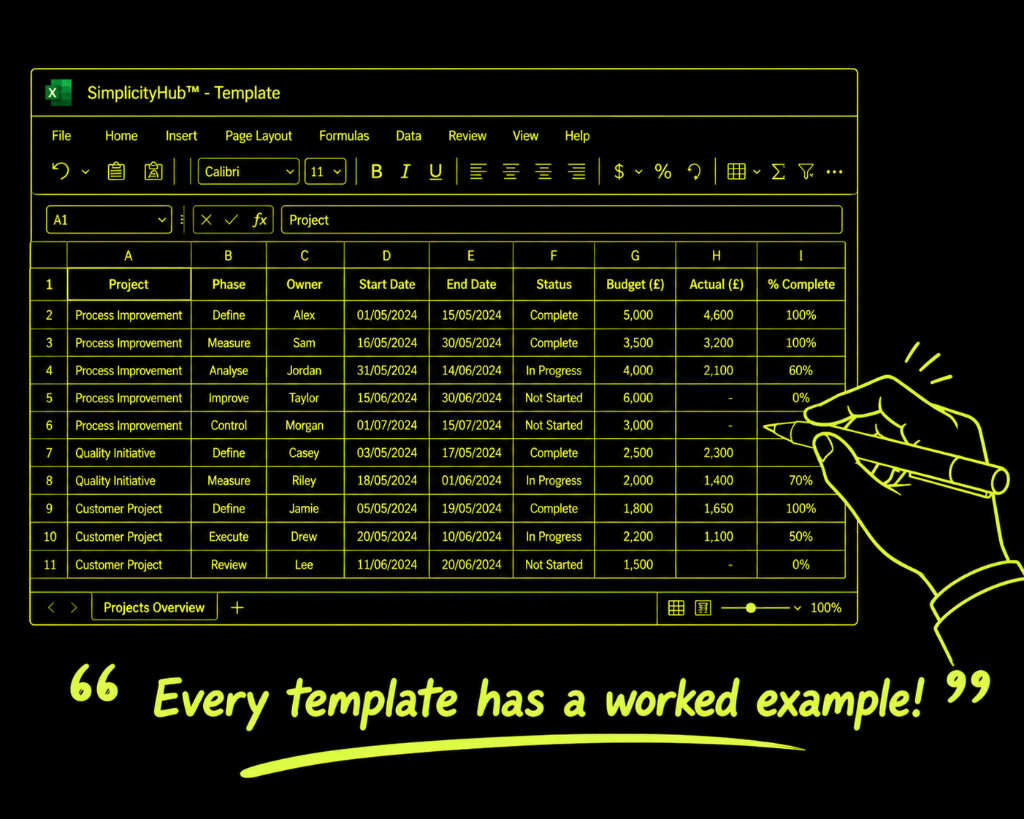
A project team used a Pugh Matrix to compare 4 booking system concepts against the current state across 8 criteria — revealing one concept as clearly dominant on 6 of 8 criteria and prompting a hybrid design that combined its strengths.
Common mistakes — and how to avoid them
Choosing a weak datum. If the datum (reference concept) is obviously inferior, all alternatives will score + across the board and the matrix provides little discrimination. Choose a realistic reference.
Scoring without evidence. Each + or – score should be justified. Unsupported scores reflect team bias, not objective evaluation.
Not iterating after the first round. The most valuable Pugh Matrix insight is often hybrid concept design — combining the best features of top-scoring concepts. Don't stop at the first pass.
Letting one person dominate scoring. Group scoring produces better outcomes than individual scoring. Discuss and agree every cell where views differ.
Tips for getting better results
Change the datum and re-score. If one concept is clearly the best candidate, make it the new datum and re-score to confirm it is better than the others on all important criteria.
Focus attention on minus scores. A concept with many minuses on critical criteria is a warning sign even if its total score is acceptable. Investigate the minuses carefully.
Document the rationale. Record why each + or – was assigned. This makes the decision defensible and creates a useful record for future reference.
Frequently asked questions
What is a Pugh Matrix?
A Pugh Matrix is a decision matrix used to compare multiple solution concepts against a set of criteria using a reference (datum) concept as a baseline. Each alternative is scored as better (+), worse (-) or the same (S) as the datum for each criterion.
How is a Pugh Matrix different from a weighted criteria matrix?
A Pugh Matrix uses relative comparison against a datum rather than absolute scoring. It is iterative — the best-performing concept often becomes the new datum in the next round, gradually converging on the strongest solution.
How many criteria should I use?
Typically 5–10 criteria weighted by importance. Too few criteria misses important factors; too many makes the matrix unwieldy. Focus on the criteria that are most critical to the customer and the process.