Solution Selection Matrix Template
Score potential solutions against impact, effort and risk so your team picks the fix that delivers the most value.


What is a Solution Selection Matrix Template?
A Solution Selection Matrix is a structured decision-making tool that scores candidate solutions against weighted criteria such as cost, impact, ease of implementation and risk. It removes gut-feel from solution selection.
When to use a Solution Selection Matrix Template
Use it in the Improve phase after generating a list of potential solutions via brainstorming or an Idea Generation Log. Score each solution before committing to a pilot.
Who should use a Solution Selection Matrix Template
- Green Belts and Black Belts — leading Improve phase solution selection within a DMAIC project
- Project teams — when multiple viable solutions exist and an objective decision is needed
- Process owners — to validate that the chosen solution meets their operational constraints
- Sponsors — to review and challenge the selection logic before approving the pilot
Vote yes and we’ll prioritise a quick walkthrough showing you exactly how to use it.
How to use a Solution Selection Matrix — step by step
-
1Write the problem statement at the top
Start with a clear, factual problem statement. 'Machine stopped' or 'Customer received wrong item' — specific, observable, factual. Vague problems produce vague root causes.
-
2Ask 'Why did this happen?' — Why 1
Write down the first-level cause. This is usually a symptom or a direct cause — not yet the root. Examples: 'Machine overheated', 'Wrong item was picked'.
-
3Ask 'Why did that happen?' — Why 2
Challenge the previous answer. Keep the team focused on causes, not blame. If the answer is 'human error', push further — why did the human make the error?
-
4Continue to Why 3, 4 and 5
Keep going until you reach a cause that is systemic — a missing process, a failed control, a gap in training or a design flaw. The number five is a guide, not a rule.
-
5Check the logic by reading upward
Read the chain back to front: 'Because of X, Y happened, which caused Z.' If the logic holds, you have a valid chain. If it breaks, revisit the step where it breaks.
-
6Identify the actionable root cause
The root cause is the deepest level where a corrective action can prevent recurrence. Document it clearly — this feeds your Improve phase solution design.
-
7Validate before acting
Do not jump to solution immediately. Check whether data or observation confirms the root cause is real and significant before committing resource to fixing it.
Worked example — Reducing Invoice Processing Errors
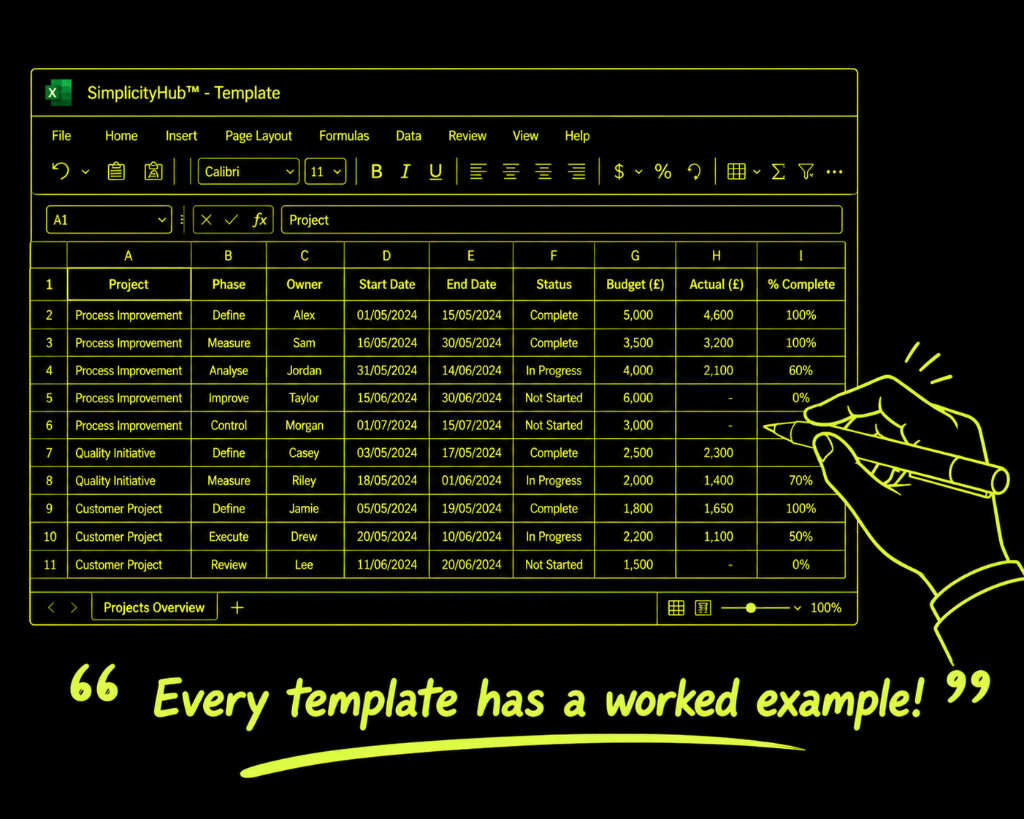
A project team scored five candidate solutions against criteria of cost, impact, speed and risk — with weighted totals revealing the optimal solution clearly.
Common mistakes — and how to avoid them
Setting weights after scoring. Agreeing weights after you already know the scores introduces bias. Always set and agree weights first, before any scoring happens.
Using too many criteria. More than eight criteria dilutes the model. Focus on the factors that genuinely differentiate the options.
Scoring without evidence. Each score should be justifiable with data or structured reasoning. Gut-feel scoring produces gut-feel results.
Ignoring the lowest-scoring winner. If the top scorer feels wrong to the team, don't override it — interrogate the weightings. The model may be telling you something.
Tips for getting better results
Run the matrix as a team, not solo. Individual scoring misses team knowledge. Complete the matrix together and discuss every score that has a spread of views.
Include a 'do nothing' row. Scoring the status quo forces the team to be honest about whether any solution is actually better than the current state.
Use it to kill weak solutions early. A matrix quickly exposes options that score poorly across all criteria. Remove them early to focus team energy on the real contenders.
Frequently asked questions
What is a solution selection matrix?
A solution selection matrix is a scoring tool used to evaluate multiple solution options against a set of weighted criteria. Each solution is scored on each criterion and the weighted scores are totalled to identify the strongest overall option.
How do I choose the criteria?
Base criteria on what matters most: impact on the CTQ, cost to implement, time to implement, risk, reversibility and alignment with strategy. Weight each criterion by its relative importance — typically on a scale of 1–5 or as a percentage.
What if two solutions score very similarly?
If scores are very close, do not rely on the matrix alone. Consider running a small pilot of both options, or revisit the criteria weights with the team to check they truly reflect what matters most.