Response Plan Template
Predefine who does what when a process drifts — triggers, actions and owners — so out-of-control signals get answered fast.


What is a Response Plan Template?
A Response Plan is a documented set of actions that are triggered when a process metric hits a defined threshold or goes out of statistical control. It is a required deliverable of the Control phase.
When to use a Response Plan Template
Use it in the Control phase alongside your control plan and KPI dashboard. Complete it before handing the process back to the process owner — every out-of-control condition must have a documented response.
Who should use a Response Plan Template
- Process owners — managing out-of-control conditions in their process day to day
- Team leaders and supervisors — responding to process signals and escalating appropriately
- Black Belts and Green Belts — building the response system as part of the Control phase deliverables
- Quality and operations managers — reviewing escalated issues and authorising corrective actions
Vote yes and we’ll prioritise a quick walkthrough showing you exactly how to use it.
How to use a Response Plan — step by step
-
1Write the problem statement at the top
Start with a clear, factual problem statement. 'Machine stopped' or 'Customer received wrong item' — specific, observable, factual. Vague problems produce vague root causes.
-
2Ask 'Why did this happen?' — Why 1
Write down the first-level cause. This is usually a symptom or a direct cause — not yet the root. Examples: 'Machine overheated', 'Wrong item was picked'.
-
3Ask 'Why did that happen?' — Why 2
Challenge the previous answer. Keep the team focused on causes, not blame. If the answer is 'human error', push further — why did the human make the error?
-
4Continue to Why 3, 4 and 5
Keep going until you reach a cause that is systemic — a missing process, a failed control, a gap in training or a design flaw. The number five is a guide, not a rule.
-
5Check the logic by reading upward
Read the chain back to front: 'Because of X, Y happened, which caused Z.' If the logic holds, you have a valid chain. If it breaks, revisit the step where it breaks.
-
6Identify the actionable root cause
The root cause is the deepest level where a corrective action can prevent recurrence. Document it clearly — this feeds your Improve phase solution design.
-
7Validate before acting
Do not jump to solution immediately. Check whether data or observation confirms the root cause is real and significant before committing resource to fixing it.
Worked example — Production Line Quality Response
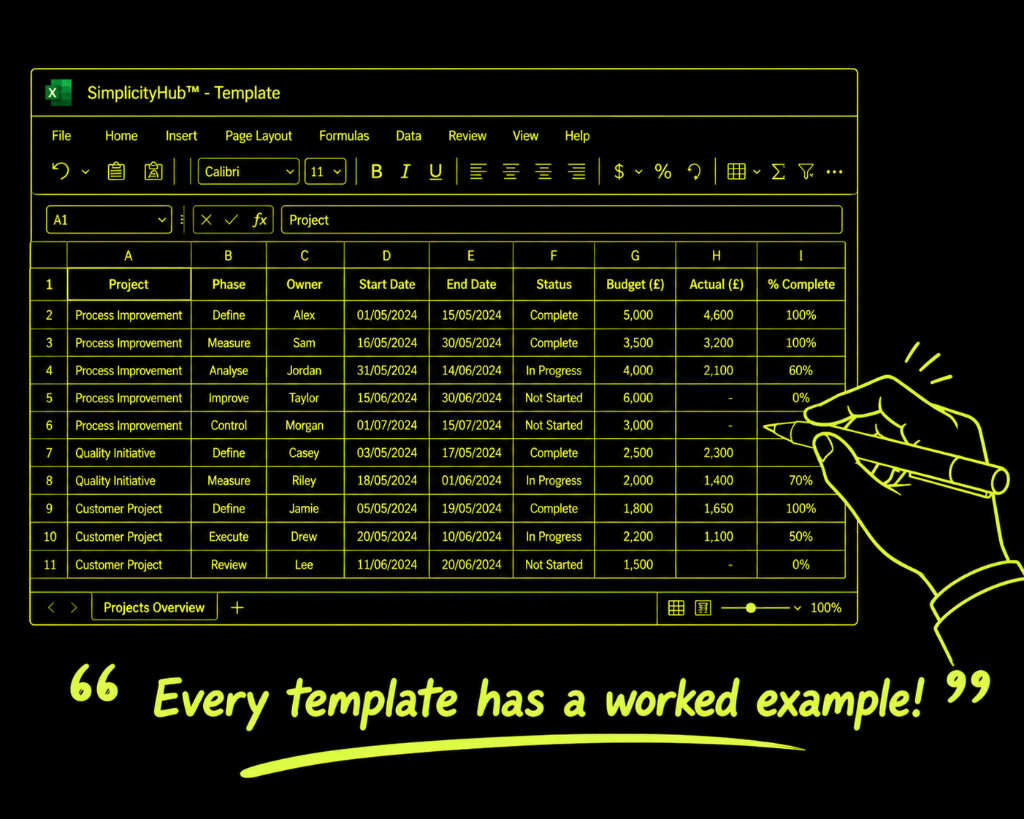
A manufacturing team built a 4-level response plan for their defect rate KPI: operator self-check at Level 1, team leader investigation at Level 2, quality engineer escalation at Level 3 and production manager stoppage authority at Level 4.
Common mistakes — and how to avoid them
Vague trigger conditions. If the trigger condition for a response is unclear, people will wait and hope rather than act. Define exact thresholds — not 'when it looks high'.
Not training the team on the plan. A response plan that only exists in a project file provides no value. Brief the whole team and display key contacts visibly.
No authority to act. If the responder doesn't have the authority to stop a process or call in resource, the plan will stall at the first real incident.
Never testing the plan. Run a tabletop exercise before going live. You will discover gaps that aren't obvious until someone tries to follow the plan under pressure.
Tips for getting better results
Display the response plan at the workstation. The plan is useless if the operator has to find it. Post the key triggers and contacts visibly in the work area.
Review it at every process review. Contacts change, processes change and trigger thresholds change. Check the plan is still accurate at every scheduled review.
Link it to the control chart. Reference the specific control chart rule violations that trigger each response level. This removes ambiguity about when to escalate.
Frequently asked questions
What is a response plan?
A response plan defines the specific actions to take when a control chart signals an out-of-control condition. It answers the question: what do we do when this measure goes outside its control limits or shows a trend?
How is a response plan different from an escalation matrix?
A response plan specifies the immediate corrective actions for each type of signal. An escalation matrix defines who to contact and when. They work together — the response plan is the 'what', the escalation matrix is the 'who'.
Should every CTQ have a response plan?
Yes. Any measure that appears on a control chart should have a corresponding response plan. Without it, operators see the signal but do not know what to do — which leads to ad-hoc fixes or doing nothing.