Capacity Planning Sheet Template
Calculate your current and required capacity to identify gaps and prevent overload.


What is a Capacity Planning Sheet Template?
A Capacity Planning Sheet Template is a structured calculation tool for matching available resource capacity to customer demand. It breaks down available time, utilisation and efficiency at each process step to produce a practical capacity figure that can be compared directly to demand.
When to use a Capacity Planning Sheet Template
Use it in the Measure phase to establish current capacity constraints, and in the Improve phase to model the capacity impact of proposed changes. It is essential before any staffing or resource decision.
Who should use a Capacity Planning Sheet Template
- Operations managers — planning staffing levels and shift patterns to meet forecast demand
- Black Belts and Green Belts — analysing capacity constraints as part of a DMAIC project
- Finance and planning teams — modelling resource costs against demand scenarios for budget planning
- Process owners — understanding and managing day-to-day capacity utilisation in their area
Watch: a quick explainer
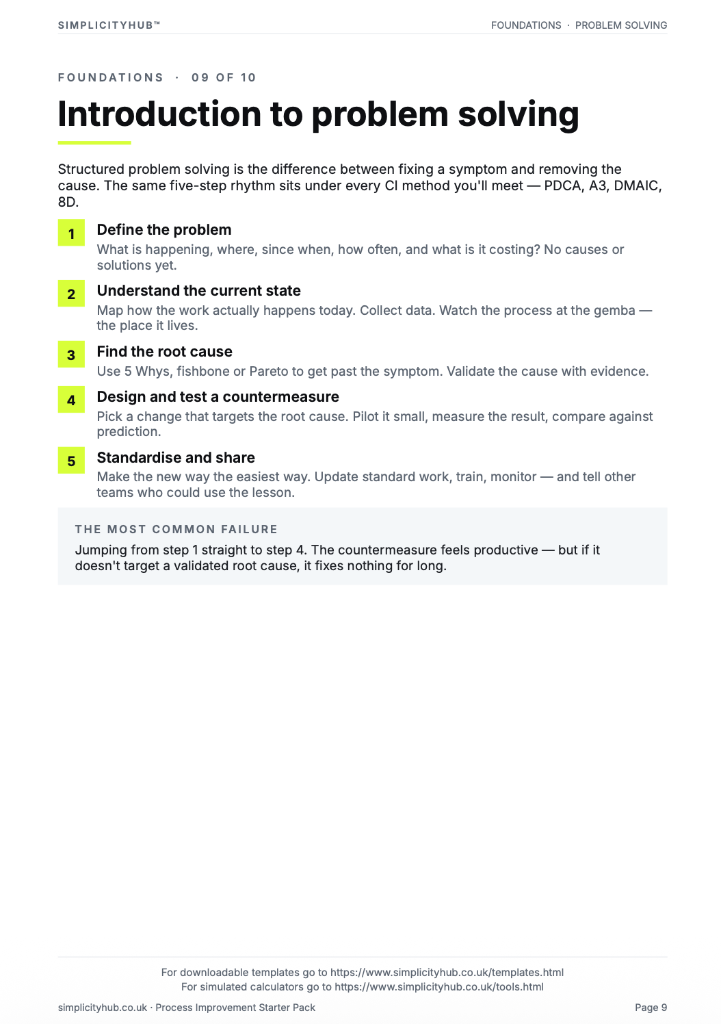
New to this? This short video walks you through capacity planning — how to lay out demand scenarios and check them against available capacity — a helpful primer before you download and use the template.

How to use a Capacity Planning Sheet — step by step
- 1Define the process and output unit
What process are you planning for, and how is output measured? Standardise the unit throughout the sheet.
- 2Record available working time
Total available time minus scheduled breaks, changeovers and planned downtime. Use the same time period as your demand data.
- 3Apply utilisation and efficiency rates
Utilisation = time actually working. Efficiency = output rate vs standard. Practical capacity = available time × utilisation × efficiency.
- 4Map demand by time period
Record actual or forecast demand by hour, day or week. Use peak demand, not average, for conservative planning.
- 5Calculate the capacity gap
Practical capacity minus demand = surplus or deficit. A deficit identifies where improvement or resource investment is needed.
- 6Model improvement scenarios
Recalculate capacity after each proposed improvement — waste reduction, cycle time saving, additional resource. Compare scenarios.
- 7Define the capacity plan
Based on the analysis, specify what changes are needed: process improvement, resource reallocation or demand management.
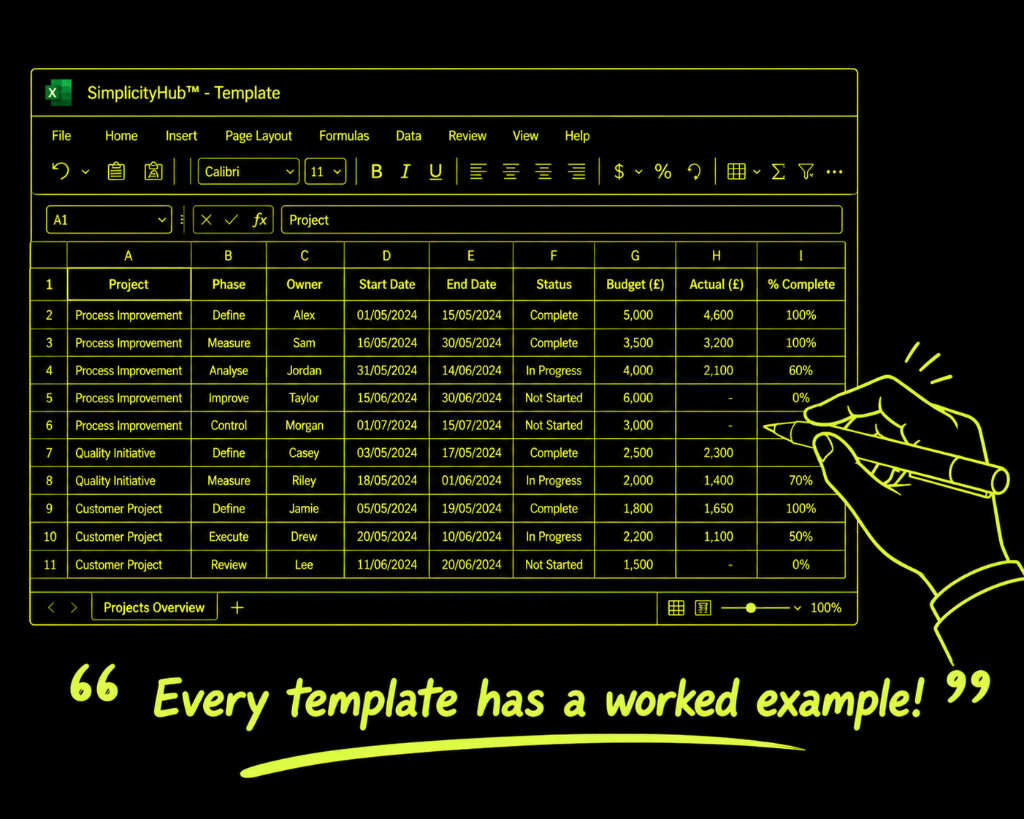
Worked example — Outpatient Clinic Capacity
A clinic team used the sheet to calculate practical capacity of 34 appointments per day (vs 40 booked) due to room turnaround waste — identifying a 15-minute room preparation step as the capacity constraint, resolved by redesigning the room changeover process.
Common mistakes — and how to avoid them
Using theoretical capacity. 100% utilisation never happens in reality. Always apply a realistic utilisation and efficiency factor — typically 75–85% for people-based processes.
Planning for average demand. Average demand masks the peaks that cause capacity failures. Always model for P90 or peak demand.
Ignoring the bottleneck step. Improving non-bottleneck steps does not increase overall capacity. Identify the bottleneck first.
Static planning models. Demand changes. Build a model that can be updated regularly, not a one-off spreadsheet that becomes obsolete in weeks.
Tips for getting better results
Express everything in the same unit. Mixing hours, headcount and units is a common planning error. Standardise on one unit throughout the model.
Validate cycle times by observation. Planned or standard times are often inaccurate. Time the process yourself before building the model.
Build three scenarios: base, peak, growth. A single-scenario plan is fragile. Modelling best, realistic and worst cases makes the plan robust to uncertainty.
Frequently asked questions
What is capacity planning in Lean?
Capacity planning in Lean means matching your process capacity to customer demand. The goal is to have enough capacity to meet takt time without creating excess inventory or idle time.
How do I calculate capacity?
Capacity is calculated as available working time divided by cycle time per unit. Compare this to the demand rate (takt time) to understand if you are over or under capacity.
When should I do capacity planning?
Do capacity planning in the Improve phase before implementing a new process design. It ensures your proposed solution can actually meet demand before you commit to full rollout.