
What is a Takt Time Calculator Template?
A Takt Time Calculator Template calculates the rate at which a process must deliver output to meet customer demand. It uses available production time and customer demand to produce the takt time in seconds or minutes per unit.
When to use a Takt Time Calculator Template
Use it in the Measure phase to establish the process pace requirement, and in the Improve phase to balance work content to takt and identify where staffing or cycle time changes are needed.
Who should use a Takt Time Calculator Template
- Green Belts and Black Belts — establishing the pace requirement for a process during the Measure and Improve phases
- Operations managers — balancing staffing levels and work allocation to customer demand
- Lean practitioners — designing balanced flow in production cells, service lines and back-office processes
- Industrial engineers — setting standard times and manning levels based on customer demand rates
Vote yes and we’ll prioritise a quick walkthrough showing you exactly how to use it.
How to use a Takt Time Calculator — step by step
-
1Write the problem statement at the top
Start with a clear, factual problem statement. 'Machine stopped' or 'Customer received wrong item' — specific, observable, factual. Vague problems produce vague root causes.
-
2Ask 'Why did this happen?' — Why 1
Write down the first-level cause. This is usually a symptom or a direct cause — not yet the root. Examples: 'Machine overheated', 'Wrong item was picked'.
-
3Ask 'Why did that happen?' — Why 2
Challenge the previous answer. Keep the team focused on causes, not blame. If the answer is 'human error', push further — why did the human make the error?
-
4Continue to Why 3, 4 and 5
Keep going until you reach a cause that is systemic — a missing process, a failed control, a gap in training or a design flaw. The number five is a guide, not a rule.
-
5Check the logic by reading upward
Read the chain back to front: 'Because of X, Y happened, which caused Z.' If the logic holds, you have a valid chain. If it breaks, revisit the step where it breaks.
-
6Identify the actionable root cause
The root cause is the deepest level where a corrective action can prevent recurrence. Document it clearly — this feeds your Improve phase solution design.
-
7Validate before acting
Do not jump to solution immediately. Check whether data or observation confirms the root cause is real and significant before committing resource to fixing it.
Worked example — Insurance Claims Processing
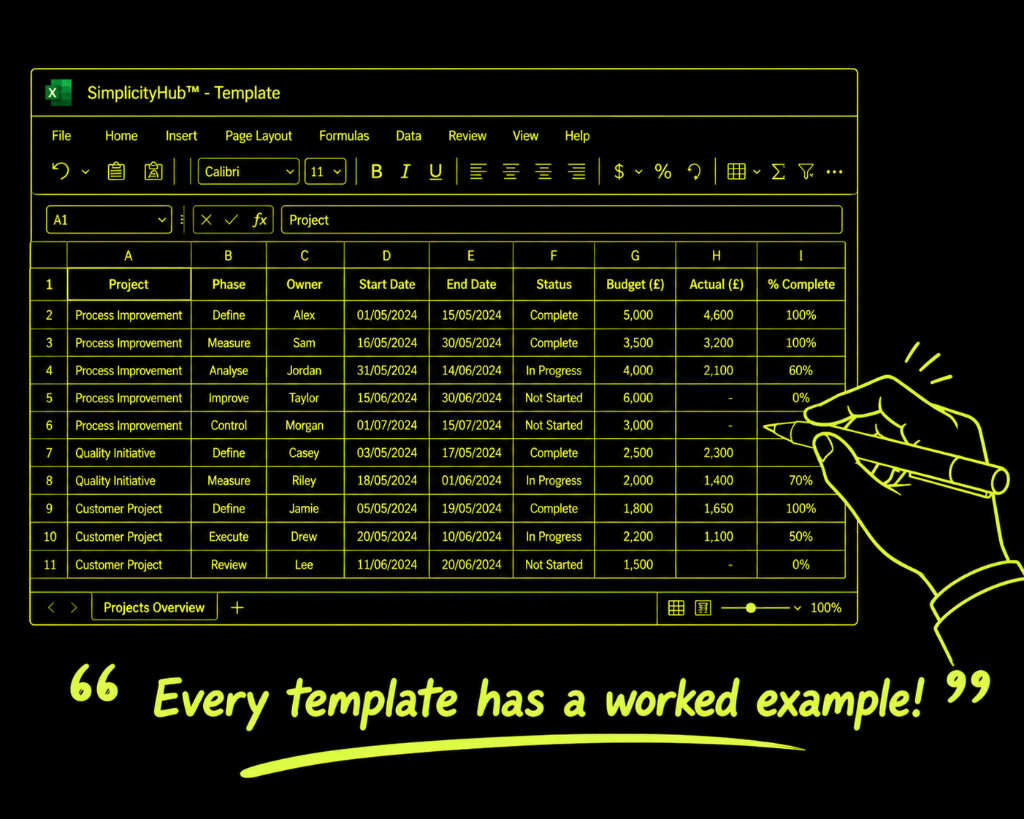
A claims team calculated a takt time of 18 minutes per claim based on 390 minutes available time and 22 daily claims. Comparing this to actual step cycle times revealed a 26-minute bottleneck at the assessment step — the target for the improvement project.
Common mistakes — and how to avoid them
Using gross available time instead of net. Always subtract breaks, changeovers and planned downtime before calculating takt. Gross time produces an unachievable takt.
Calculating one takt for a mixed-product process. If different product or service types have significantly different cycle times, calculate separate takt times rather than averaging.
Confusing takt time with target time. Takt time is set by customer demand. Target time is an internal efficiency goal. Confusing them leads to misaligned capacity planning.
Not updating when demand changes. Takt time changes when demand changes. Recalculate it whenever demand forecasts are revised significantly.
Tips for getting better results
Express takt in seconds for operational processes. Seconds give you a more precise and actionable figure for processes with short cycle times.
Use takt to design standard work. Each operator's standard work cycle should be designed to fit within takt time — this is the fundamental principle of flow design.
Calculate takt separately for each shift. If demand and available time differ between shifts, calculate a separate takt for each. A single average takt masks shift-level imbalances.
Frequently asked questions
What is takt time?
Maximum time allowed per unit of output to meet demand. Available time divided by customer demand in the same period.
Takt time vs cycle time?
Takt time is the demand-driven target pace. Cycle time is the actual pace. Cycle time must be at or below takt time.
How do I calculate it?
Divide available time by demand. For example 480 minutes divided by 120 units equals 4 minutes takt time.
What if cycle time exceeds takt time?
You have a capacity problem. Reduce cycle time through waste elimination, add resource at the bottleneck, or manage demand.
Advanced Toolkit Packs — available now
Structured, ready-to-use template packs designed for real improvement work. Pick the pack that matches your project and get started straight away.
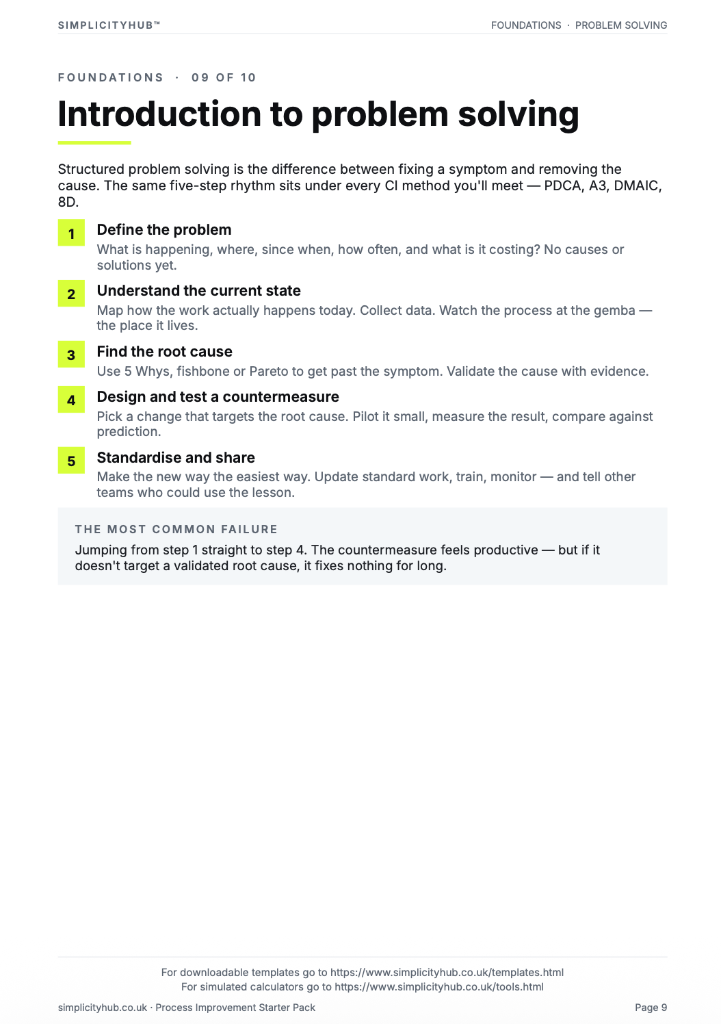
Process Improvement Starter Pack
A starter pack for identifying improvement opportunities, measuring baselines and planning action.


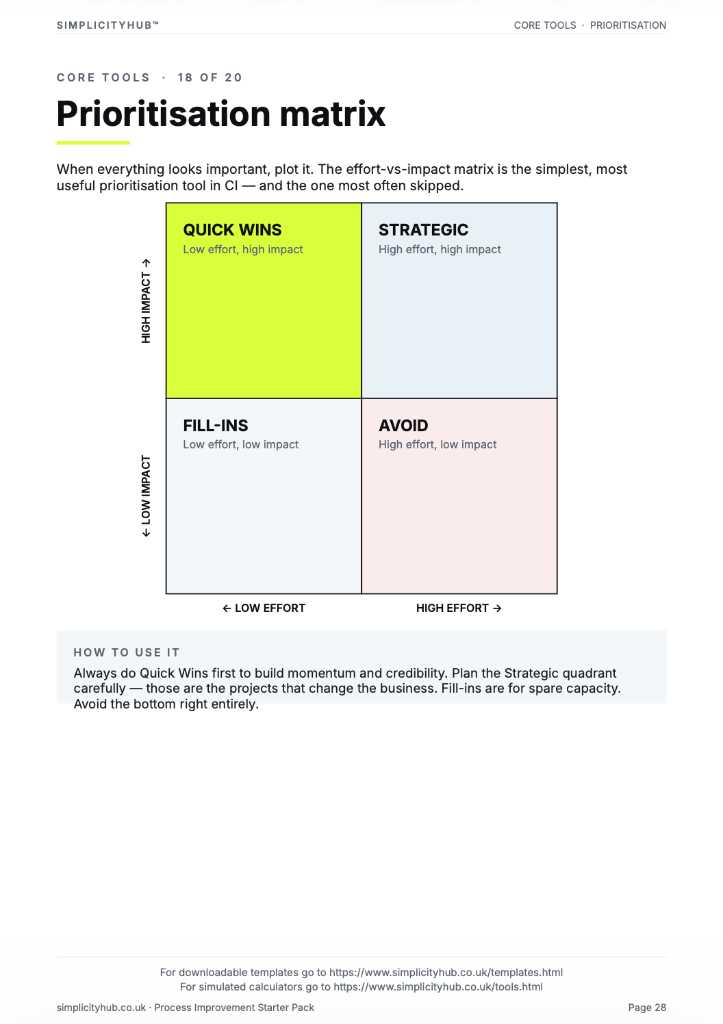
Root Cause Analysis Toolkit
A practical RCA toolkit for defining problems, finding causes, validating evidence and creating action.
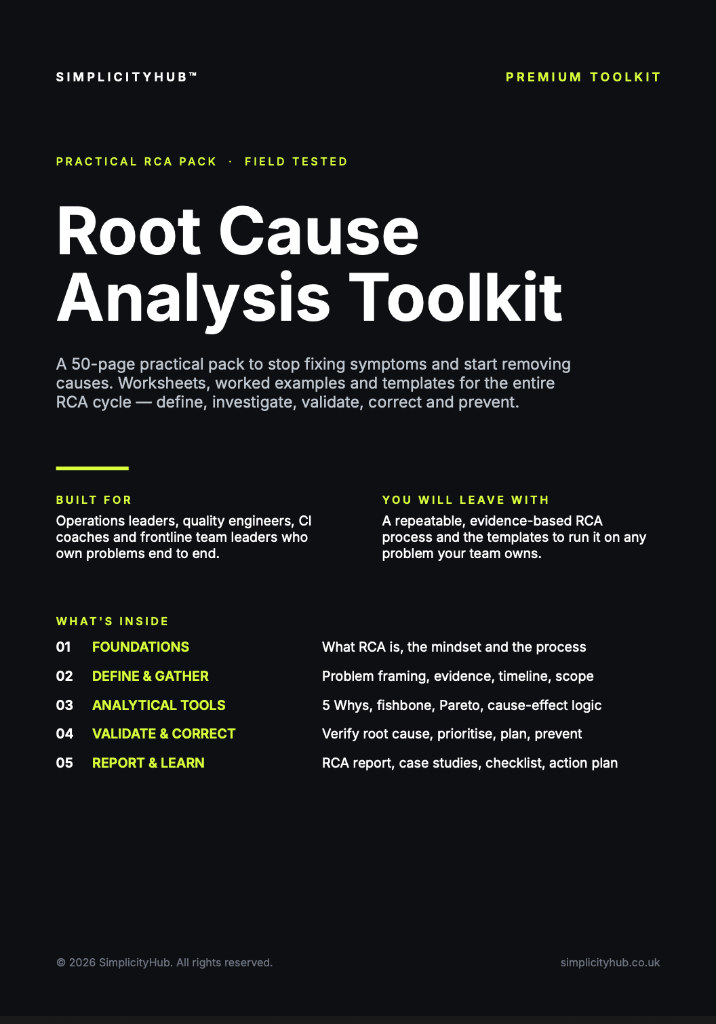
A3 Template Pack
A clean A3 problem-solving pack for concise, visual improvement thinking and follow-through.