In one line: Heijunka, Japanese for "levelisation," levels both the volume and mix of production over a fixed period, replacing batch-and-queue scheduling with deliberate, controlled buffer placement that reduces waste, shortens lead times, and stabilises the workload across every station.
Every Production System Has a Buffer. The Question Is Where.
Most introductions to heijunka frame it as a Toyota factory technique for smoothing schedules. That framing is accurate but incomplete. The deeper decision inside heijunka is about where you choose to hold your buffer.
Every production system absorbs variability somewhere. In batch-and-queue, the buffer hides in work-in-progress piles between stations, in expanded lead times, and in overtime hours nobody planned for. Heijunka moves that buffer to a place you can see and control: a small, deliberate stock of finished goods sized to match demand variability.
Toyota's approach is to manufacture at the long-term average demand and carry an inventory proportional to the variability of demand, the stability of the production process, and the frequency of shipments. That is not anti-inventory. It is inventory with a purpose.
The practical diagnostic for any practitioner starts here: find where variability is hiding in your process today, then decide where you want it to live instead.
What Heijunka Actually Means
The Japanese word heijunka translates roughly as "levelisation." In lean practice, it means levelling the type and quantity of production over a fixed period of time, enabling production to meet customer demand while avoiding batching and minimising inventories, capital costs, manpower, and production lead time through the whole value stream.
Heijunka is a technique for reducing mura (unevenness), which in turn reduces muda (waste). It was vital to the development of the Toyota Production System. Within that system, it functions as a method for facilitating Just-In-Time production, smoothing output across all departments and suppliers over a set period.
The distinction from batch-and-queue is structural. Batch scheduling groups identical products into long runs to minimise changeovers. Heijunka does the opposite: it sequences different products throughout the day, keeping each batch as small as the operation can handle.
Why Batch Production Costs More Than It Appears
Batch-and-queue scheduling creates three failure modes that compound each other.
Lead times expand. When you commit a line to a single product for hours or days, customers who need something different wait. That delay forces investment in finished goods inventory on the chance that what the customer wants is already sitting on a shelf.
Defects multiply. A single defect in a batch gets replicated throughout the entire run before anyone catches it. The longer the batch, the larger the scrap pile.
Worker load becomes uneven. Some lines run flat out while others sit idle, which degrades efficiency and corrodes safety and morale.
Daniel T. Jones, founder of the Lean Enterprise Academy, put this plainly: no production system can be continuously responsive to varying orders without suffering from mura and muri, and mura and muri together create muda. Heijunka is the counter-measure. It attacks the unevenness that generates the 8 wastes of lean in the first place.
Two Dimensions of Levelling
Production levelling operates along two distinct axes: volume and mix.
Levelling by volume means producing a constant total quantity in each period. If weekly demand averages 500 units, you produce 100 per day rather than 300 on Monday and 200 on Thursday.
Levelling by product mix means sequencing different product types throughout the schedule rather than dedicating entire shifts to a single type. Toyota's final assembly line never assembles the same automobile model in a batch. Instead, it assembles a mix of models in each batch and keeps those batches as small as possible.
The two dimensions are closely related. You cannot level mix effectively without first stabilising volume, and stabilising volume without levelling mix just moves the unevenness from one dimension to the other.
Where to Put the Buffer: The Real Decision
This is where heijunka diverges from the simplified "eliminate all inventory" narrative that sometimes attaches itself to lean.
Toyota does not eliminate inventory. It carries inventory proportional to the variability of demand, the stability of the production process, and the frequency of shipments. The discipline is in choosing where that inventory sits and how much of it you hold.
In a batch system, the buffer is unplanned. It accumulates as work-in-progress between stations, as overtime, as expediting costs. In a levelled system, the buffer is planned. It sits in a small finished-goods store calibrated to absorb demand fluctuations without forcing the production line to chase every spike and dip.
There is a second lever available: demand levelling. Rather than absorbing all variability on the production side, you can deliberately influence demand itself to deliver a smoother pattern at the source. Pricing strategies, order windows, and delivery schedules all shape demand before it reaches the factory floor.
Michael Ballé captures the goal: by producing every product during every relevant timeframe, lead time drops and the business moves closer to meeting real demand. Pulling production tight with demand is the essence of heijunka.
Changeover Time: The Prerequisite
None of this works if changeovers take hours. A line that needs 90 minutes to switch between products cannot economically produce small mixed batches.
Ballé recommends dedicating 10 percent of capacity to changeover flexibility. "If you want to make every product every day, which is kind of the Lean first goal, you need to reduce changeover time accordingly," he writes.
Toyota demonstrated what that looks like at scale. Changeover periods for vital processes such as die changes within the steel presses run as short as three minutes. That speed is not decorative. It is the mechanical precondition that makes mixed-model sequencing viable.
The downstream effects reach beyond the factory. In 2004, Toyota USA allowed dealers to change product attributes such as colour from sales floor computers linked to the factory queue, reducing production-related lead times precisely because changeover times through heijunka were already so short.
How to Implement: Takt Time, Heijunka Box, and the Staged Journey
The frame of any heijunka implementation begins with takt time and ends with a heijunka box.
Takt time is the rate at which you need to complete a product to meet customer demand. At the end of a day or a week, it shows how much of product A, B, C, or D needs to be shipped. Calculate it before doing anything else. Without takt time, you have no basis for deciding how to distribute work.
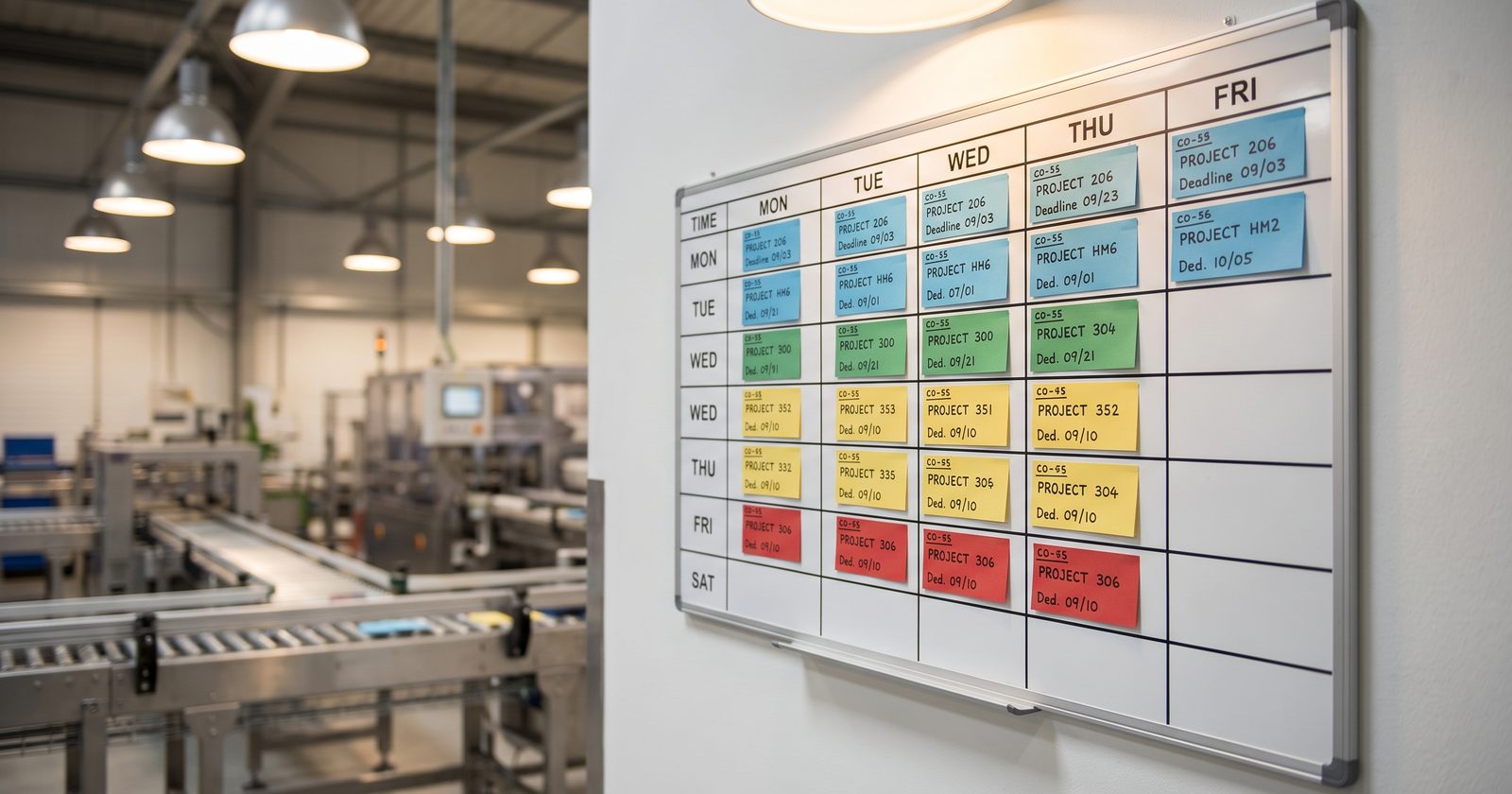
The heijunka box is a visual scheduling tool: a grid with rows for products (or product families) and columns for time intervals such as hours, shifts, or days. Production cards placed in the grid cells indicate the product type, quantity, and sequence, creating a visual representation of the levelled schedule.
Setting up a heijunka box requires three inputs: a stable takt time, reliable changeover times, and accurate demand data by product type. Without all three, the box becomes a wall decoration.
The staged journey follows a progression that Toyota uses internally. The sequence runs from a fixed-sequence, fixed-volume schedule (producing Every Product Every Cycle, or EPEC) through faster fixed sequences, then variable volume with fixed sequence, then variable sequence with fixed volume, and finally true single-piece flow.
This is not a weekend project. According to lean practitioners, heijunka is better achieved as a later-stage implementation, long after value streams have been identified and lean philosophy is already deeply embedded into process and materials cycles. Attempting it before foundational disciplines are in place risks building a levelled schedule on an unstable base.
What Changes When Levelling Works
The results Toyota achieved during the 1980s remain the most cited proof. Production levelling, alongside broader lean techniques, helped Toyota massively reduce vehicle production times and inventory levels during that decade.
The mechanics behind those results are straightforward. Heijunka reduces waste by matching production to customer demand, preventing overproduction, and cutting excess inventory. It keeps a more consistent production pace, improving the use of labour, equipment, and materials. It gives manufacturers the flexibility to respond to changes in demand or market conditions. And it raises customer satisfaction by ensuring products are consistently available when customers need them.
Those benefits are real, but they are second-order. The first-order change is simpler: you stop hiding variability and start placing it where you can manage it. Every improvement that follows is a consequence of that single decision.