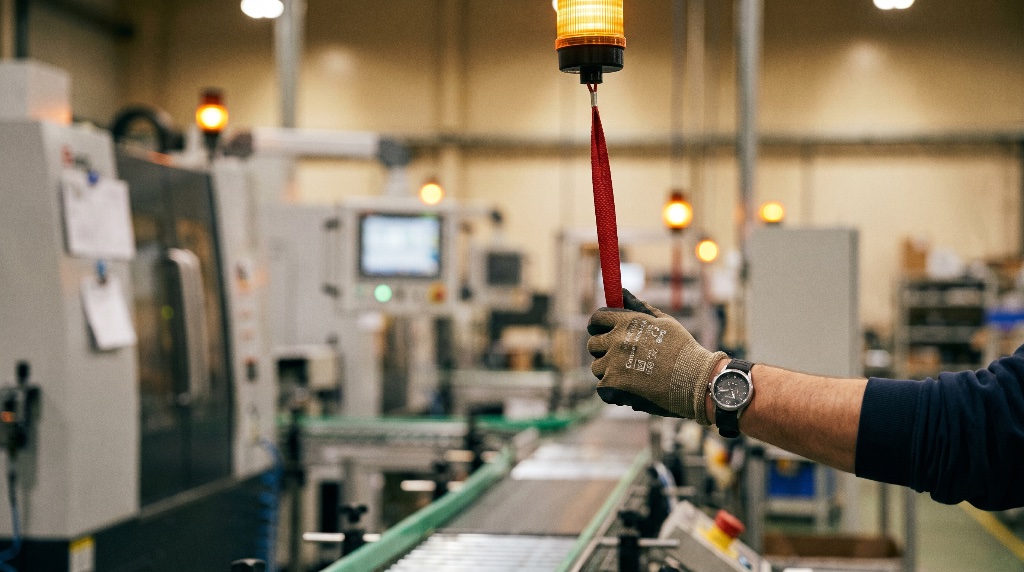
Quick answer: Jidoka translates as "automation with a human touch," giving machines and operators the ability to detect abnormalities and stop work before defects move downstream. One of the two pillars of the Toyota Production System alongside Just-in-Time, its four-step loop (detect, stop, fix, prevent) is the oldest practical framework for building quality into a process rather than inspecting it in afterwards.
What Jidoka Actually Means
Most lean glossaries define jidoka in a single phrase and move on. The word deserves more than a phrase.
Jidoka translates as "automation with a human touch" because it enables machines and operators to work together to identify and correct errors. It is also called autonomation, meaning automation with human intelligence, giving equipment the ability to distinguish good parts from bad without being monitored by an operator.
The word itself is a Toyota creation. In Japanese, jidoka is pronounced exactly the same as the standard word for automation and written in kanji almost the same, but it carries added connotations of "humanistic" and "creating value." That distinction matters. Standard automation removes humans from the process. Jidoka keeps them in it, positioned where they add the most value: not watching machines cycle after cycle, but stepping in when something goes wrong.
Where It Came From: Sakichi Toyoda's Loom
The concept originated in the early 1900s when Sakichi Toyoda invented a textile loom that stopped automatically when any thread broke. Before that innovation, a broken thread meant the loom would churn out mounds of defective fabric, so each machine needed a dedicated operator standing watch.
Toyoda's design inverted that arrangement. The loom monitored its own output. When a thread snapped, it stopped. No defective fabric. No wasted material. And one operator could now control many machines.
This practice became known as multiprocess handling: eliminating continuous machine monitoring so that a single person can oversee several machines at once. The operator's job shifted from watching to responding. That shift, from surveillance to exception-based intervention, is still the core of jidoka over a century later.
Jidoka's Place in the Toyota Production System
Jidoka is one of the two pillars of the Toyota Production System, alongside Just-in-Time. Where JIT governs flow (making only what is needed, when it is needed, in the amount needed), jidoka governs quality.
The mechanism is direct. Jidoka highlights the causes of problems because work stops immediately when a problem first occurs. Compare this with batch-and-inspect: defects accumulate, get caught at final inspection (or worse, by the customer), and root causes become difficult to trace because time and distance separate the defect from its origin. Jidoka collapses that gap. The process stops at the moment of occurrence, and the cause is still visible.
Jidoka is one of the fundamental principles of lean manufacturing, ensuring that quality is built into the production process from the start. Understanding where defects rank among the 8 wastes of lean helps teams prioritise which quality failures to address first.
The Four Steps: Detect, Stop, Fix, Prevent
Jidoka operates as a four-step loop. Each step has a specific purpose, and skipping any of them breaks the system.
1. Detection. Identify abnormalities at the source. Sensors, visual indicators, or manual checks detect irregularities immediately before they escalate.
2. Stoppage. Once a problem is detected, the process stops. Halting the line ensures that no defective products move forward, preventing waste and protecting overall quality.
3. Response. After stoppage, immediate action corrects the issue. Operators or automated systems fix the problem so production resumes without carrying defects further.
4. Prevention. The final step focuses on root cause analysis. Thorough investigation and permanent solutions prevent recurrence, strengthening long-term process reliability.
The loop is sequential and non-negotiable. Detection without stoppage produces data about defects you already shipped. Stoppage without root cause analysis produces the same stoppage again next week. Prevention without detection means you are guessing at what to prevent.
The Andon System in Practice
The most visible expression of jidoka on a shop floor is the Andon system. Andon allows operators to stop the production line whenever a problem is identified, alerting the team and indicating the specific workstation where the anomaly occurred.
Andon boards installed along the production line display light signals and codes identifying the machine, process, or operator that reported the issue, allowing line supervisors to respond quickly and take corrective action.
The Andon cord (or button, in modern installations) is a deliberate design choice. It gives every operator the authority to halt production. That authority separates jidoka from standard automation, where machines run until someone in quality control notices a problem downstream.
Pulling the cord triggers a response chain: the light board identifies the location, the supervisor arrives, and the team addresses the issue before the line restarts. Problems become impossible to ignore or defer.
The Lean Tools That Plug Into Jidoka
Jidoka's four-step loop does not operate in isolation. Two families of lean tools connect directly to its diagnose and prevent steps.
For root cause analysis (the "diagnose" moment after stopping), tools such as the 5 Whys and the Ishikawa Diagram (Fishbone Diagram) are commonly used to identify the root cause of errors. The 5 Whys drives investigation deeper than the immediate symptom. The Ishikawa diagram maps potential causes across categories (machine, method, material, manpower, measurement, environment) to ensure the team has not fixated on the first plausible explanation.
For prevention, Poka-Yoke (error-proofing) systems prevent defects from occurring or passing through the production process. A poka-yoke device makes the correct action easier than the incorrect one, or makes the incorrect action physically impossible. It is the permanent countermeasure that closes the jidoka loop.
Together, these tools form a system. Jidoka stops the process. 5 Whys and Ishikawa find the cause. Poka-yoke prevents recurrence. Without all three, you have fragments of a quality system rather than an operating one.
Quality Built In, Not Inspected Out
The phrase "build quality in" gets repeated often enough in lean circles that it risks becoming decoration. Jidoka is the mechanism that makes it operational.
Instead of relying on final inspections, quality control is built into the production flow, significantly reducing the risk of failures and rework. This increases product reliability, resulting in fewer customer complaints and returns.
Jidoka also changes the role of the people doing the work. Workers become active problem-solvers rather than passive machine operators, fostering a culture of continuous improvement. An operator who can stop the line, investigate a defect, and implement a countermeasure is doing quality work. An operator who watches a machine and waits for the end-of-line inspector is not.
This distinction matters for organisations running kaizen events. A kaizen team trying to improve a process where operators have no authority to stop and investigate will find that improvements do not hold. Jidoka provides the operating conditions that make continuous improvement sustainable.
Jidoka and Industry 4.0: The Same Principle, Smarter Tools
The jidoka principle was first introduced almost a century ago in the Toyota Production System, yet it is more relevant than ever in the age of Industry 4.0.
The technology has changed. The logic has not. Modern implementations use the same detect-stop-fix-prevent loop with faster, more precise instrumentation:
- IoT sensors monitor machines continuously for performance, positioning, or wear. Errors are detected before defects occur, allowing predictive action.
- AI and machine learning identify failure patterns, enabling predictive maintenance and reducing downtime.
- Collaborative robots (cobots) stop immediately when resistance is detected, ensuring safety while automating repetitive tasks.
- Digital Andon systems use cloud dashboards and alerts to make production issues visible in real time across the organisation.
Each of these is a modern implementation of a principle Sakichi Toyoda built into a textile loom. The sensor replacing the mechanical thread-break detector. The cloud dashboard replacing the light board above the production line. The cobot's force-torque limiter replacing the operator's hand on the Andon cord.
For practitioners evaluating where to start, the four-step loop remains the diagnostic. Can your process detect its own abnormalities? Does it stop when it does? Do you fix the immediate issue and then address the root cause? The technology you use to answer those questions is secondary to whether you are answering them at all.