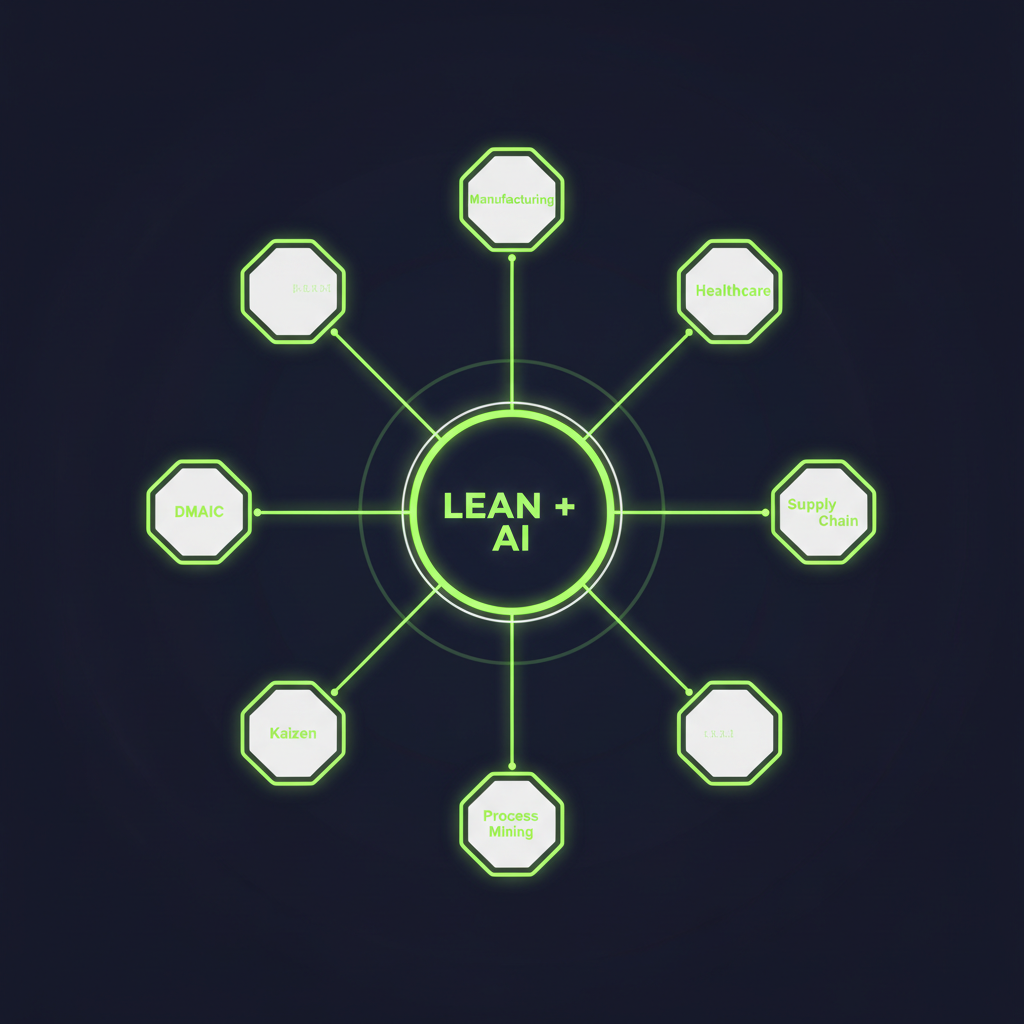
The Lean AI Revolution: What's Actually Happening
For decades, Lean Six Sigma practitioners have used data to drive improvement. What's changed is the quantity, quality and speed of data available — and the AI tools to analyse it. The combination creates something genuinely new.
Lean provides the framework: structured problem-solving, waste elimination, respect for people, continuous improvement. AI provides the capability: pattern recognition at scale, predictive analytics, automation of routine cognitive tasks. Together, they're transforming what's possible in operational improvement.
AI Tools by DMAIC Phase: Quick Reference
LLMs for problem statements, project charters. NLP for VoC analysis. ML for project prioritisation.
IoT/sensors for automated data collection. AI-powered MSA. Process mining for baseline measurement.
ML for root cause ranking. NLP for qualitative data. AI-generated fishbones. Anomaly detection.
Digital twins for solution testing. AI simulation. LLMs for SOP drafting and solution generation.
AI SPC monitoring. Predictive alerts. Automated dashboards. Adaptive process control.
Real-World Lean AI Examples by Industry
Manufacturing
AI predictive maintenance eliminating unplanned downtime, computer vision quality control, AI-optimised OEE — see our Lean AI in Manufacturing guide.
Healthcare
AI patient flow systems, clinical decision support, NHS waste reduction — see our Lean AI in Healthcare guide.
Supply Chain & Logistics
AI demand forecasting, supplier quality AI, route optimisation — see our Lean AI in Supply Chain guide.
Financial Services
Process mining for loan origination, AI fraud detection, automated compliance monitoring. Banks using AI + Lean are reducing process cycle times by 40-60%.
Retail
AI inventory optimisation, demand-driven replenishment, AI-powered returns management.
Your Lean AI Roadmap: Where to Start
Phase 1 — Low Hanging Fruit (Months 1-3)
Start with AI tools that require no infrastructure investment. Use ChatGPT for DMAIC documents, project charters and fishbone diagrams. Use process mining on a single high-volume process.
Phase 2 — Data Foundation (Months 3-9)
Invest in clean, consistent data collection. Connect your key process systems. Build a basic performance dashboard. Run your first ML-assisted root cause analysis.
Phase 3 — Predictive AI (Months 9-18)
Deploy predictive maintenance on critical equipment. Implement AI SPC for key quality metrics. Build ML demand forecasting for your most important products.
Phase 4 — Intelligent Operations (18+ months)
Continuous AI-powered process improvement. Predictive CI systems. Digital twins for major process changes. AI coaching and knowledge management.
Lean AI Skills: What Your Team Needs
The most important thing to understand about Lean AI is that AI doesn't replace Lean thinking — it requires more of it. The better your team understands Lean methodology, the more effective they'll be at deploying AI tools to support it.
- Lean Six Sigma fundamentals: DMAIC, waste identification, statistical thinking. Start with our White Belt course.
- Data literacy: Understanding what data is available, what it means and how to interpret it.
- AI prompt engineering: How to get the best out of LLMs for structured problem-solving work.
- Statistical thinking: Understanding correlation vs causation, what the numbers actually mean.
- Change management: Getting people to trust and use AI insights requires the same skills as any Lean change programme.