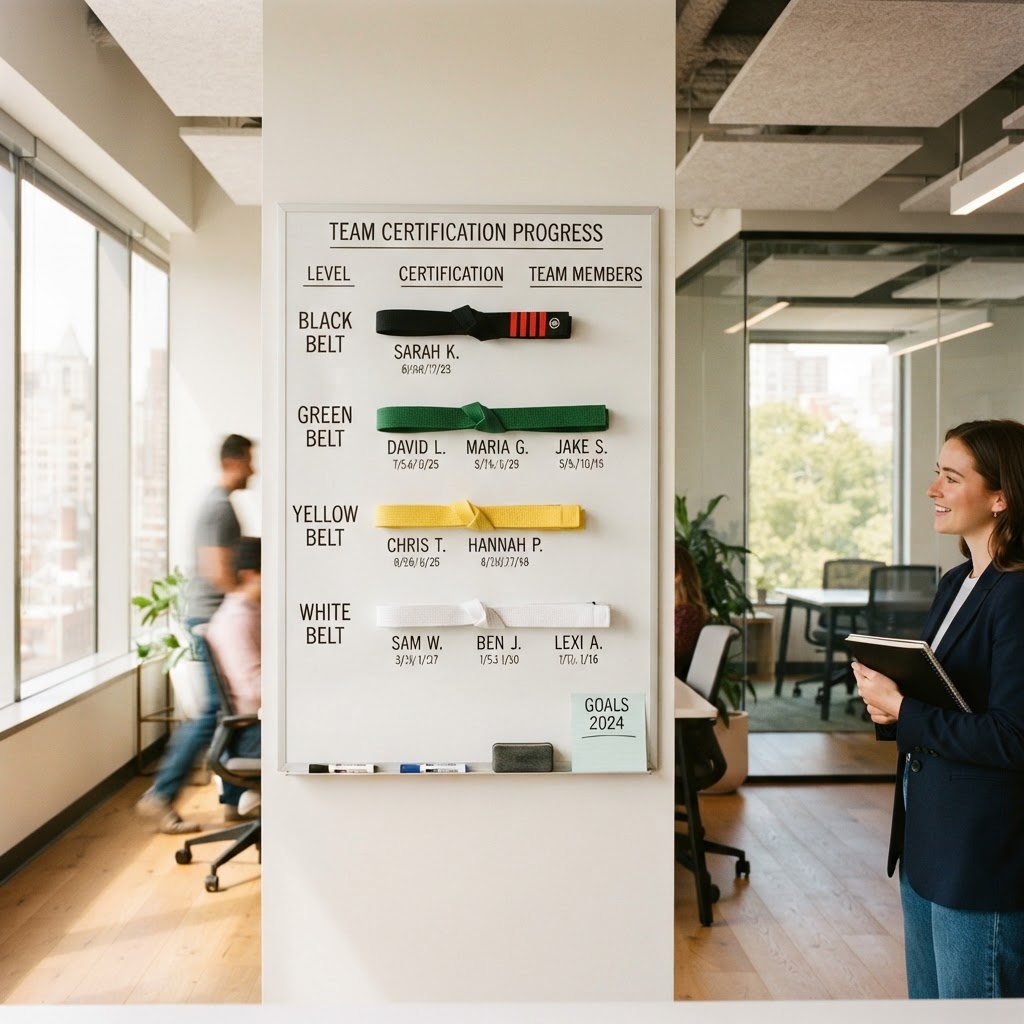
Lean Six Sigma uses a belt system borrowed from martial arts. White through Black, each level builds on the last. But the names alone tell you nothing about what you will actually learn, which tools you will use, or how long it takes.
This guide breaks down the real curriculum at each level so you can pick the right starting point for where you are now.
White Belt: the foundation
A White Belt gives you the language of continuous improvement. You will learn what Six Sigma means in practice: data-driven decision making, the concept of variation, and why defects matter even when a process looks like it works.
Expect to cover:
- The difference between decision making with and without Six Sigma
- How to calculate a basic sigma level
- Common principles like customer-focused improvement, value streams, and waste removal
- An overview of other quality methods (Lean, TQM, Scrum) and when Six Sigma fits better
- Lean fundamentals including the seven types of waste (muda) and 5S
White Belt training typically takes a few hours. It is designed for anyone in an organisation where Six Sigma is being deployed, not just project team members. You will not run projects at this level, but you will understand what project teams are doing and why.
Yellow Belt: supporting the team
Yellow Belts participate in Six Sigma projects in a supporting role. The curriculum repeats the White Belt foundations, then goes deeper into the tools you will use day to day.
You will add:
- The Pareto principle and how to build a Pareto chart
- Voice of the Customer (VOC) campaigns and selecting the right VOC tools
- Basic metrics: defects per million opportunities (DPMO), defects per unit, first time yield, rolled throughput yield
- Problem framing with y = f(x), the 5 Whys method, and writing a strong problem statement
- The Likert scale for survey design
Yellow Belts still hold other responsibilities in their job. The training prepares you to contribute meaningfully to projects without leading them.
Green Belt: running your own projects
This is where you move from participant to practitioner. Green Belts lead improvement projects using the full DMAIC framework: Define, Measure, Analyse, Improve, Control.
The curriculum expands significantly:
- Define: project charters, SIPOC diagrams, stakeholder analysis, scope management
- Measure: data collection plans, measurement system analysis, process capability (Cp and Cpk)
- Analyse: hypothesis testing, regression, root cause analysis tools like fishbone diagrams
- Improve: designed experiments, solution selection matrices, piloting changes
- Control: control charts, control plans, statistical process control, handover documentation
Green Belt training usually runs over several weeks. You will work on a real project alongside the coursework. This is the level where most practitioners see the biggest jump in practical capability.
Black Belt: leading the programme
Black Belts manage multiple projects, mentor Green Belts, and drive strategy. The curriculum assumes fluency with DMAIC and adds advanced statistical methods.
New material includes:
- Advanced DOE (design of experiments) with multiple factors
- Multivariate analysis and ANOVA
- Lean value stream mapping at an organisational level
- Change management and programme governance
- Financial modelling for project benefits
Black Belt training is intensive. Many programmes require completion of two or more projects with measurable financial impact before certification.
How accreditation fits in
Not all Lean Six Sigma certifications carry the same weight. The difference often comes down to who accredits the training provider.
The Council for Six Sigma Certification (CSSC) is the largest accreditation body for Six Sigma training worldwide. They publish a detailed body of knowledge for every belt level that maps out exactly which topics, tools, and competencies each certification should cover. When a training provider is CSSC-accredited, it means their curriculum has been validated against this standard.
Our courses at SimplicityHub are CSSC-accredited. That means the White Belt you start for free here covers the same body of knowledge that the Council requires at that level, and the same applies as you progress through Yellow, Green, and Black Belt.
Picking your starting point
If you have never studied Lean Six Sigma, start with White Belt. It is free, it takes a couple of hours, and it gives you enough context to decide whether to go further.
If you already understand the basics and want to contribute to projects, Yellow Belt fills in the practical tools.
If you want to lead your own improvement projects, Green Belt is where most practitioners should aim. The DMAIC framework and statistical tools at this level are what make the real difference in day-to-day operations work.
Black Belt makes sense when you are ready to coach others and manage a portfolio of improvement projects across a team or department.
Each level builds on the last. There is no shortcut, and there should not be. The belt system works because each stage gives you time to absorb and apply before moving on.