By The SimplicityHub Team
Lean has a reputation for being a long-term cultural transformation, and in the fullest sense it is — but plenty of individual Lean tools deliver a measurable result within days, not quarters. Here are seven you can start using this week, roughly ordered from easiest to set up to most involved.
The 7 Tools
1. 5S workplace organisation
Sort, Set in order, Shine, Standardise, Sustain. A basic 5S pass on one workstation or cell — removing anything not needed, giving everything else a fixed location, cleaning, then writing down the standard — routinely cuts search-and-retrieval time noticeably within a single shift. Start with our 5S audit sheet template to score a workstation and track improvement over successive passes.
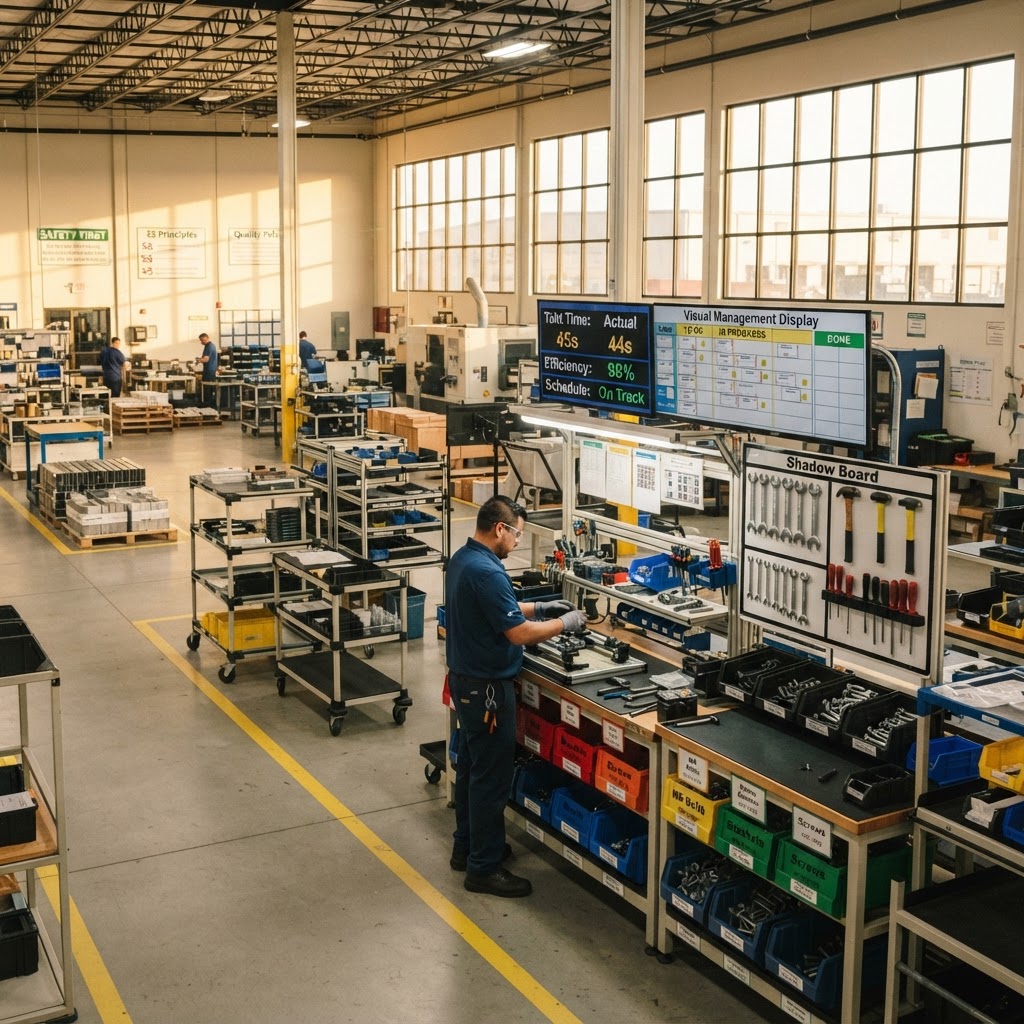
2. Visual management boards
A simple whiteboard showing today's target, actual output, and the gap between them, updated hourly, makes problems visible the moment they happen instead of at end-of-shift review. This alone often surfaces issues that would otherwise go unnoticed for days.
3. Kanban (pull-based replenishment)
A Kanban system replaces "make to forecast" with "make to actual consumption" — a card, bin, or signal triggers replenishment only when something is actually used. Even a simple two-bin system (use from one bin while the other is being refilled) reduces excess work-in-progress without needing software.
4. Value Stream Mapping (VSM)
A value stream map traces one product or service from order to delivery, marking value-adding steps versus waiting/handoff time. Most first-time VSMs are genuinely surprising — it's common to find that value-adding work is a small fraction of total lead time, with the rest sitting in queues and handoffs. Our value stream map template gives you a ready structure to map your first process.
5. Standard work documentation
A one-page standard — the current best-known way to do a task, with key steps, timing, and quality checkpoints — is one of the highest-leverage, lowest-cost Lean tools available. Without it, "the way we do it" varies by whoever's on shift, and improvements from one operator never spread to the rest of the team.
6. Quick changeover (SMED principles)
Single-Minute Exchange of Die (SMED), developed by Shigeo Shingo, separates changeover steps into those that must be done while the machine is stopped ("internal") and those that can be done while it's still running ("external"). Simply sorting your current changeover checklist into these two categories, without buying anything, often cuts changeover time substantially by moving external steps earlier.
7. Poka-yoke (error-proofing)
A poka-yoke is a simple mechanical or procedural safeguard that makes a mistake physically difficult or impossible — a jig that only fits the part one way, a checklist field that can't be left blank, a cable that only plugs in the correct way round. These are typically cheap to design and, unlike training, don't rely on someone remembering to be careful.
Where to start
If you can only pick one this week, start with 5S on your worst-performing workstation — it's the fastest to see a result from, and it usually surfaces problems (missing tools, unclear ownership, awkward layout) that make the other six tools easier to apply afterward. Browse our full free templates library for ready-to-use versions of each tool mentioned here.
📚 Further reading
Ready to get certified in Lean Six Sigma?
CSSC-recognised certificates. Starting from free.
View Courses & Pricing →