What is a Goal Statement Template?
A goal statement defines the specific, measurable improvement your project is aiming to achieve. It names the metric, the current baseline, the target and the date by which the improvement will be achieved — in one or two sentences.
The goal statement is written directly from the problem statement: whatever metric is broken in the problem becomes the target in the goal. If your problem statement says response time is averaging 5.2 days, your goal statement says you will reduce it to 3.0 days by a specific date.
It sits in the Define phase and is the yardstick against which project success is measured at closure. Without a clear goal statement, projects cannot be formally closed — because there is nothing to measure success against.
When to use a Goal Statement Template
Write the goal statement immediately after the problem statement — before scope is agreed or data collection begins. Use it when:
- You need to define what "done" looks like for a project
- A sponsor is asking what the project will actually deliver
- You need a SMART target to baseline your Measure phase against
- Multiple stakeholders disagree on what success looks like
Who should use a Goal Statement Template
- Green Belts and Black Belts — as a Define phase deliverable on every DMAIC project
- Yellow Belts — for smaller scoped improvements requiring a clear success criterion
- CI Managers — when agreeing project targets with sponsors and business owners
- Operations Leaders — when setting performance improvement targets for their teams
Watch: a quick explainer
New to this? This short video walks you through setting a clear, focused goal — a helpful primer before you download and use the template.

How to write a strong goal statement
A goal statement must be SMART: Specific, Measurable, Achievable, Relevant and Time-bound. Each element should come directly from the data you already have in the problem statement — not from guesswork.
How to write a strong goal statement — step by step
-
1Use the same metric as the problem statement
Whatever you measured as broken in the problem statement becomes your improvement target. Same metric, same unit. This ensures the goal directly addresses the problem.
-
2State the current baseline
Include the current performance level: 'from X'. This anchors the goal to reality and makes the improvement visible. Example: 'from 5.2 days'.
-
3State the target
Write the specific target value: 'to Y'. This must be achievable — set it based on customer requirements or benchmarks, not an arbitrary stretch. Example: 'to 3.0 days'.
-
4Set a specific end date
Name the date by which the target will be achieved. 'By 30 September 2026' is specific. 'In Q3' is not. Use a realistic date based on your project timeline.
-
5Add any constraints
If the improvement must be achieved without increasing cost, headcount or adding complexity, state it. Example: 'without increasing headcount'. Constraints are part of the goal.
-
6Validate it is achievable
Check the target is within the capability of the process to achieve. If data suggests the process has never come close to the target, the target needs justification or revision.
-
7Get sponsor agreement
The sponsor must agree the goal statement before you proceed. If they think the target is too easy or too ambitious, resolve it now — not at project closure.
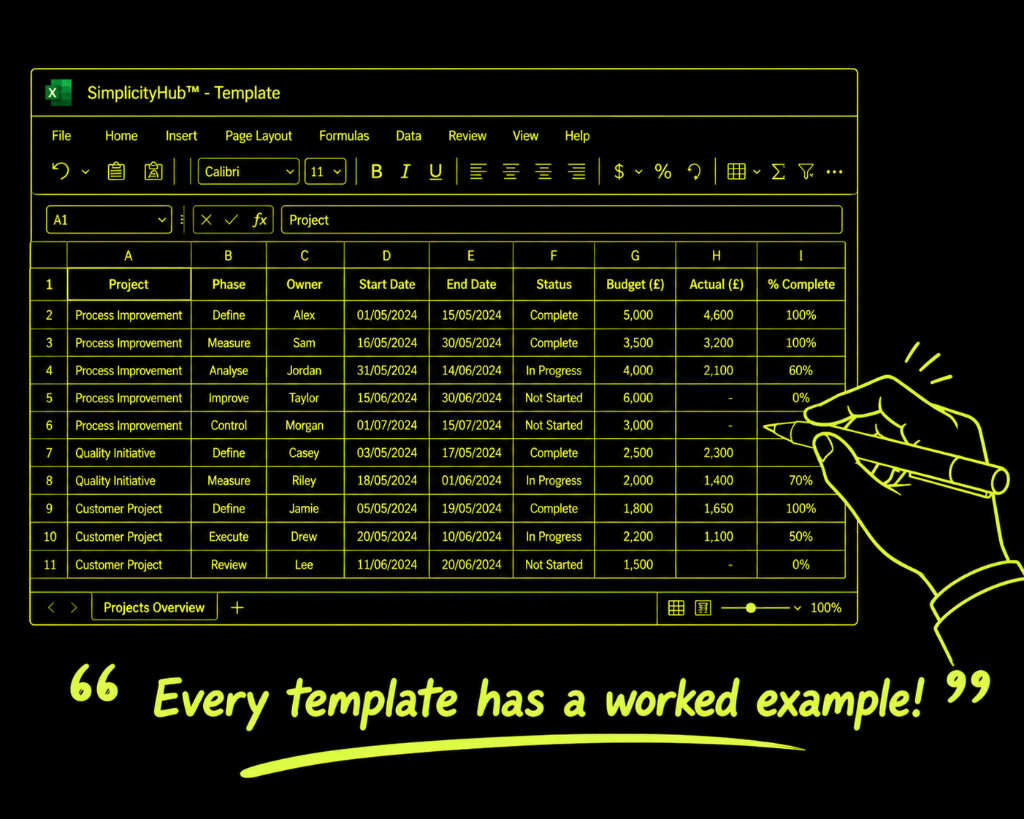
Worked example — Complaint Response Time Goal
A completed goal statement for a complaint response improvement project — showing the metric, baseline, target, date and constraints all in one clear sentence.
Common mistakes — and how to avoid them
Writing a goal without a number. 'Improve customer satisfaction' is not a goal statement. State the specific metric, baseline value, target value and date. Without a number it cannot be measured.
Setting an arbitrary target. Targets should come from customer requirements, regulatory standards or benchmarks — not from rounding down the current value. '3.0 days' because that is the SLA target is valid. '3.0 days' because it sounds reasonable is not.
Misaligning goal and problem. If the problem statement measures complaint volume but the goal statement targets response time, you are solving a different problem. Same metric throughout.
No end date. A goal without a date is a wish. 'As soon as possible' is not a date. Commit to a specific deadline that is reflected in the project plan.
Tips for getting better results
Write it in one sentence. If your goal statement needs more than two sentences, it is either too complex or covering more than one improvement. Simplify until it fits in one clear sentence.
Use the format: Reduce/Increase [metric] from [baseline] to [target] by [date]. This formula forces you to include every required element. Fill in the blanks from your data before writing prose.
Revisit after baseline measurement. The Measure phase sometimes reveals the baseline is different from what was assumed in Define. Update the goal statement if the data changes — with sponsor agreement.
Download the Goal Statement Template
A clean, editable Excel template for immediate use — structured, professional and ready to fill in.
Frequently asked questions
What is the difference between a goal and a problem statement?
The problem statement describes what is wrong today. The goal statement describes what good looks like — the target, the measure, and the deadline. Write the problem statement first; the goal statement flows from it.
Does the goal statement need a number?
Yes. Without a measurable target it is just a wish. Use the baseline from your problem statement and set a specific improvement — for example "reduce defect rate from 12% to below 4% by September 2026."
Can the goal change during the project?
Yes, but only with sponsor agreement. If Measure reveals the baseline was wrong, update the goal and reconfirm with your sponsor before continuing.
Should the goal mention how we will achieve it?
No. The goal statement describes the destination, not the route. Solutions come in Improve. If your goal mentions a specific fix, rewrite it to focus purely on the outcome.
Advanced Toolkit Packs — available now
Structured, ready-to-use template packs designed for real improvement work. Pick the pack that matches your project and get started straight away.
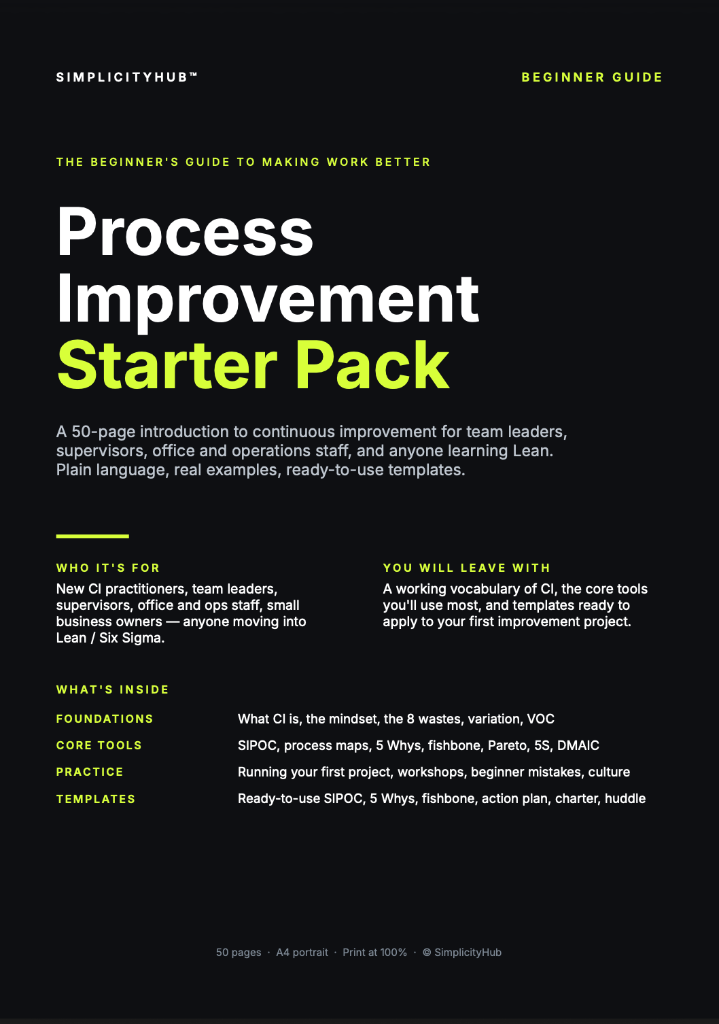
Process Improvement Starter Pack
A starter pack for identifying improvement opportunities, measuring baselines and planning action.
Root Cause Analysis Toolkit
A practical RCA toolkit for defining problems, finding causes, validating evidence and creating action.
A3 Template Pack
A clean A3 problem-solving pack for concise, visual improvement thinking and follow-through.