
What is a Simple 5 Whys Worksheet Template?
A Simple 5 Whys Worksheet Template provides a clean, straightforward one-page format for conducting a 5 Whys root cause analysis. It is designed for frontline use — quick to complete, easy to explain and effective for most day-to-day operational problems.
When to use a Simple 5 Whys Worksheet Template
Use it when a problem needs a root cause investigation but a full fishbone or statistical analysis is not warranted. It is ideal for team leaders, quality teams and anyone conducting a first-level investigation into a defect, near-miss or customer complaint.
Who should use a Simple 5 Whys Worksheet Template
- Team leaders and supervisors — conducting fast root cause analysis for day-to-day quality or operational issues
- Quality teams — investigating non-conformances and customer complaints with a structured approach
- All belt levels — the worksheet is accessible to anyone regardless of CI training level
- Health and safety teams — documenting near-miss and incident root cause investigations
Watch: a quick explainer
New to this? This short video walks you through getting to the real root cause — a helpful primer before you download and use the template.
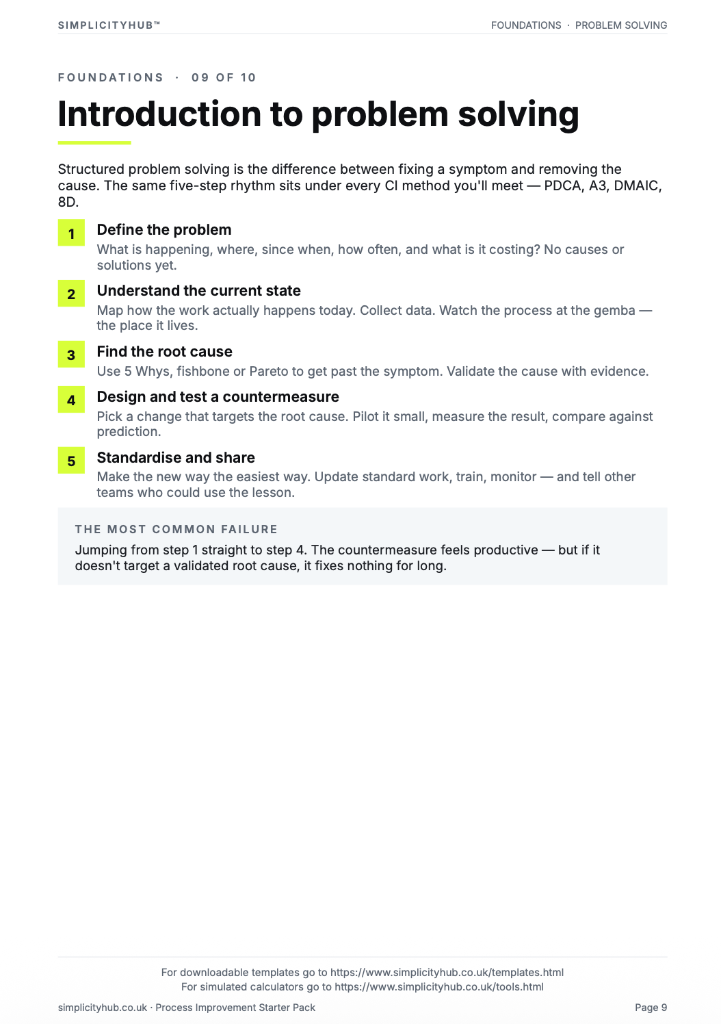
How to use a Simple 5 Whys Worksheet — step by step
- 1Write the problem statement
One clear sentence describing the specific problem — what happened, where and when. Use data if available.
- 2Ask and answer Why 1
What directly caused this problem? Write the first-level cause.
- 3Ask and answer Why 2
What caused Why 1? Go deeper than the first answer.
- 4Continue to Why 3, 4 and 5
Keep asking why until you reach a systemic cause — not a person's mistake, but the process or system that allowed the mistake to happen.
- 5Identify the root cause
The deepest 'why' where a corrective action can prevent recurrence is the root cause. Circle or highlight it.
- 6Define the corrective action
One specific action that addresses the root cause — with an owner and a completion date.
- 7Verify the fix worked
After the corrective action is implemented, check whether the problem has recurred. If it has, the root cause may not have been deep enough.
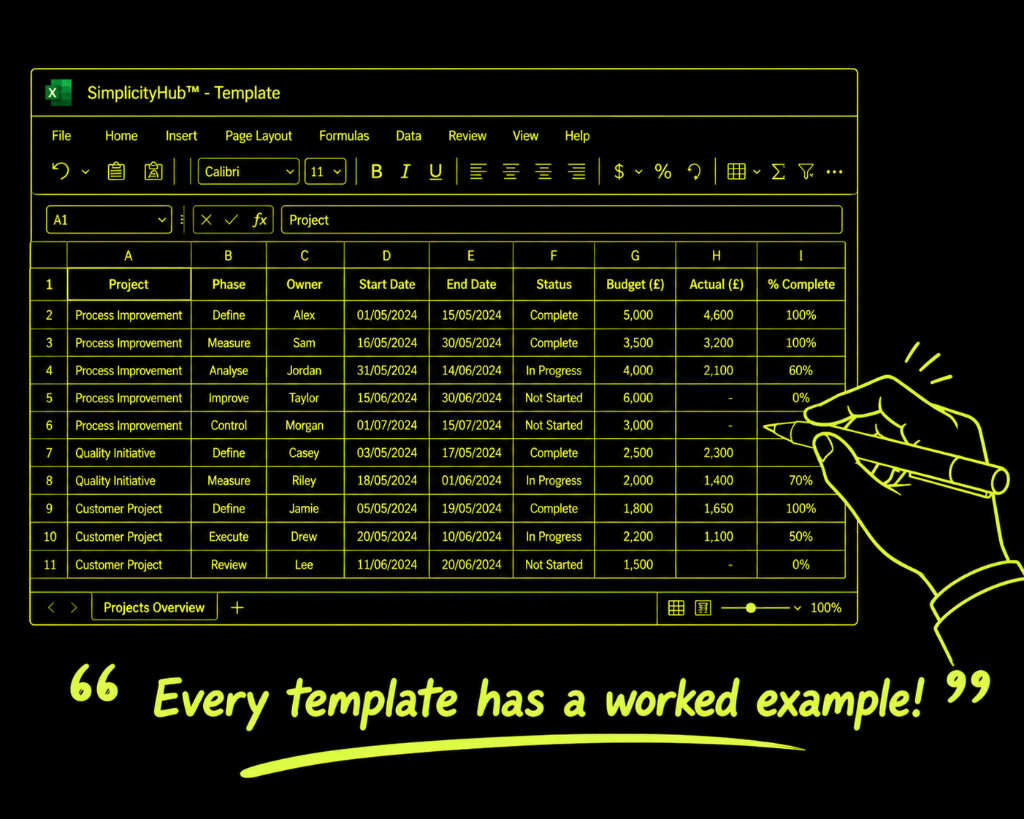
Worked example — Incorrect Customer Invoice
A billing team used the simple worksheet to investigate a customer complaint about an incorrect invoice — tracing from 'wrong price on invoice' through 5 whys to a root cause of price list updates not being automatically synced to the billing system.
Common mistakes — and how to avoid them
Treating the worksheet as a form to fill in rather than a thinking tool. The answers should be the output of a discussion with people who know the process — not a solo desk exercise.
Stopping when you find a person to blame. 'Because the operator made a mistake' is never a root cause. Ask why the operator made the mistake — the answer is almost always a process or system failure.
Not assigning a corrective action owner. A root cause without an assigned fix is a documented failure, not a resolved problem.
Not verifying the fix. Closure means the problem has stopped — not that the action has been taken. Follow up to confirm the problem has not recurred.
Tips for getting better results
Keep the language simple. The worksheet should be completable by anyone in the team, not just those with CI training.
Laminate a blank copy at the workstation. Instant availability at the point of work means problems get investigated immediately, while the details are still fresh.
Build it into your CAPA process. A completed 5 Whys worksheet should be the mandatory root cause component of every corrective action raised.
Frequently asked questions
Who can use this worksheet?
Anyone — designed to be usable without formal Lean Six Sigma training.
Simple worksheet vs full five whys?
Simple for quick investigations of isolated incidents. Full template for complex problems needing formal documentation.
How long does a session take?
15-30 minutes. If spending more than an hour, consider a fishbone analysis instead.
Should the worksheet be kept?
Yes — file it with the corrective action record for future reference.
Advanced Toolkit Packs — available now
Structured, ready-to-use template packs designed for real improvement work. Pick the pack that matches your project and get started straight away.
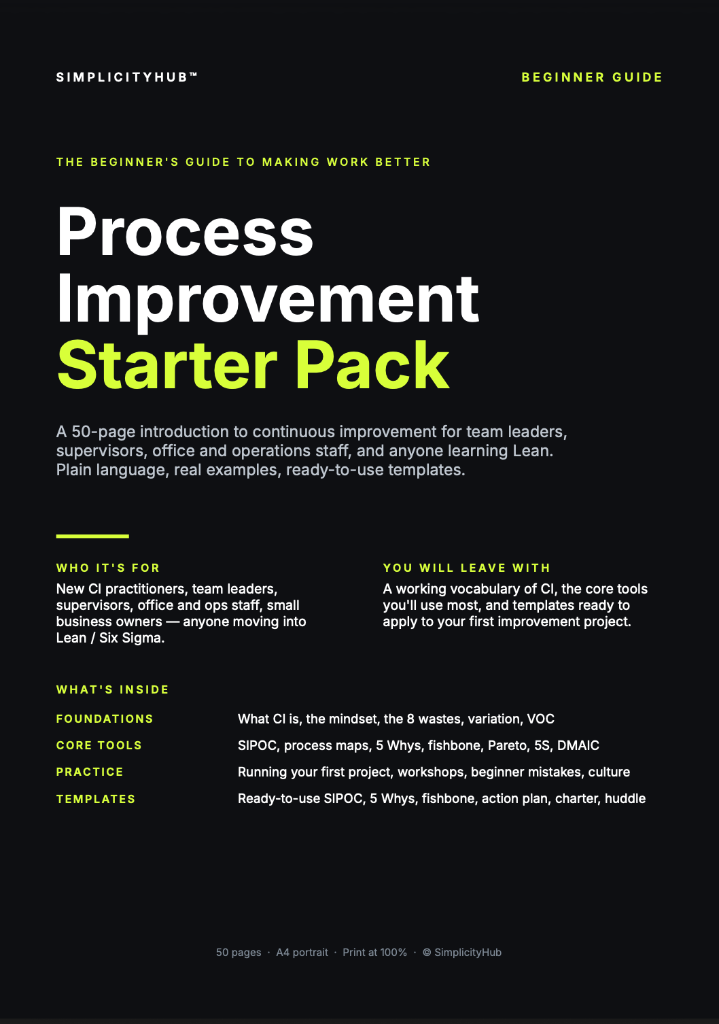
Process Improvement Starter Pack
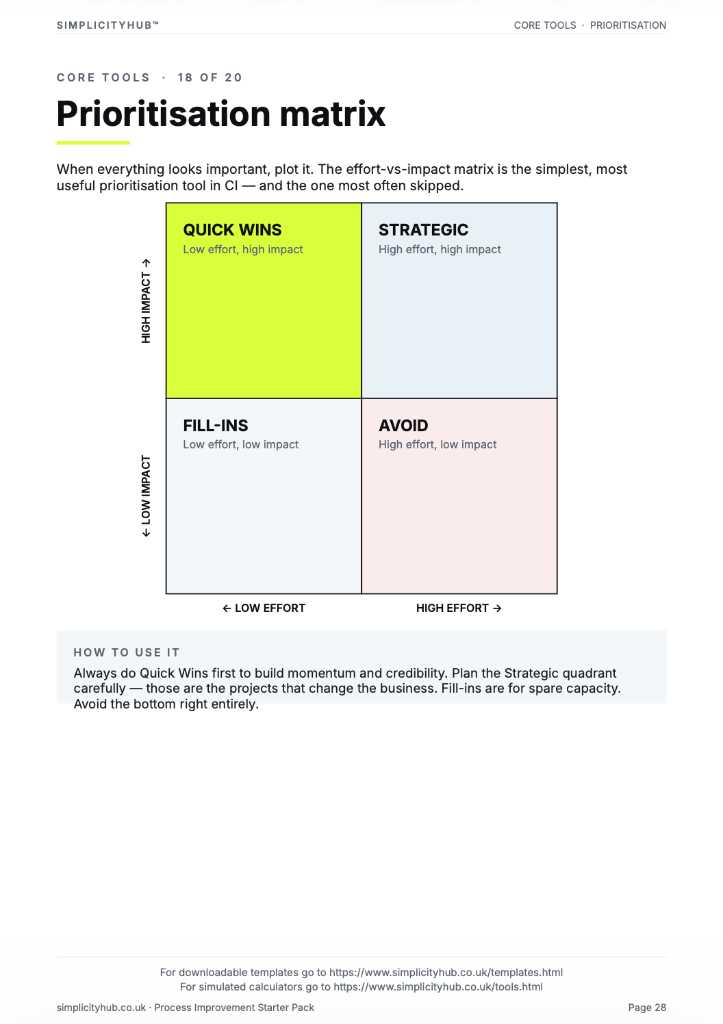
A starter pack for identifying improvement opportunities, measuring baselines and planning action.
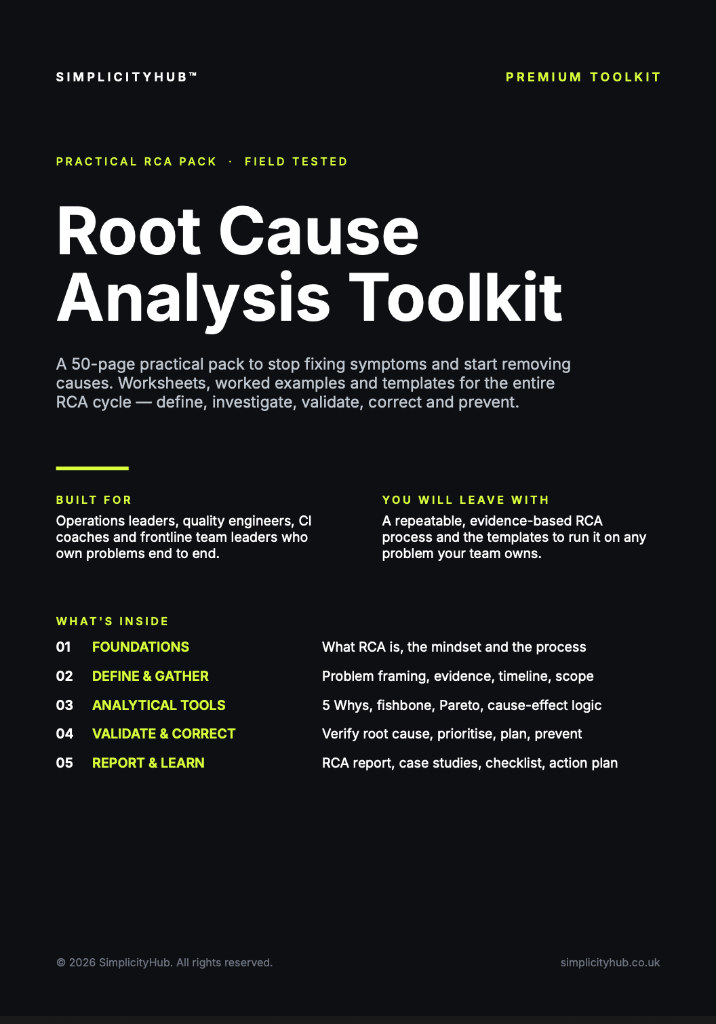
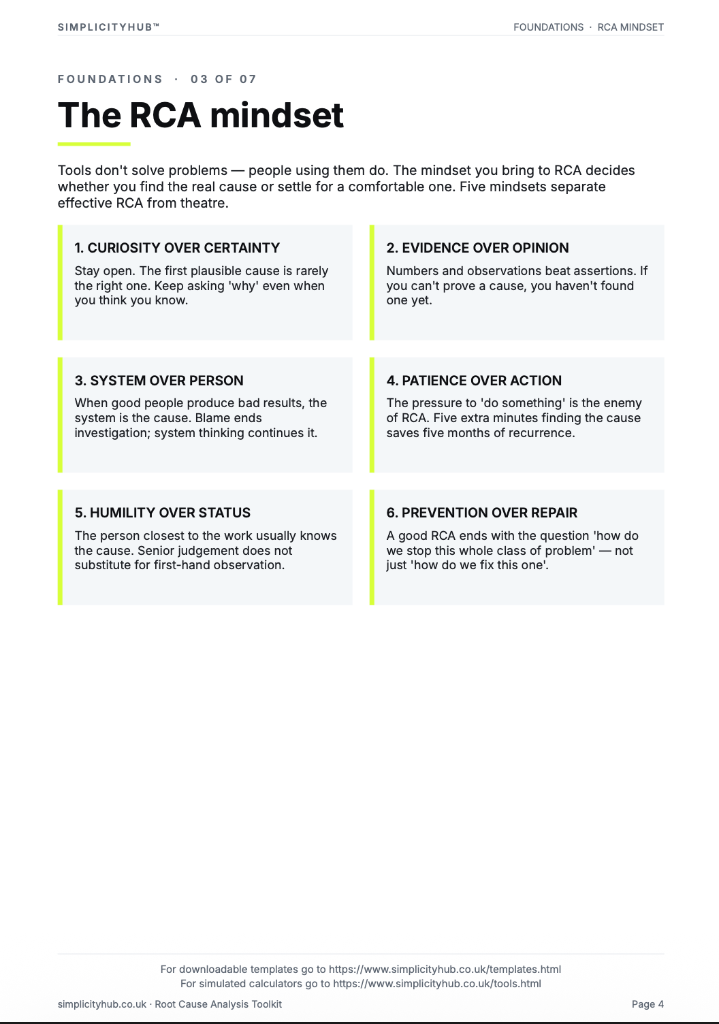
Root Cause Analysis Toolkit
A practical RCA toolkit for defining problems, finding causes, validating evidence and creating action.
A3 Template Pack
A clean A3 problem-solving pack for concise, visual improvement thinking and follow-through.