
What is a RCA Worksheet Template?
An RCA (Root Cause Analysis) worksheet is a single, structured document that captures the complete root cause investigation for a problem — from the initial problem statement through the cause analysis, evidence gathered and confirmed root causes to the recommended corrective actions.
It provides a complete, auditable record of the investigation in one place — suitable for sharing with a sponsor, a customer or a regulatory body. It is especially useful for problem-solving outside a formal DMAIC project, where a lightweight but rigorous approach is needed.
RCA worksheets are typically used in the Analyse phase of DMAIC but are equally valuable for standalone operational problem solving without a full project structure.
When to use a RCA Worksheet Template
Use an RCA worksheet when you need to document a structured root cause investigation in a single, shareable format. Use it when:
- A specific incident or quality failure needs to be formally investigated and documented
- A customer or regulator requires a written root cause analysis and corrective action response
- You want a lighter-weight alternative to a full FMEA or fishbone session
- An issue has been escalated and the sponsor needs a written investigation summary
Who should use a RCA Worksheet Template
- All belt levels — the RCA worksheet is accessible at Yellow Belt level and above
- Quality and Operations Teams — for documenting CAPA investigations and customer complaint responses
- Green Belts and Black Belts — when a focused root cause investigation is needed within a larger project
- Team Leaders and Supervisors — for operational problem-solving that requires a documented investigation record
Watch: a quick explainer
New to this? This short video walks you through running a structured root cause analysis — a helpful primer before you download and use the template.

How to complete the RCA Worksheet
Complete the worksheet in sequence — do not skip sections. The discipline of working through each section in order prevents the common failure of jumping to solutions before understanding the cause.
How to complete the RCA Worksheet — step by step
-
1Describe the problem clearly
Write a factual problem statement: what happened, where, when, how many times and the impact. Use data. Avoid causes and solutions at this stage.
-
2Confirm the problem with evidence
What evidence confirms this is a real problem and not a one-off? Data, customer complaint records, photos, system logs. Attach evidence to the worksheet.
-
3Identify all possible causes
Use 5 Whys, Fishbone or brainstorming to generate all plausible causes. List them all without filtering. This section should be comprehensive.
-
4Narrow to the most likely causes
From the full list, identify the two to four causes most likely to be contributing to the problem based on available evidence. Explain the reasoning for each selection.
-
5Test and confirm root causes
Collect targeted data or conduct observations to confirm each probable cause. Document the evidence for and against each cause. Confirm the root cause — the deepest cause where a corrective action will prevent recurrence.
-
6Define the corrective actions
For each confirmed root cause, write a specific corrective action: what will be done, by whom, by when. Actions should address the root cause — not just the symptom.
-
7Define the verification method
How will you confirm the corrective actions have been effective? What will be measured, when and by whom? Include a review date.
Worked example — Invoice Error Root Cause Analysis
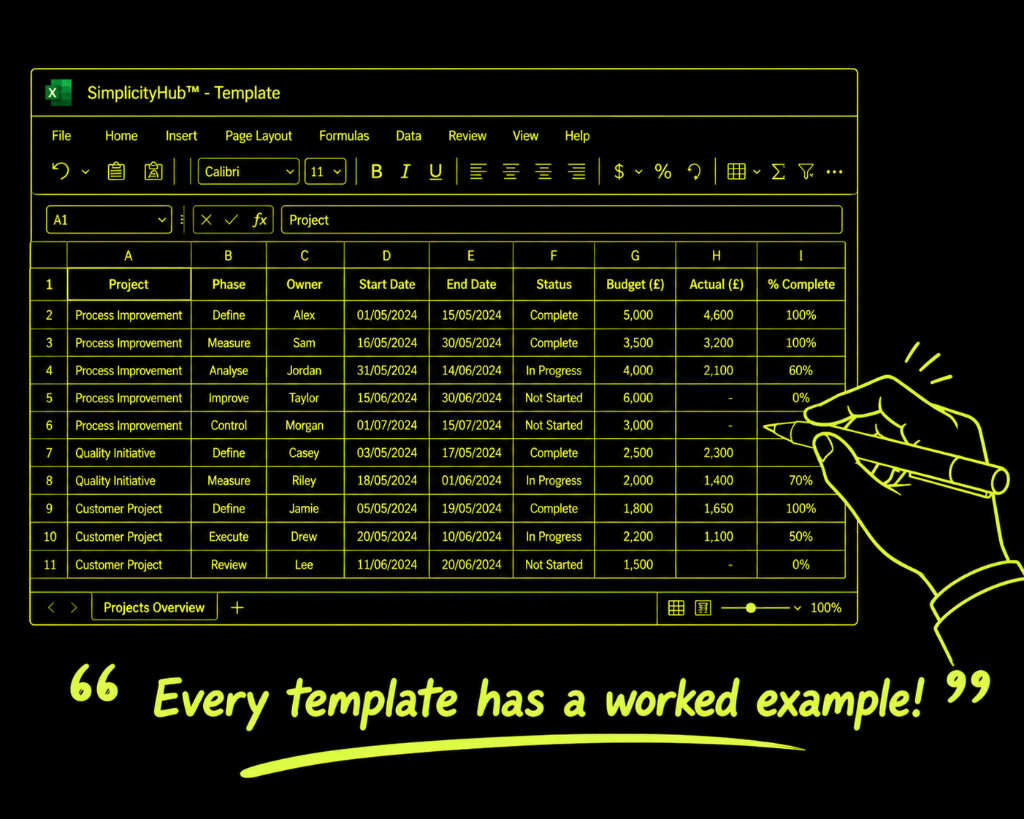
A completed RCA worksheet for an invoice error investigation, tracing from a 12% error rate through cause analysis to a confirmed root cause of manual data re-entry between two systems with no validation check.
Common mistakes — and how to avoid them
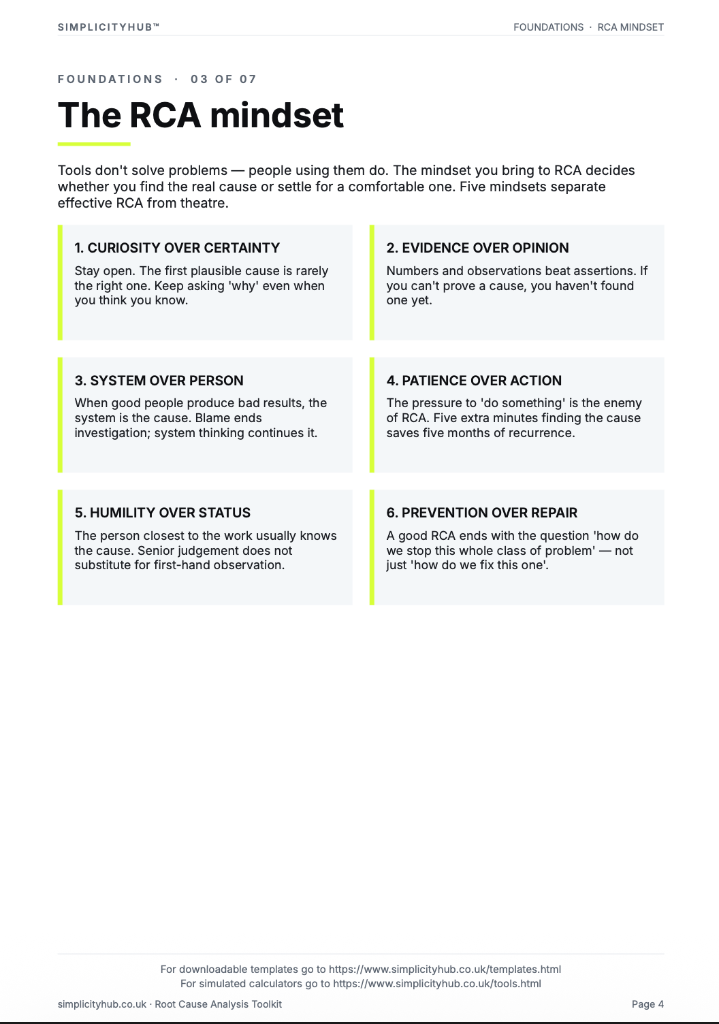
Writing the root cause as a person rather than a system. 'The operator made an error' is not a root cause — it is a description of what happened. The root cause is the system, process or design that allowed or caused the error to occur.
Stopping at the first cause. The first 'why' is almost never the root cause. Keep asking why until you reach a systemic failure — a missing control, a design flaw, an absent standard — that, if fixed, prevents recurrence.
Corrective actions that address symptoms. Retraining an operator is not a root cause fix — it is treating the symptom. If the process design allowed the error, fix the process design. Corrective actions that address root causes prevent recurrence; those that address symptoms allow it.
No verification plan. A corrective action without a verification plan cannot be confirmed as effective. Define specifically how and when you will check that the action has worked.
Tips for getting better results
Use the worksheet for customer complaint responses. A completed RCA worksheet is an ideal format for a formal customer response to a quality complaint — it shows structured investigation, confirmed cause and specific corrective action with a timeline.
Keep it to one page where possible. A one-page RCA worksheet that tells the complete story concisely is more useful than a multi-page report that buries the key findings in detail. Discipline in brevity improves clarity.
Build a library of completed RCA worksheets. Over time, a library of completed RCAs reveals patterns — the same root causes recurring across different problems or areas. These patterns are where systemic improvement focus should go.
Download the RCA Worksheet Template
A clean, editable Excel template for immediate use — structured, professional and ready to fill in.
Frequently asked questions
What is root cause analysis?
A structured approach to identifying the underlying cause of a problem rather than addressing symptoms.
Which RCA method should I use?
Five Whys for simpler problems. Fishbone for complex multi-dimensional problems.
How do I know I have found the root cause?
If fixing it means the problem definitely will not recur, and the fix is within our control, you are likely there.
Can there be multiple root causes?
Yes. Many real problems have two or three. Identify and address all of them.
Advanced Toolkit Packs — available now
Structured, ready-to-use template packs designed for real improvement work. Pick the pack that matches your project and get started straight away.
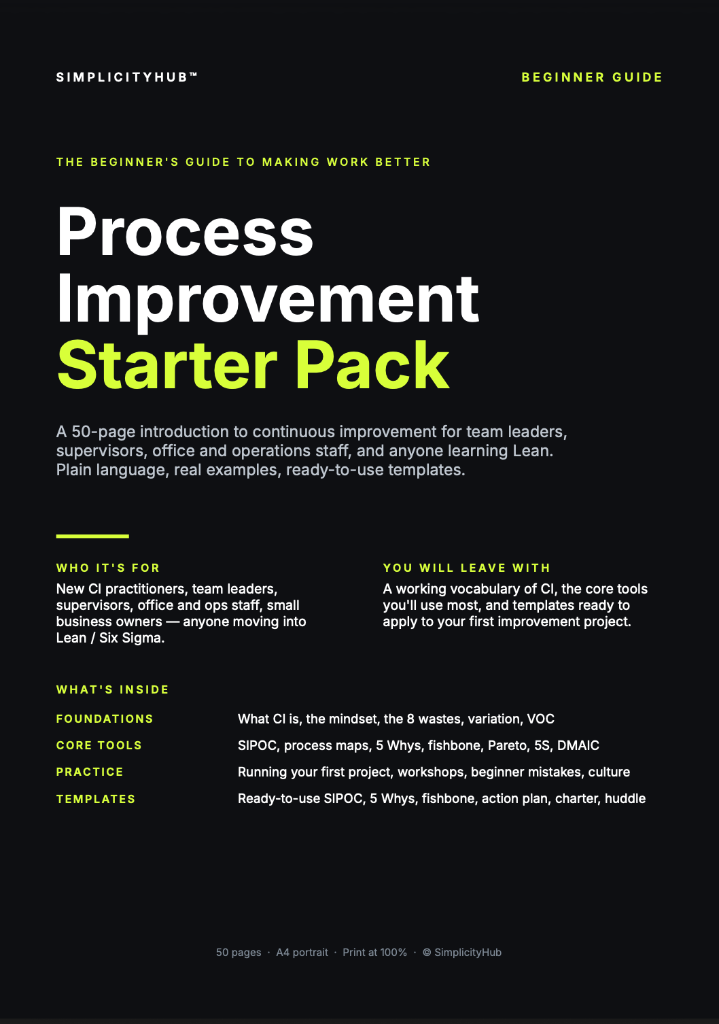
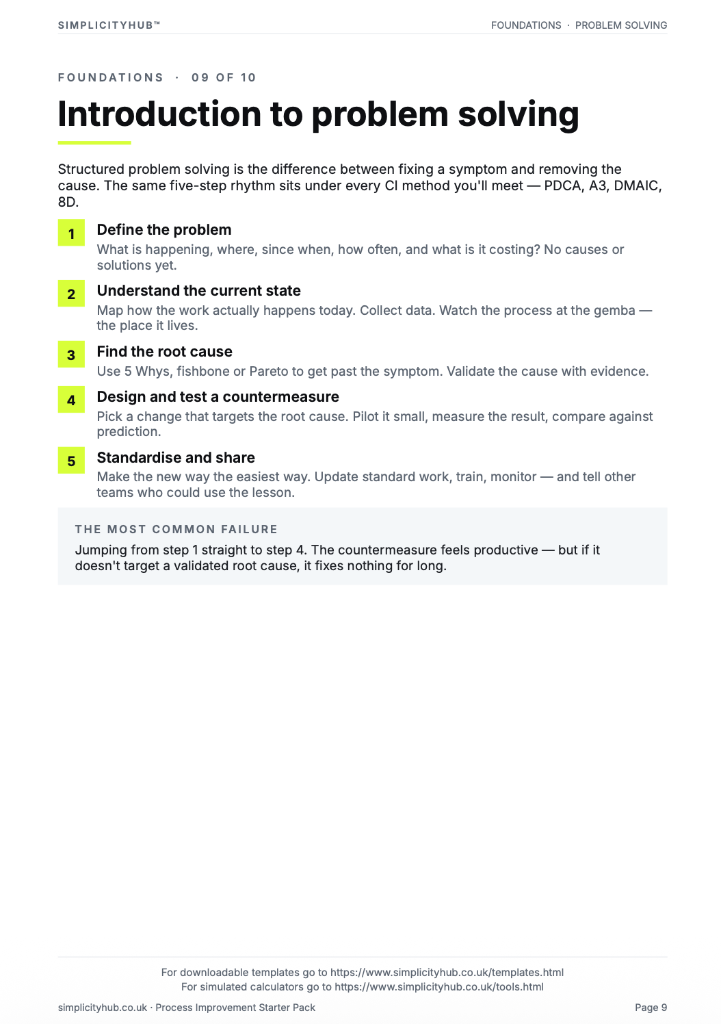
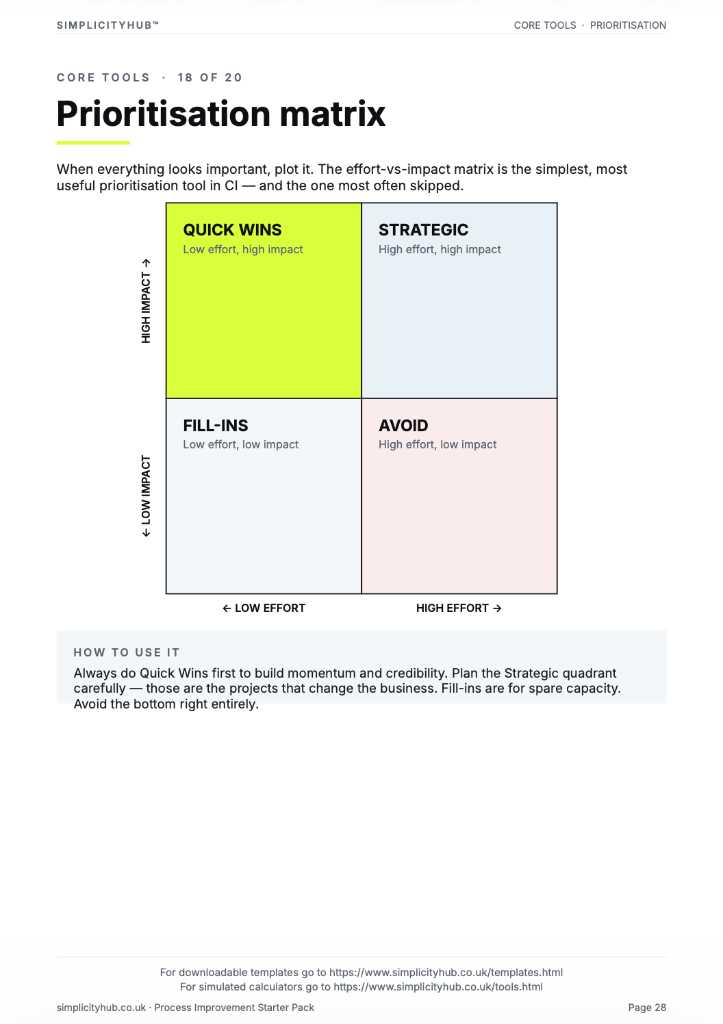
Process Improvement Starter Pack
A starter pack for identifying improvement opportunities, measuring baselines and planning action.

Root Cause Analysis Toolkit
A practical RCA toolkit for defining problems, finding causes, validating evidence and creating action.
A3 Template Pack
A clean A3 problem-solving pack for concise, visual improvement thinking and follow-through.