A process that works well in a hospital does not look the same as a process that works well in a factory, a bank, a warehouse or a school. The improvement principles are shared. The problems, the pressures, the risks and the numbers are not.
That is why we built the SimplicityHub Industry Hub: a starting point for anyone who wants to use Lean Six Sigma and DMAIC in the environment they actually work in, rather than translating a manufacturing example into their own world and hoping the meaning survives the trip.
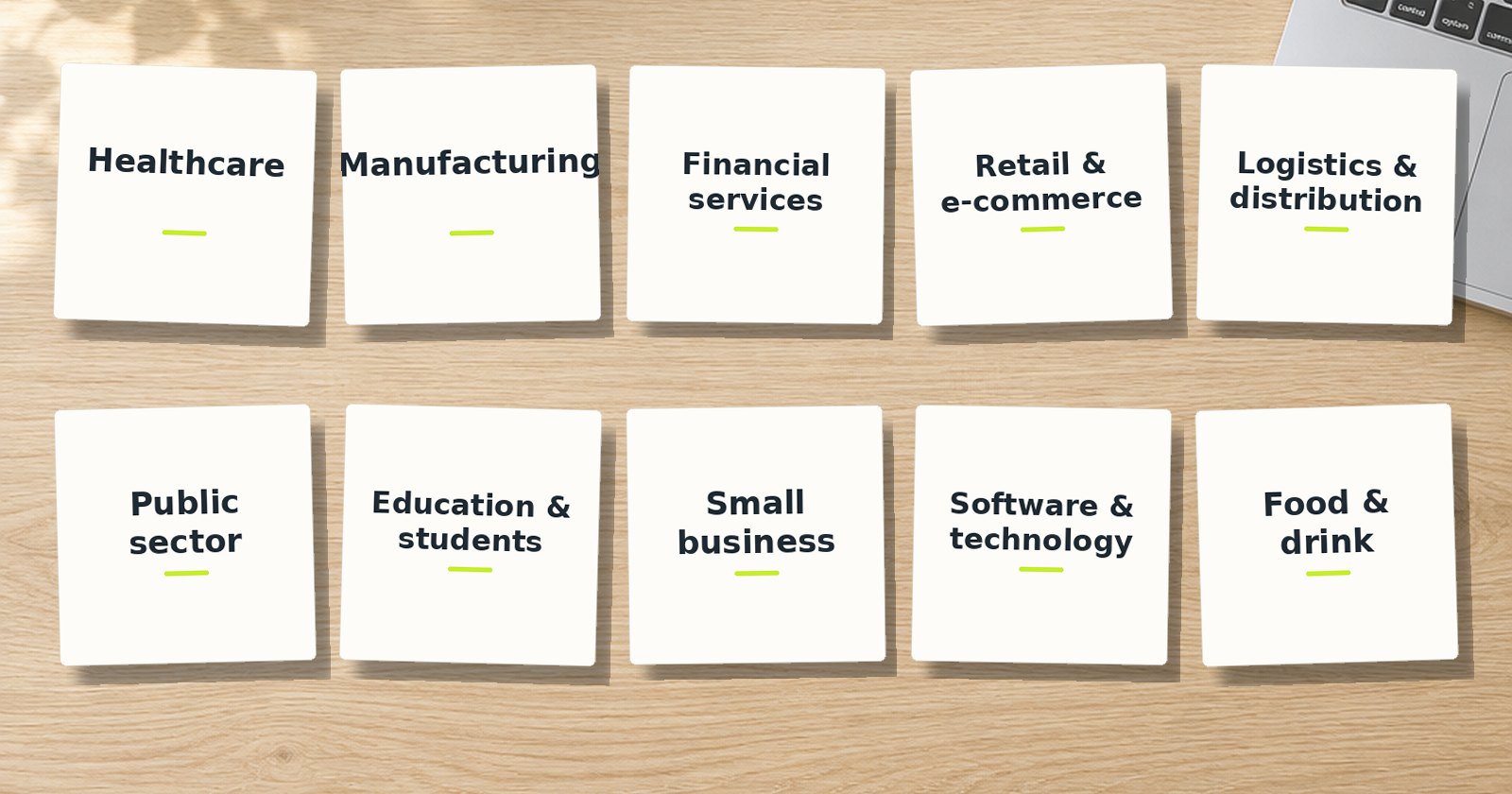
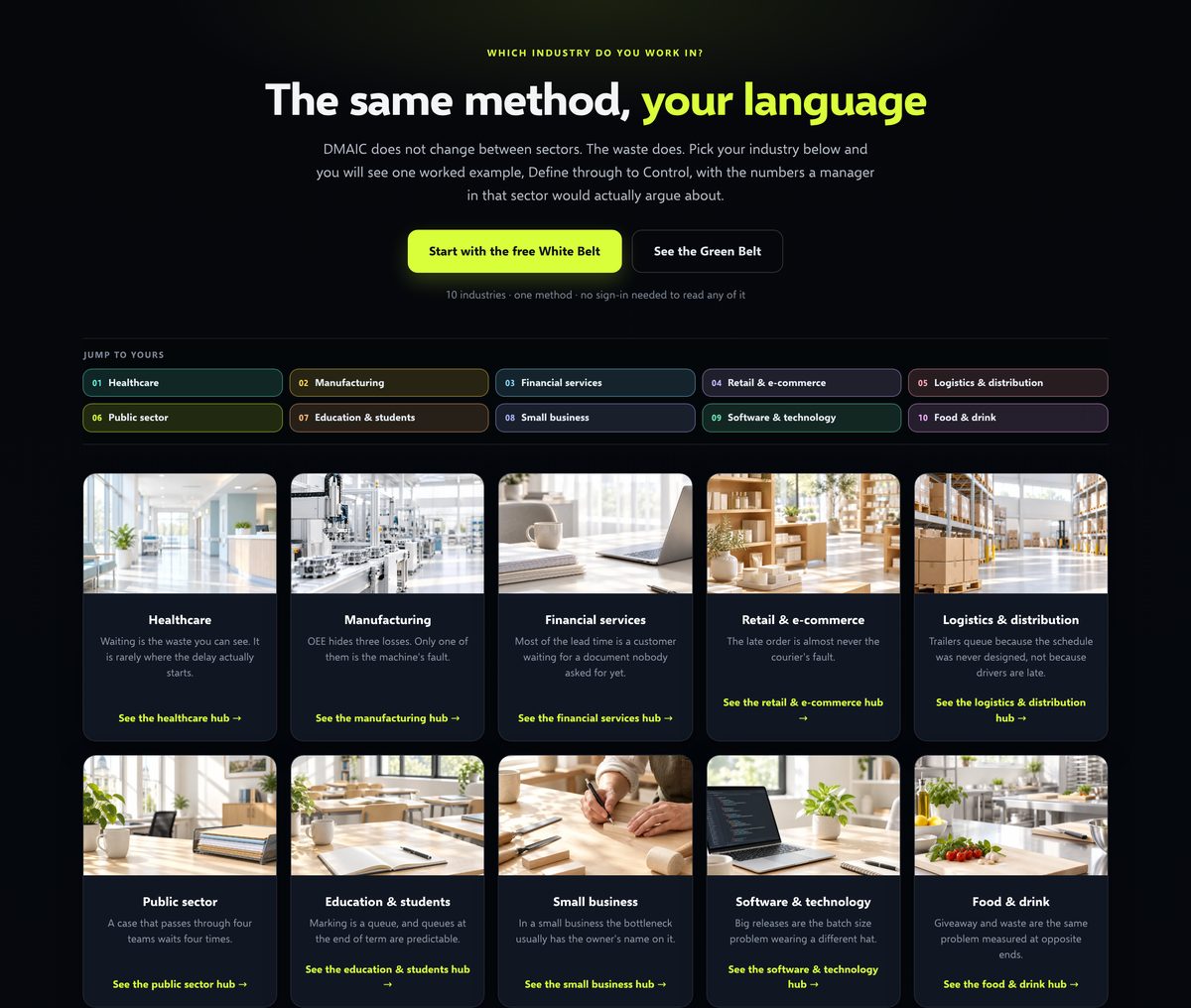
The hub covers ten industries. Each one carries a worked example that runs from Define through to Control, with the numbers a manager in that sector would actually argue about, the measures that move, and a link to the tools that fit the problem. The examples start with the work, not the tool: a patient pathway, a production line, a mortgage application, an online order, a delivery dock, a public service case, an assignment, a small business quote, a software release, a food preparation shift.
What each industry page actually contains
Every industry section follows the same shape, so you can compare sectors without relearning the layout. There is a one-line hook for the sector, a worked DMAIC example with real operating detail, the measures that move, and links to the templates and calculators that suit that problem.
| Industry | What the worked example looks at |
|---|---|
| Healthcare | Patient pathways, waiting times, bed flow, handovers and safe discharge. |
| Manufacturing | OEE, scrap, changeovers, first pass yield and production reliability. |
| Financial services | Application lead time, document rework, underwriting queues and complaints. |
| Retail and e-commerce | Order fulfilment, stock accuracy, late dispatch, returns and picking. |
| Logistics and distribution | Trailer turnaround, dock utilisation, dwell time and on-time delivery. |
| Public sector | Case backlogs, service response times, handoffs and incomplete requests. |
| Education and students | Marking turnaround, moderation queues, feedback and student experience. |
| Small business | Enquiry response, quote turnaround, conversion and owner-dependent bottlenecks. |
| Software and technology | Release lead time, deployment frequency, change failure and escaped defects. |
| Food and drink | Food cost, waste, portion variation, preparation and service time. |
One method, ten different operating environments
DMAIC does not need to be reinvented for every sector. The five phases stay where they are. What changes is the process being improved, the people affected, the constraints that have to be respected, and the numbers that tell you whether the process is genuinely getting better.
In a warehouse, the constraint might be dock capacity. In a clinic, it might be a handover between two teams. In a small business, it is often the owner's diary. The method is identical. The conversation you have with the team is not.
Why healthcare is a useful place to start
A generic improvement article will tell a team to reduce waiting time and then stop. A useful healthcare example has to go further. Which part of the patient pathway is being measured? Where does the delay build up? What does the data show? How do you improve the process without compromising patient safety or clinical judgement?
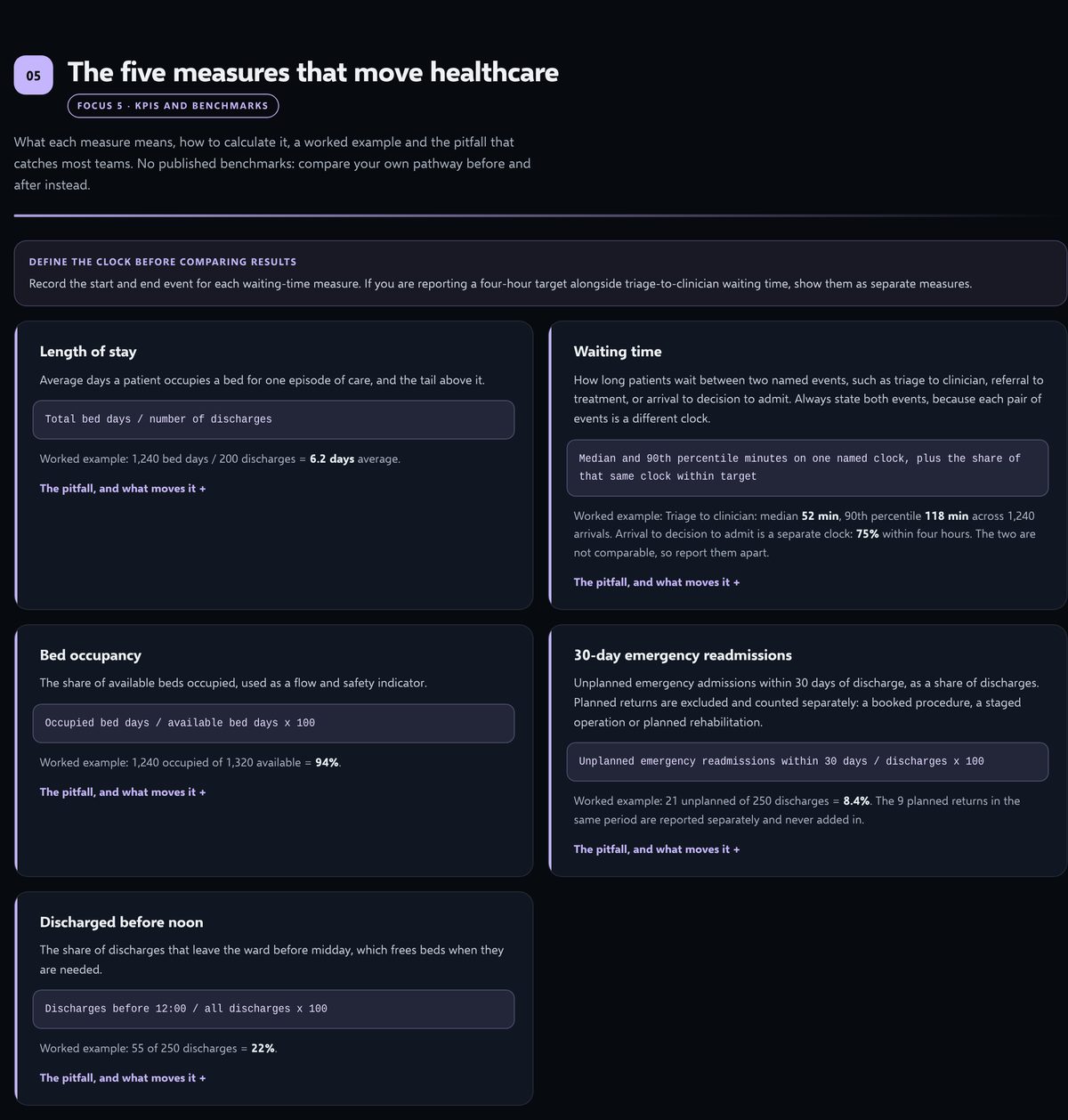
The healthcare hub works through patient flow, emergency department waits, bed allocation, discharge, outpatient pathways and shift handovers. The worked example is an emergency department that breaches its four-hour target on 40% of weekday afternoons, scoped to the adult walk-in pathway from triage to decision to admit. The hospital in the example is made up. The method is not.
Define: make the problem specific
"The department is too slow" is not a project definition. A pathway, a population, a time period and a measurable gap give a team something it can actually investigate. In the example, that means the adult walk-in pathway, ninety days, and the specific point where the four-hour clock is being lost.
Measure: understand the real patient journey
The example uses timestamp data across 90 days and 1,240 arrivals, including median and 90th percentile triage-to-clinician waits. Looking at the typical wait and the long tail together stops you hiding the experience of the patients who wait far longer than average. It also stops you improving the average while making the worst cases worse.
Analyse: find where the delay is concentrated
A Pareto analysis shows that 68% of the delay sits in two steps: the triage queue and the bed-allocation handover between teams. That changes the conversation from "people need to work faster" to "which parts of the system are creating the queue in the first place".
Improve: test the change before you scale it
The example considers a fast-track stream for suitable minor injuries and standard work for bed allocation, piloted across six shifts before anything is rolled out more widely. The emphasis is on testing, learning, and checking the change is appropriate for the service, not on imposing a new target and hoping.
Control: make the gain visible and sustainable
Control is where most improvement work quietly dies. The example uses a daily huddle, a control chart and a written reaction plan, so it is clear who reviews the measure, how often, and what the team does when performance moves outside the expected pattern.
Illustrative example, not a client result. The numbers in the healthcare example were written to show how the method works. They are not an NHS result and should not be quoted as one.
Five healthcare measures that help teams understand performance
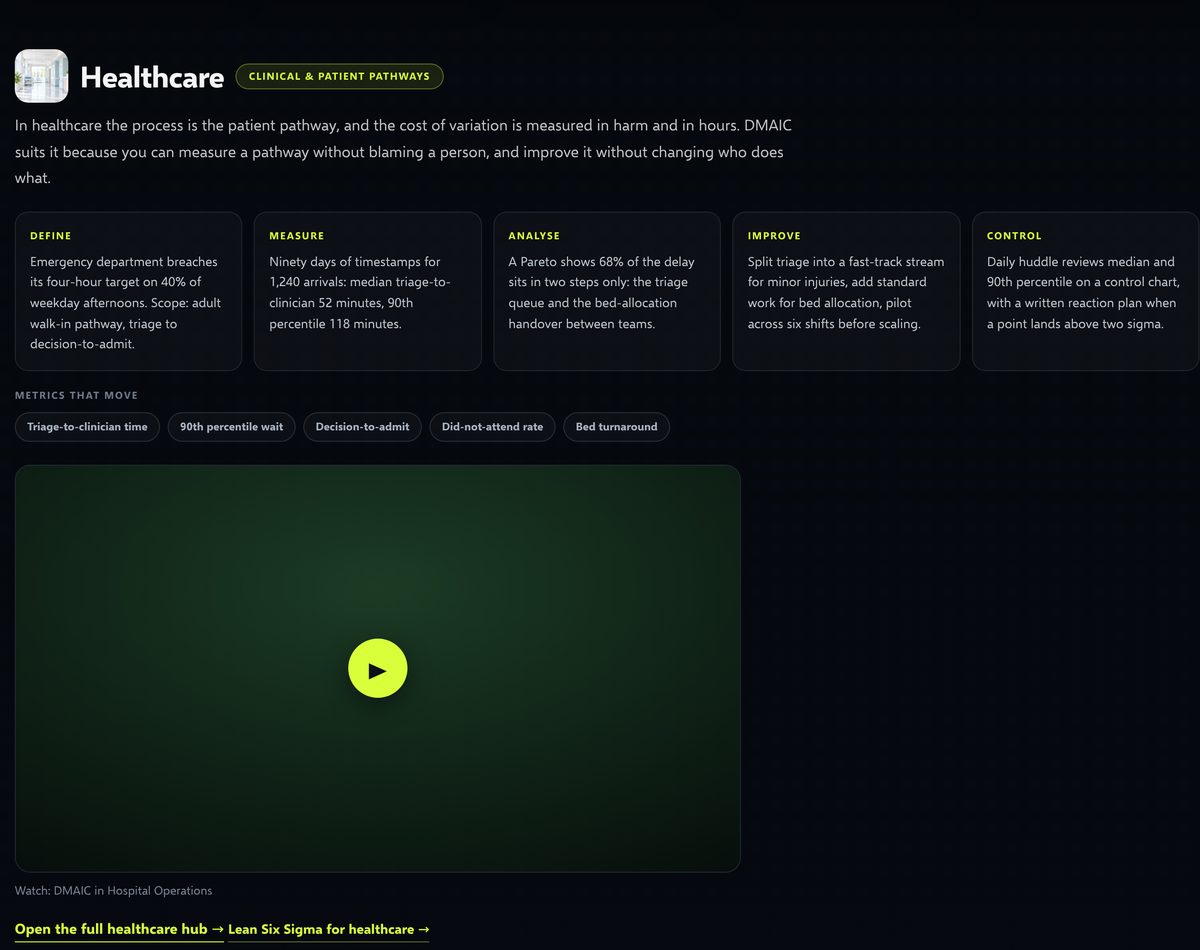
The healthcare hub explains five measures in plain language, including how to calculate each one and the pitfalls to watch for:
- Length of stay. Average bed days per discharge, read alongside variation and the complexity of the patient group.
- Waiting time. Measured between clearly defined events, with median and 90th percentile waits, because a single clock hides where the wait actually builds.
- Bed occupancy. A flow and capacity indicator that only means something when it sits next to safety and operational context.
- 30-day emergency readmissions. Unplanned emergency returns, with planned returns reported separately so the number means what people think it means.
- Discharged before noon. A flow measure that must never be pursued at the expense of a safe, appropriate discharge.
The important point is not to chase a number in isolation. Measures need clear definitions, consistent data and balancing measures, so that improving one part of a service does not quietly create a problem somewhere else.
Practical guidance for people who are not improvement specialists
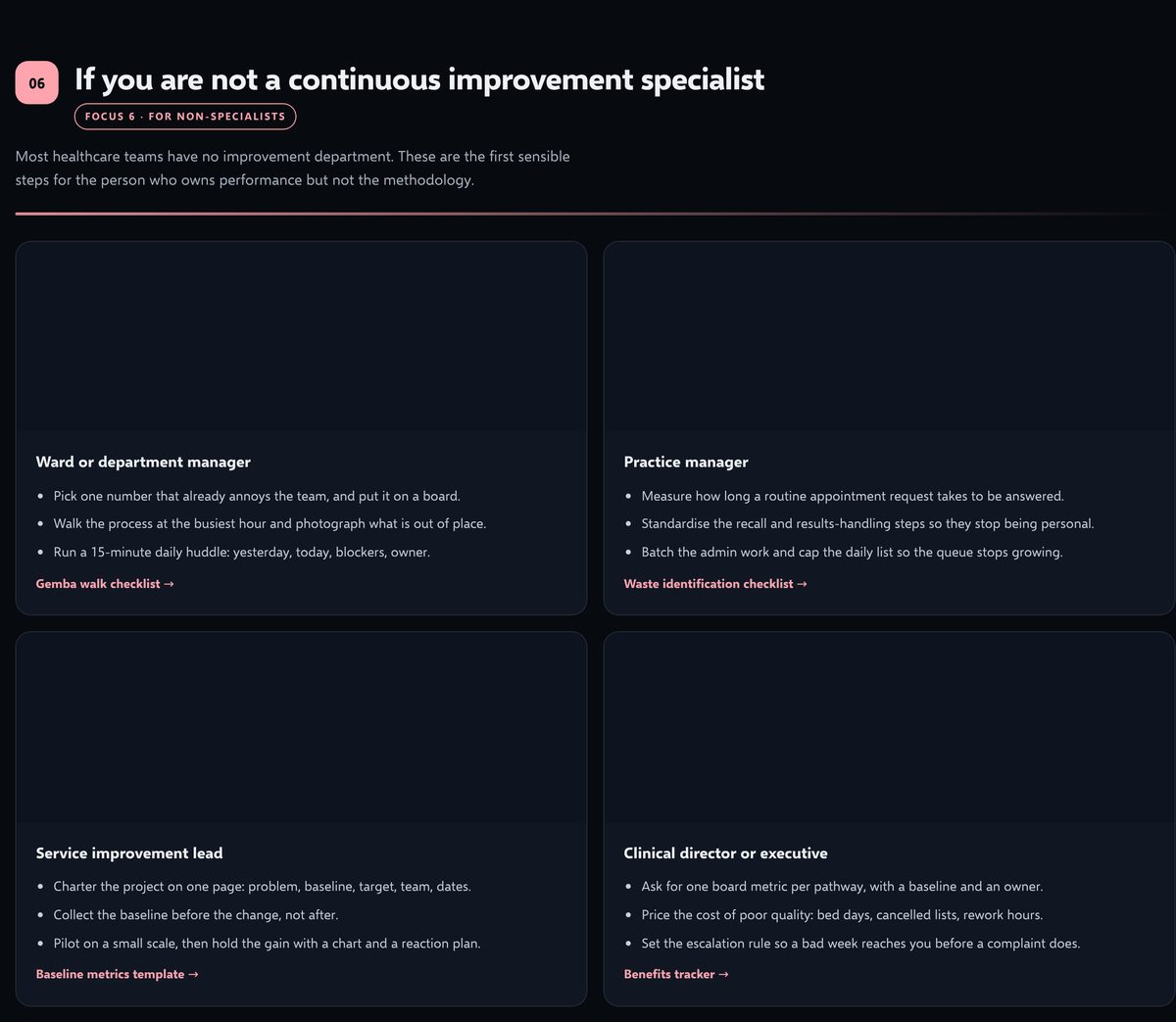
Not every team has a continuous improvement department, and most improvement starts with someone who already has a full day job. The healthcare hub gives each role a different starting point. A ward or department manager is encouraged to pick one visible problem, walk the process and run a short daily huddle. A practice manager can look at appointment requests, recall and results handling. A service improvement lead defines the project, builds a baseline and pilots a change. A clinical director or executive connects pathway measures to accountability, quality and the cost of poor quality.
That role-based approach matters. Improvement should be accessible to the people closest to the work while staying properly governed and supported. Those two things are not in conflict, and treating them as if they are is how good ideas stall.
Where AI can help, and where it stops
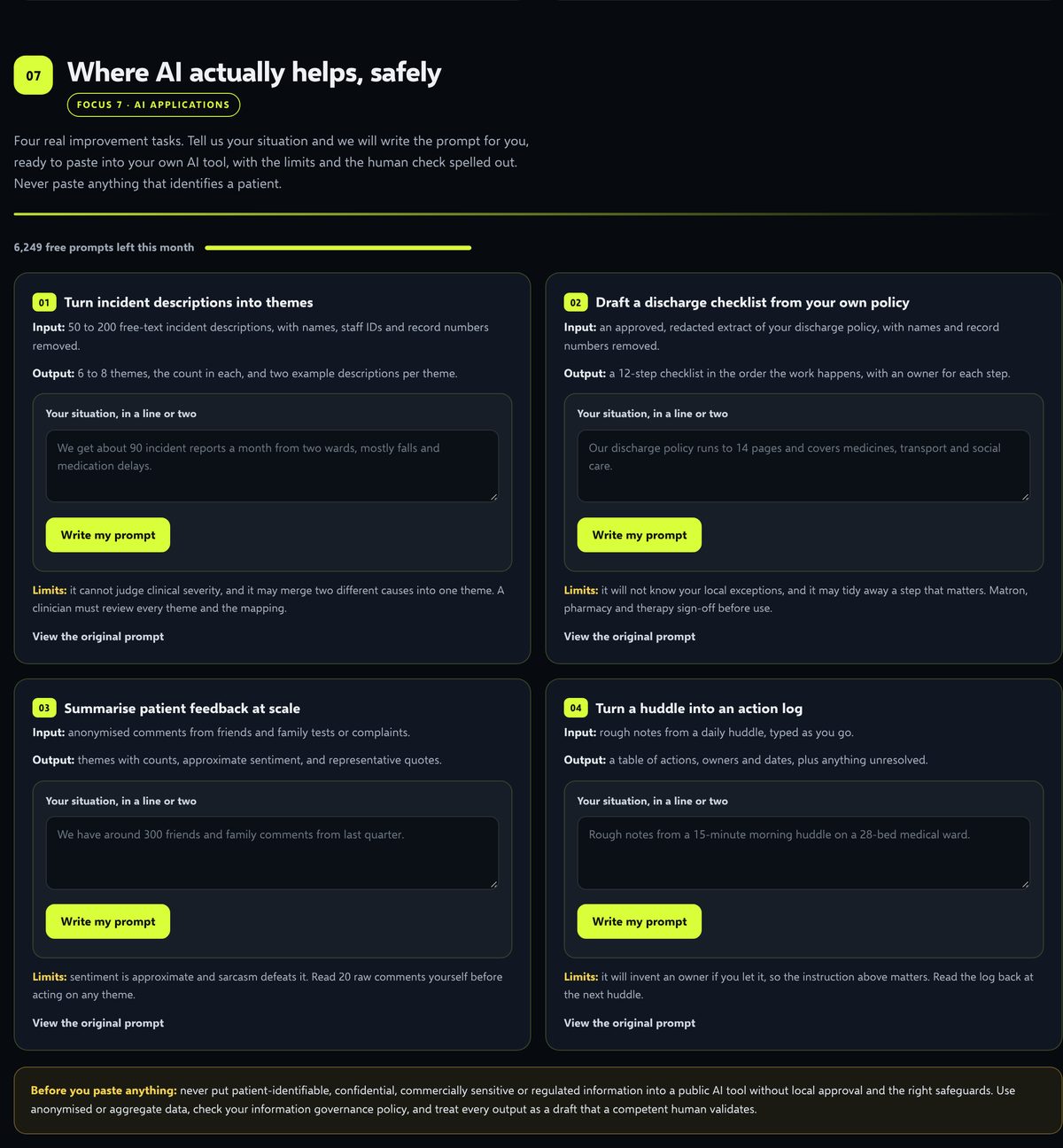
The healthcare page includes four practical AI prompt applications, each built around a defined task rather than a vague promise about artificial intelligence: turning anonymised incident descriptions into themes for human review, drafting a discharge checklist from an approved policy extract, summarising anonymised patient or family feedback into themes and counts, and turning rough huddle notes into an action log with owners and dates for the team to check.
Each application states the input it needs, the output to expect, the limitations, and how a person validates the result. The same rule sits over all of them: do not put patient-identifiable, confidential, commercially sensitive or regulated information into a public AI tool without the right approval and safeguards. AI output is a draft for competent human review. It does not replace clinical judgement, local policy or information governance.
There is also a short DMAIC in practice video on the page, which walks the method through hospital operations rather than describing it on a page. It is the same order of work: problem, baseline, analysis, intervention, results and controls.
The other nine industries: the same discipline, different problems
Healthcare is one way to see the approach. The other nine examples show how the same discipline lands in very different operating environments.
- Manufacturing. A production line with low OEE and recurring scrap. The example separates availability, performance and quality, then looks at changeover losses, tooling and standard work.
- Financial services. A mortgage application taking longer than its service commitment. The example examines document waiting, rework, handoffs and the sequence of underwriting work, while keeping the regulatory controls that have to stay.
- Retail and e-commerce. Late online orders and returns. The example follows order, pick, pack and dispatch data to show how stock location problems make orders miss a cut-off.
- Logistics and distribution. Long trailer turnaround at a distribution centre. The example uses gate and dock timestamps, arrival patterns, dock availability and booked slots.
- Public sector. Resident enquiries taking longer than the service commitment. The example examines incomplete requests, repeat handling and case ownership.
- Education and students. Assignment feedback arriving late. The example investigates end-of-term batch marking and moderation queues, then considers staggered deadlines and shared rubrics.
- Small business. Quotes taking too long to reach customers. The example looks at supplier pricing and owner approvals as the likely bottlenecks, with changes that do not need a formal improvement programme.
- Software and technology. Releases needing hotfixes and taking too long to reach production. The example uses delivery measures to investigate batch size, automated testing and release controls.
- Food and drink. Giveaway and waste. The example measures portion variation and waste, then considers standard portion tools and preparation based on demand.
An example is only useful if you can act on it
A worked example earns its place when it helps someone take the next step. Every industry section links to the tools that fit the problem, and the wider site carries the same tools with completed examples: 80 free templates, the calculators and tools, and the Lean Six Sigma in healthcare guide for anyone who wants the method explained without the sector detail.
You can read the whole hub without signing in. Start with the industry that matches your working environment, follow the example through, then open the tool that fits the step you are stuck on. If you want the method itself rather than the sector view, the free White Belt is the shortest route in.
Start with the process you know best
You do not need to launch a transformation programme to begin. Choose one process that matters to the people who use it. Define the problem in a way that can be measured. Collect enough data to understand what is actually happening. Find where delay, rework or variation is concentrated. Test a focused change with the people who do the work. Then put a simple control in place so the improvement does not disappear the moment attention moves elsewhere.
That is the practical value of DMAIC. It gives a team a disciplined way to move from a problem they recognise to an improvement they can measure and keep.
Frequently asked questions
What is continuous improvement by industry?
It is the application of structured improvement methods to the processes, measures, risks and customer or service needs of a particular sector. The principles are shared, but the examples, the constraints and the measures should reflect the industry you are actually working in.
What is DMAIC in Lean Six Sigma?
DMAIC stands for Define, Measure, Analyse, Improve and Control. It is a structured problem solving approach: understand and scope the problem, measure what is happening now, find where the variation or delay concentrates, test a change, then control the gain so it holds.
Can Lean Six Sigma be used outside manufacturing?
Yes. It applies wherever work moves through a process, including healthcare, financial services, retail, logistics, public services, education, small businesses, software and food operations. The method stays the same. The examples and the measures have to be adapted to the context, which is exactly what the Industry Hub sets out to do.
Do I need to be a Lean Six Sigma specialist to start?
No. Start with a clearly scoped process and one measure the team already understands. The healthcare material includes role-based starting points for people who do not work in a dedicated improvement function, and the free White Belt covers enough of the method to run a first project safely.
Are the SimplicityHub industry examples real case studies?
The Industry Hub presents worked examples to demonstrate how DMAIC can be applied. They are not independently verified client results, and should not be read as such unless a page explicitly identifies and documents a real case study. Where a page uses an illustrative scenario, it says so on the page.
Can AI be used for healthcare improvement?
Yes, for defined administrative and analytical tasks such as grouping anonymised feedback or drafting an action log. It has to sit inside local information governance rules, with appropriate safeguards and competent human review. It does not replace clinical judgement, local policy or data protection obligations.
The industry examples on the hub are worked examples written to show how DMAIC is applied. They are illustrative, not independently verified client case studies, and no figure on this page should be quoted as an NHS or customer result.