What is a 8 Wastes Assessment Template?
The 8 Wastes Assessment is a structured observation framework used to identify all eight types of Lean waste in a process: Transport, Inventory, Motion, Waiting, Overproduction, Overprocessing, Defects and Skills (underutilised talent).
Originally seven wastes from the Toyota Production System (TIM WOOD), the eighth waste — underutilised skills — was added to reflect the importance of engaging people's knowledge and ideas in service and knowledge-work environments.
The assessment is used in the Analyse phase to systematically identify where waste exists before prioritising which types to target for elimination in the Improve phase.
When to use a 8 Wastes Assessment Template
Use the 8 Wastes Assessment during a Gemba walk or process observation session. Use it when:
- You want to systematically look for all types of waste rather than just the obvious ones
- A team is new to Lean thinking and needs a structured framework for spotting waste
- You are running a Kaizen event and want to surface improvement ideas quickly
- A process has significant lead time or cost but the source of waste is not immediately obvious
Who should use a 8 Wastes Assessment Template
- All belt levels — the 8 wastes framework is accessible to everyone and does not require statistical knowledge
- Lean Practitioners and CI Facilitators — to run structured waste identification sessions with operational teams
- Operations Managers — to build waste awareness in their teams through regular observation exercises
- Green Belts and Black Belts — as part of the Analyse phase toolkit alongside root cause analysis tools
Watch: a quick explainer
New to this? This short video walks you through the 8 wastes of Lean (TIMWOODS) and how to spot them — a helpful primer before you download and use the template.

How to conduct an 8 Wastes Assessment
The 8 Wastes Assessment is best done by walking the process — going to the Gemba — and observing each of the eight waste types in turn. Do not try to identify all eight simultaneously; work through one category at a time.
How to conduct an 8 Wastes Assessment — step by step
-
1Go to the Gemba
Observe the process where it actually happens — on the shop floor, in the call centre, at the desk where the work is done. Waste is rarely visible from a meeting room.
-
2Observe for Transport waste
Look for unnecessary movement of materials, information or products between steps. How many handoffs are there? How far does the item travel? Is digital data re-entered between systems?
-
3Observe for Inventory waste
Look for items waiting in queues, batches or buffers between steps. Emails waiting in an inbox, physical items in a tray, approvals pending — all are inventory. How much is waiting, and for how long?
-
4Observe for Motion waste
Look for unnecessary movement of people — walking, reaching, searching. How far does an operator walk to collect materials? How many system screens do they navigate to complete one task?
-
5Observe for Waiting waste
Look for time when nothing is happening — items sitting idle between steps, people waiting for approvals, machines waiting for materials. Waiting is the most common waste in service processes.
-
6Observe for Overproduction, Overprocessing and Defects
Overproduction: producing more than needed. Overprocessing: doing more work than the customer requires. Defects: errors that require rework or cause complaints. Record instances of each.
-
7Look for Skills waste
Are team members' knowledge, experience and improvement ideas being used? Skills waste is the waste of not involving people in improving the work they do. Look for workarounds that have never been escalated or fixed.
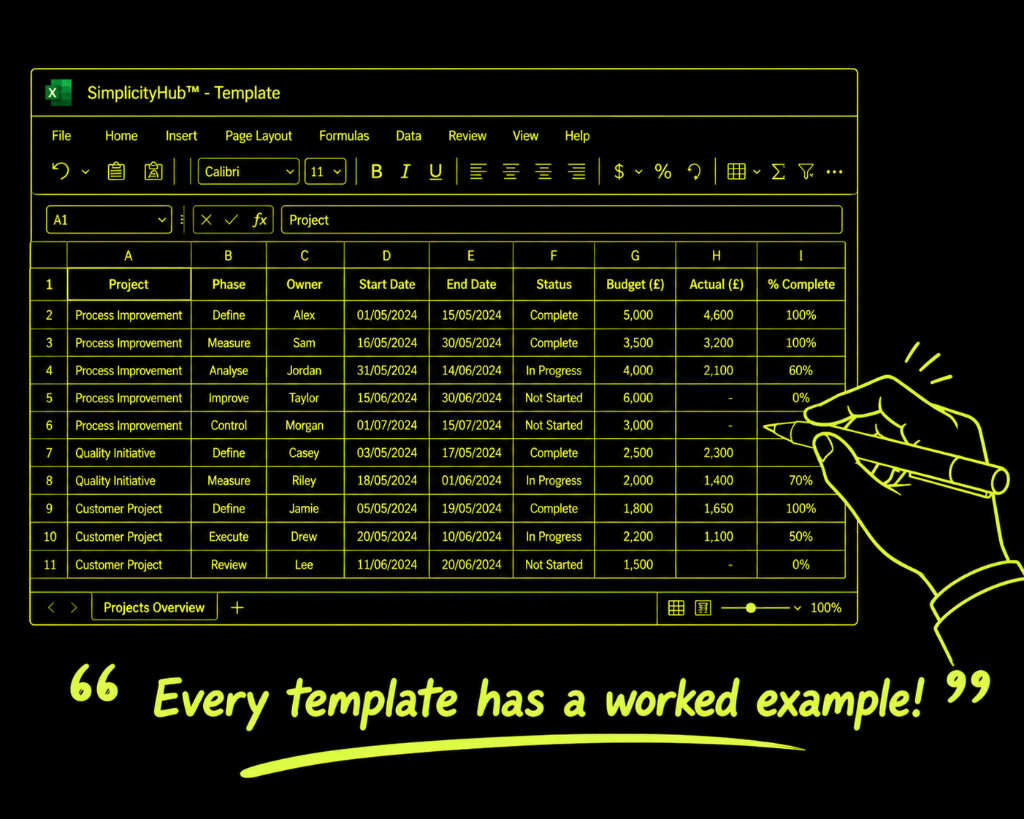
Worked example — Warehouse Process Waste Assessment
A completed 8 Wastes Assessment for a warehouse operation, with observations across all eight waste categories and the top three wastes prioritised for the Improve phase.
Common mistakes — and how to avoid them
Looking for only the obvious wastes. Defects and waiting are easy to spot. Transport, overprocessing and skills waste require more deliberate observation. Work through all eight categories systematically, not just the obvious ones.
Doing it from the office. Waste assessment requires direct observation — you cannot identify motion waste from a spreadsheet. The assessment must be done at the point where the work happens.
Only involving the CI team. The people who do the work see waste every day. Involve them in the assessment. They will spot things that an external observer misses and will be more engaged in fixing what they have helped to identify.
Not quantifying the waste. Noting that 'there is some waiting' is not enough. Quantify: '22 minutes average wait at the QC station, affecting 47 items per shift'. Numbers give the waste a financial value and help prioritise.
Tips for getting better results
Use the mnemonic TIM WOODS. Transport, Inventory, Motion, Waiting, Overproduction, Overprocessing, Defects, Skills. This is a useful memory aid for teams new to the 8 wastes.
Take photos during the observation. A photo of a pile of pending invoices, a cluttered workstation or a long travel route is worth more than written notes when presenting findings. Use photos as evidence in your project review.
Link each waste to a £ value where possible. Quantify the cost of the top three wastes. Time wasted × hourly rate. Defects × cost per error. This converts the assessment from an observation exercise into a business case for change.
Download the 8 Wastes Assessment Template
A clean, editable Excel template for immediate use — structured, professional and ready to fill in.
Frequently asked questions
What are the eight wastes?
Transport, Inventory, Motion, Waiting, Overproduction, Overprocessing, Defects, and Skills (underutilised talent). TIMWOODS.
How do I assess severity?
Score each waste on frequency and impact. Use observation data and process timing rather than estimates.
Should I involve the team?
Yes. The people who work in the process can identify wastes invisible to outside observers.
What do I do with the output?
Prioritise by the highest-scoring wastes and focus root cause analysis and solution development there.
Advanced Toolkit Packs — available now
Structured, ready-to-use template packs designed for real improvement work. Pick the pack that matches your project and get started straight away.
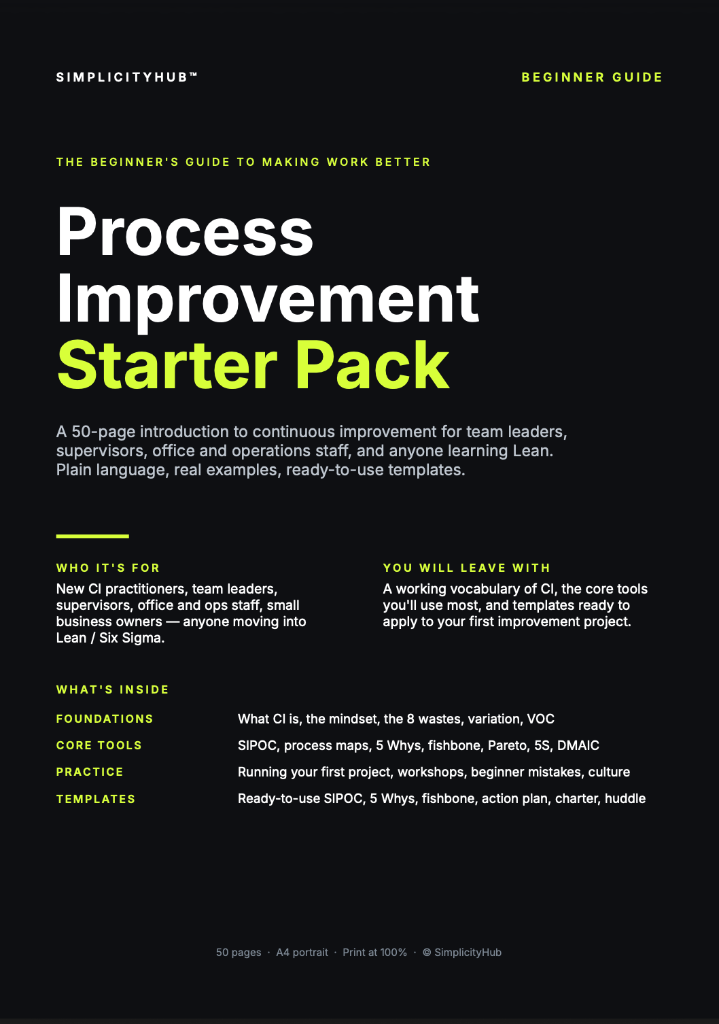
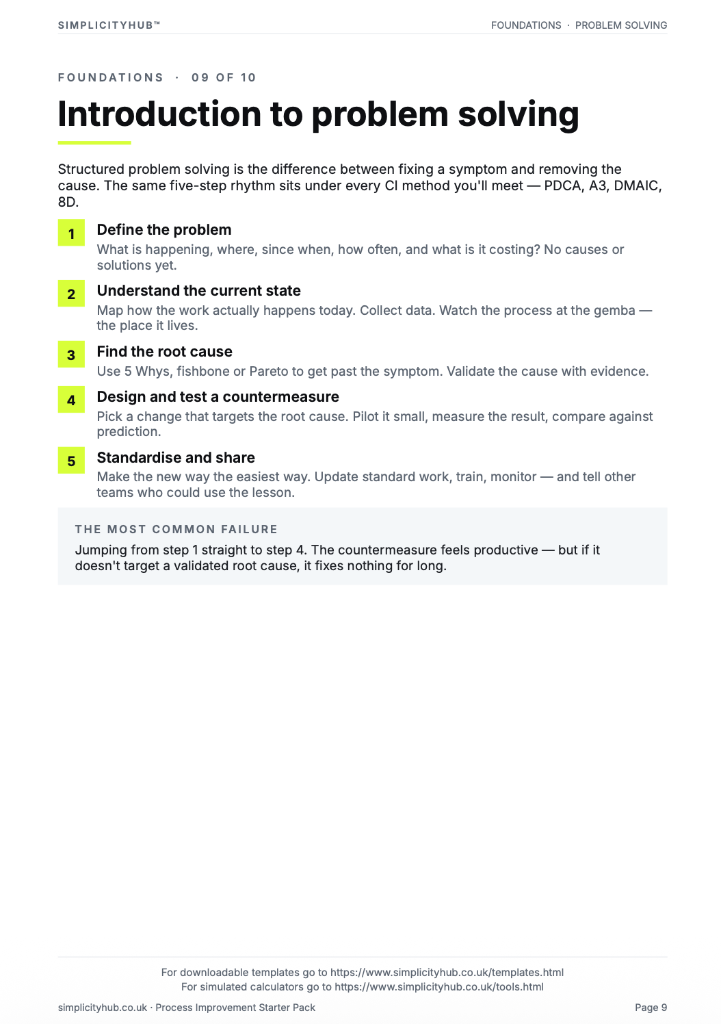
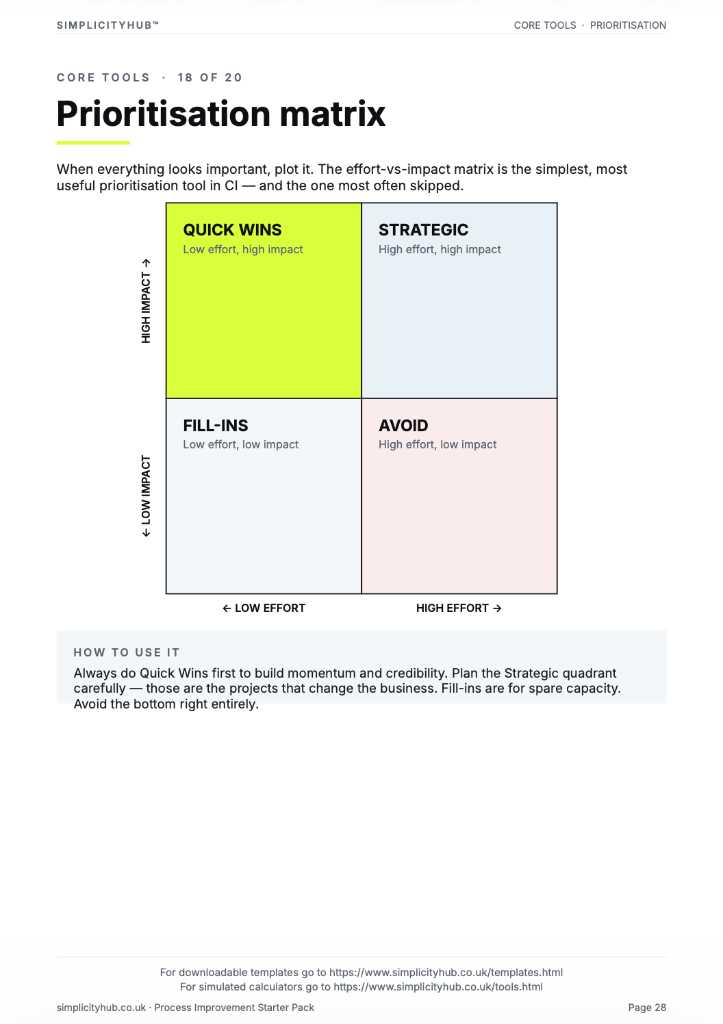
Process Improvement Starter Pack
A starter pack for identifying improvement opportunities, measuring baselines and planning action.
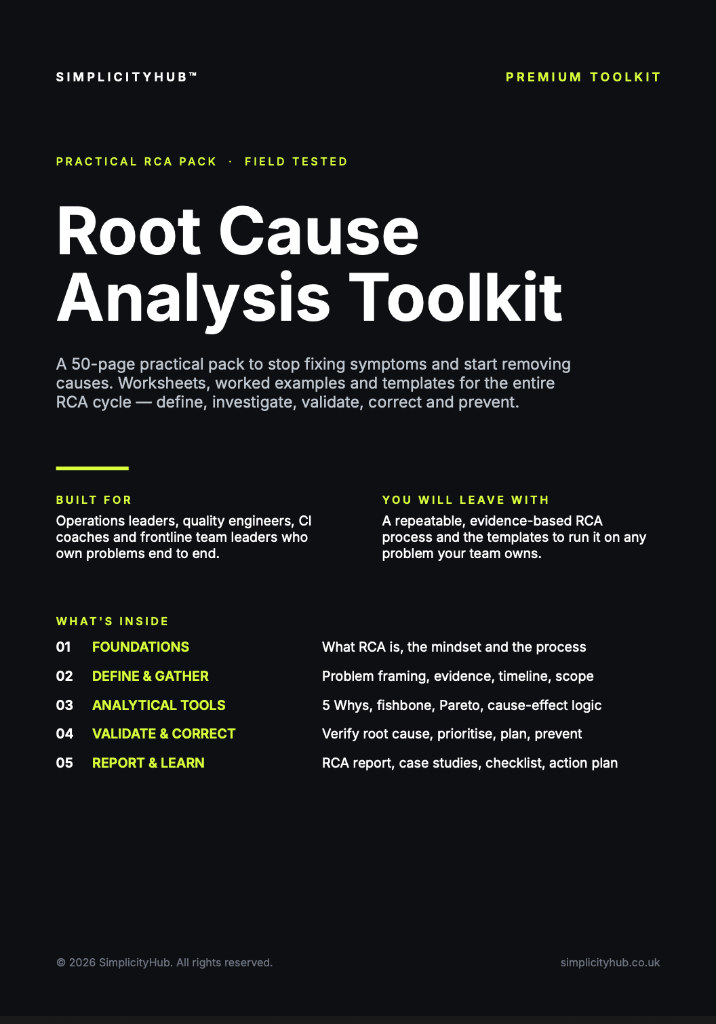
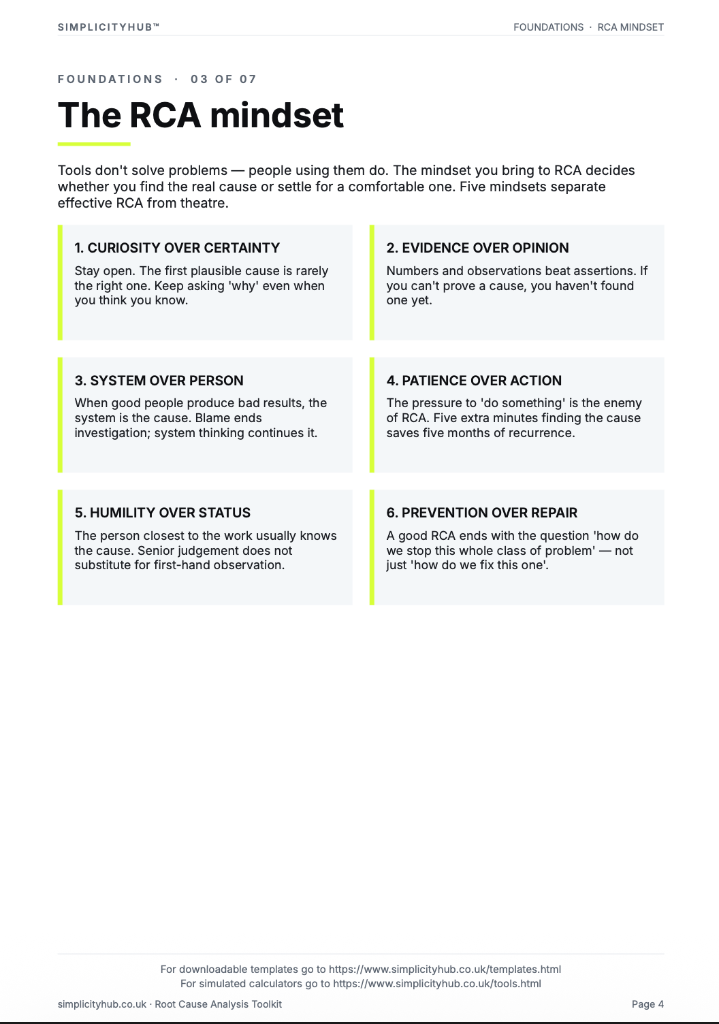
Root Cause Analysis Toolkit
A practical RCA toolkit for defining problems, finding causes, validating evidence and creating action.
A3 Template Pack
A clean A3 problem-solving pack for concise, visual improvement thinking and follow-through.