What is a Lessons Learned Log Template?
A lessons learned log captures what went well, what did not go well and what should be done differently on future projects — documented at the end of a project while the experience is still fresh.
It is both a project closure tool and a knowledge management tool. Without it, the same mistakes are repeated on every project, and hard-won insights about what works are lost when team members move on.
Used in the Control phase before formal project closure, the lessons learned log is the mechanism by which an organisation improves not just its processes but its ability to run improvement projects.
When to use a Lessons Learned Log Template
Complete the lessons learned log before closing a project. Also use it at the end of each DMAIC phase to capture learning while it is fresh. Use it when:
- A project is approaching closure and the team needs to formally capture what was learned
- A significant unexpected event (positive or negative) occurred during the project
- A technique, tool or approach worked particularly well and should be replicated
- You want to improve the organisation's project methodology based on real experience
Who should use a Lessons Learned Log Template
- Green Belts and Black Belts — as a mandatory deliverable before project closure in Control
- CI Managers — to build a programme-level knowledge base from completed projects
- Project Teams — collectively, not just the project lead, to capture diverse perspectives
- CI Coaches and MBBs — to identify systemic patterns across multiple projects
Vote yes and we’ll prioritise a quick walkthrough showing you exactly how to use it.
How to complete the Lessons Learned Log
Run a structured retrospective with the full project team — not just the project lead alone. Each team member will have different observations. The richest learning comes from comparing those different perspectives.
How to complete the Lessons Learned Log — step by step
-
1Schedule a retrospective session
Set aside 60–90 minutes with the project team before closure. This is a structured conversation, not a free-for-all. Use the Start/Stop/Continue or What Went Well/Even Better If format.
-
2Capture what went well
Ask: What should we do the same way on every project? Which tools, approaches or decisions made the biggest positive difference? Be specific — 'the stakeholder analysis workshop in week 2' is more useful than 'good planning'.
-
3Capture what to improve
Ask: What slowed us down, caused rework or nearly derailed the project? What would we do differently if starting again? Be honest — the value is in the candour.
-
4Capture what to do differently
For each 'what to improve' item, write a specific recommendation: 'Complete operational definitions before starting data collection, not during it'.
-
5Categorise the lessons
Group lessons by theme: data collection, stakeholder engagement, project scoping, tools and methods, sponsor management. Patterns across categories reveal systemic issues.
-
6Rate impact and ease of implementation
For each lesson, note: how significant is the impact if applied (High/Medium/Low) and how easy is it to implement (Simple/Moderate/Complex)?
-
7Share beyond the project team
Send the log to the CI Manager or MBB for inclusion in the programme knowledge base. A lesson that stays within one project team helps only that team.
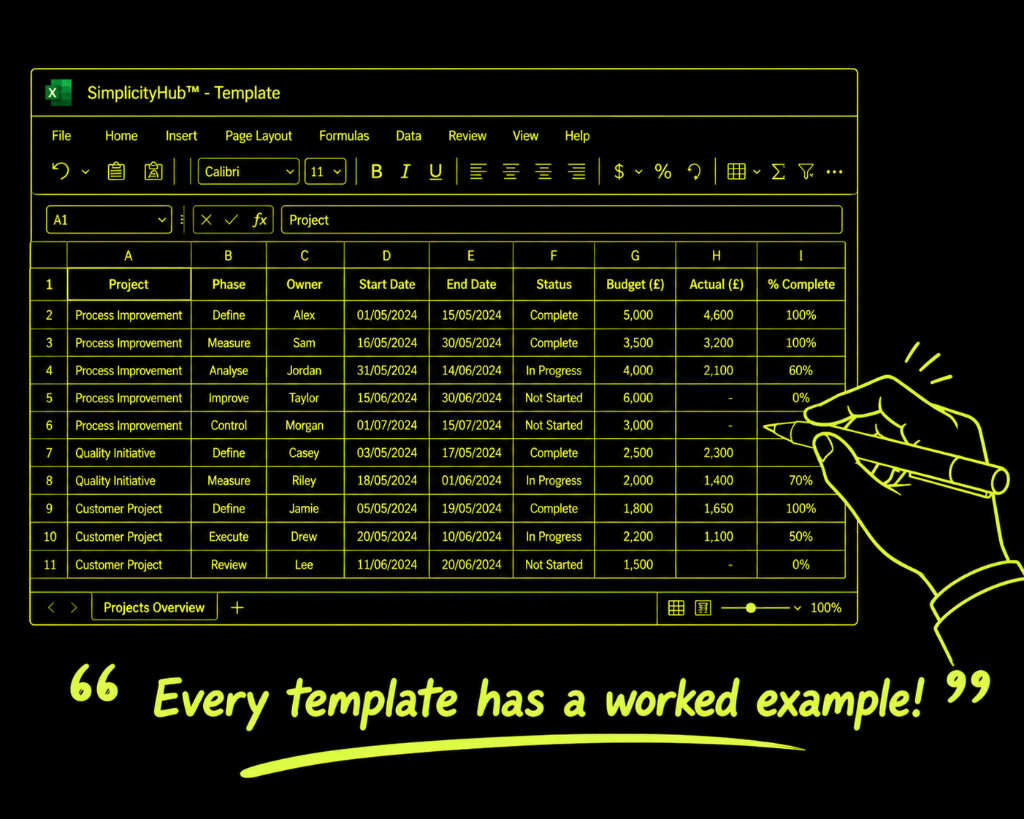
Worked example — Complaint Handling Project Retrospective
A completed lessons learned log from a 12-week DMAIC project, capturing what worked well, what to improve and specific recommendations for future projects.
Common mistakes — and how to avoid them
Only the project lead completing it. One person's perspective misses most of the learning. Run a team session — every team member experienced the project differently and has different observations to share.
Being too vague. 'Communication could be better' is not a lesson. 'The sponsor was not briefed before the all-staff email went out, causing confusion — brief the sponsor 48 hours in advance in future' is a lesson.
Filing it and never using it. A lessons learned log that is never read by anyone outside the project team is a checkbox, not a learning tool. Build a mechanism for sharing and applying lessons on future projects.
Only capturing negatives. What worked well is equally important. Replicating successes is as valuable as avoiding mistakes. Give equal time to what went right.
Tips for getting better results
Do it at each phase gate, not just at closure. Lessons captured during the project are more detailed and accurate than those recalled weeks later. A brief 15-minute reflection at each phase gate feeds the final closure log.
Use anonymous input for sensitive topics. Some team members may not raise concerns openly. Use anonymous input methods (sticky notes, survey) for sensitive topics where psychological safety may be an issue.
Connect lessons to methodology improvements. If multiple projects report the same lesson ('scope was too broad at the start'), it is a methodology problem, not a project problem. Use it to improve the standard project process.
Download the Lessons Learned Log Template
A clean, editable Excel template for immediate use — structured, professional and ready to fill in.
Frequently asked questions
When should lessons be captured?
Throughout the project, not just at the end. Capture them as they occur.
Who should contribute?
Everyone involved — team members, sponsor, process staff, and stakeholders.
How should lessons be written?
Describe what happened, why, and specifically what to do differently next time.
Where should the log be stored?
In a shared location accessible to other project leads.
Advanced Toolkit Packs — available now
Structured, ready-to-use template packs designed for real improvement work. Pick the pack that matches your project and get started straight away.
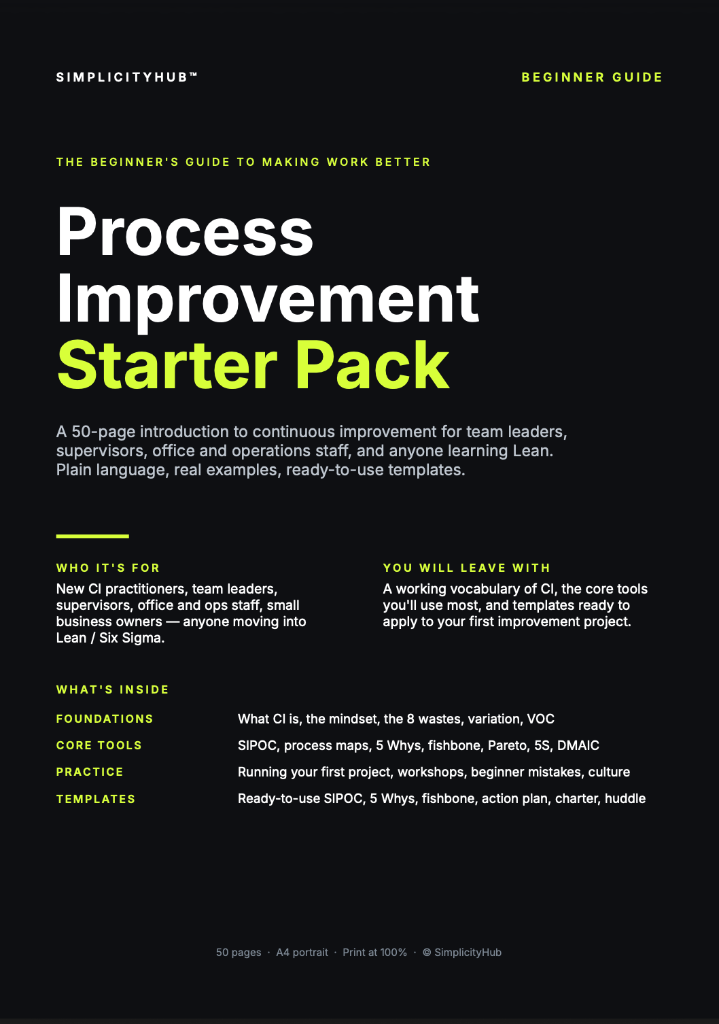
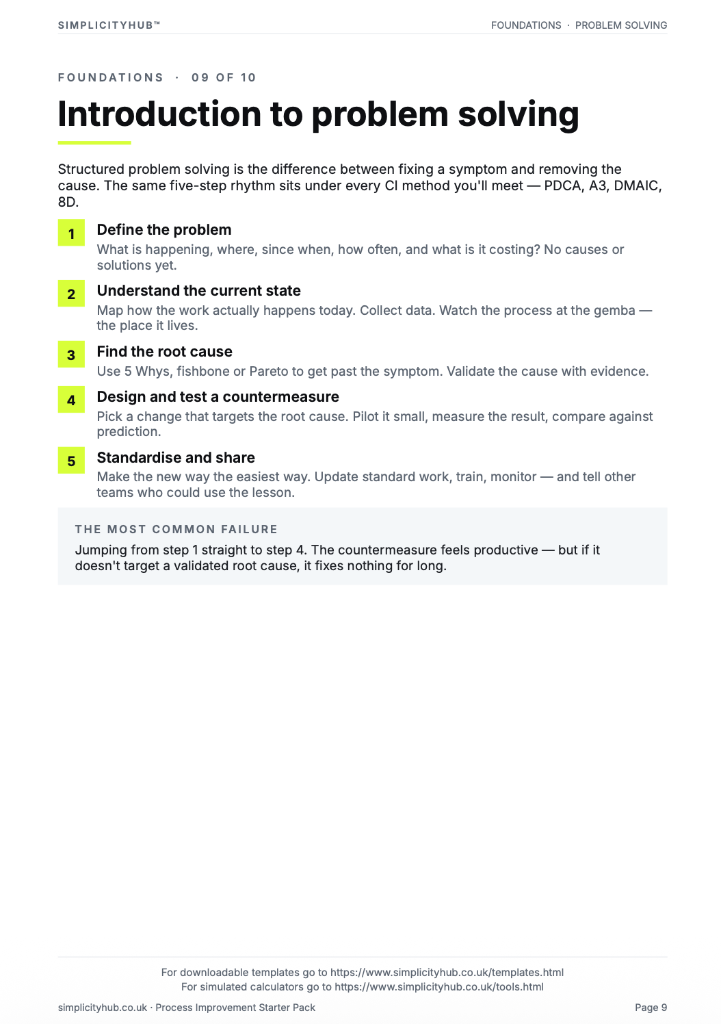
Process Improvement Starter Pack
A starter pack for identifying improvement opportunities, measuring baselines and planning action.
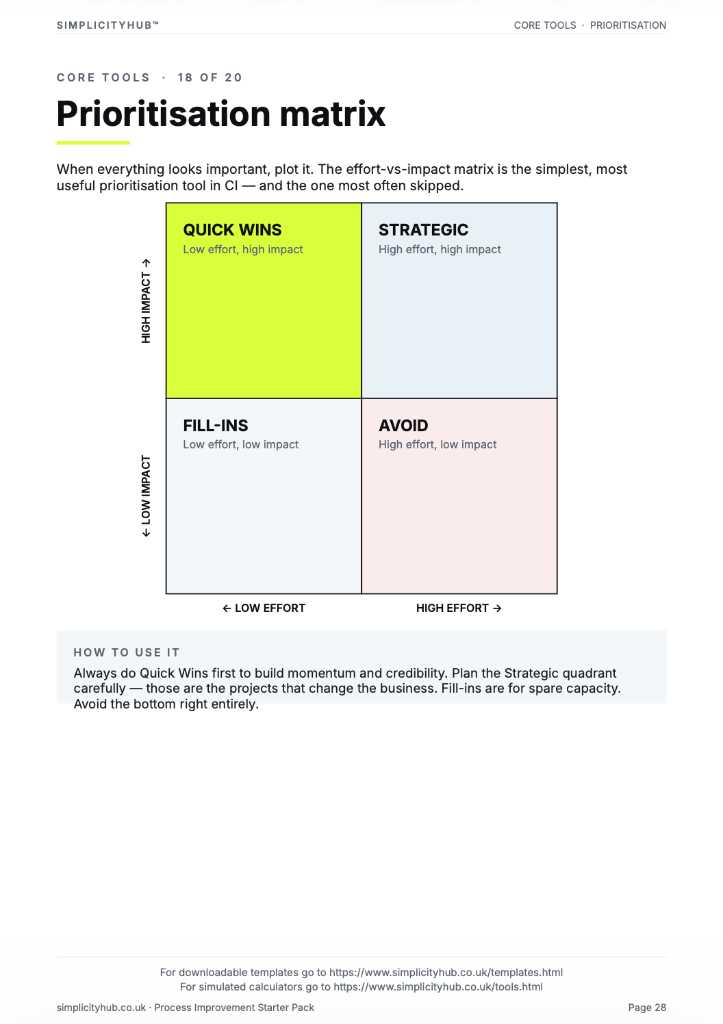
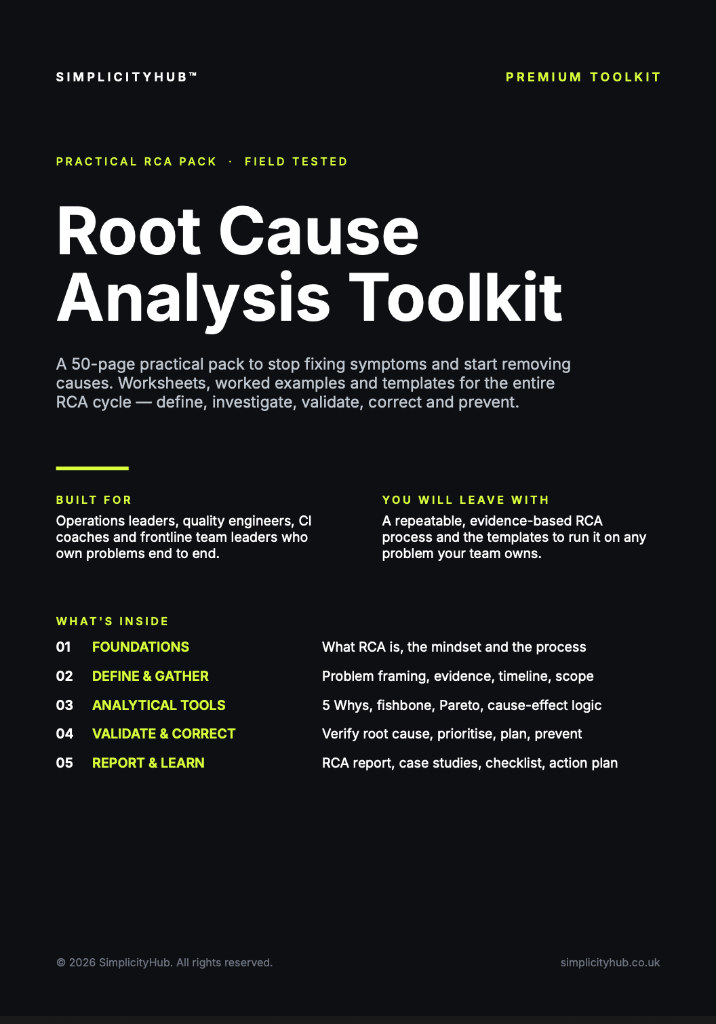
Root Cause Analysis Toolkit
A practical RCA toolkit for defining problems, finding causes, validating evidence and creating action.
A3 Template Pack
A clean A3 problem-solving pack for concise, visual improvement thinking and follow-through.