
What is a Bottleneck Analysis Template?
A Bottleneck Analysis Template provides a structured framework for identifying the process step that limits overall throughput. It compares available capacity against demand at every step to locate the constraint — the point where work queues up and flow breaks down.
When to use a Bottleneck Analysis Template
Use it in the Measure or Analyse phase when cycle time, lead time or throughput is the primary problem. It is essential before any flow improvement work — you must know where the constraint is before you can improve it.
Who should use a Bottleneck Analysis Template
- Black Belts and Green Belts — identifying and quantifying process constraints during Measure or Analyse phase
- Operations managers — understanding where capacity investments or process changes will have most impact
- Industrial and process engineers — designing balanced workflows that eliminate throughput bottlenecks
- Value stream mapping teams — locating the constraint step before redesigning the future state
Vote yes and we’ll prioritise a quick walkthrough showing you exactly how to use it.
How to use a Bottleneck Analysis — step by step
- 1Map all process steps
List every step in the process from input to output. Include any rework loops or parallel paths.
- 2Measure cycle time at each step
Time each step under normal operating conditions. Use average and range — not just the best-case time.
- 3Calculate available capacity per step
Available time × utilisation × efficiency = practical capacity. Express in the same units as demand.
- 4Compare capacity to demand at each step
Where demand exceeds capacity, you have a potential bottleneck. Where capacity significantly exceeds demand, you may have waste.
- 5Identify the primary bottleneck
The step with the lowest practical capacity relative to demand is the bottleneck. It sets the maximum throughput of the whole process.
- 6Quantify the impact
Calculate how much throughput is being lost due to the bottleneck. Translate this into financial or customer impact.
- 7Prioritise improvement at the bottleneck
Apply the Theory of Constraints — exploit the bottleneck first, then subordinate everything else to it before elevating capacity.
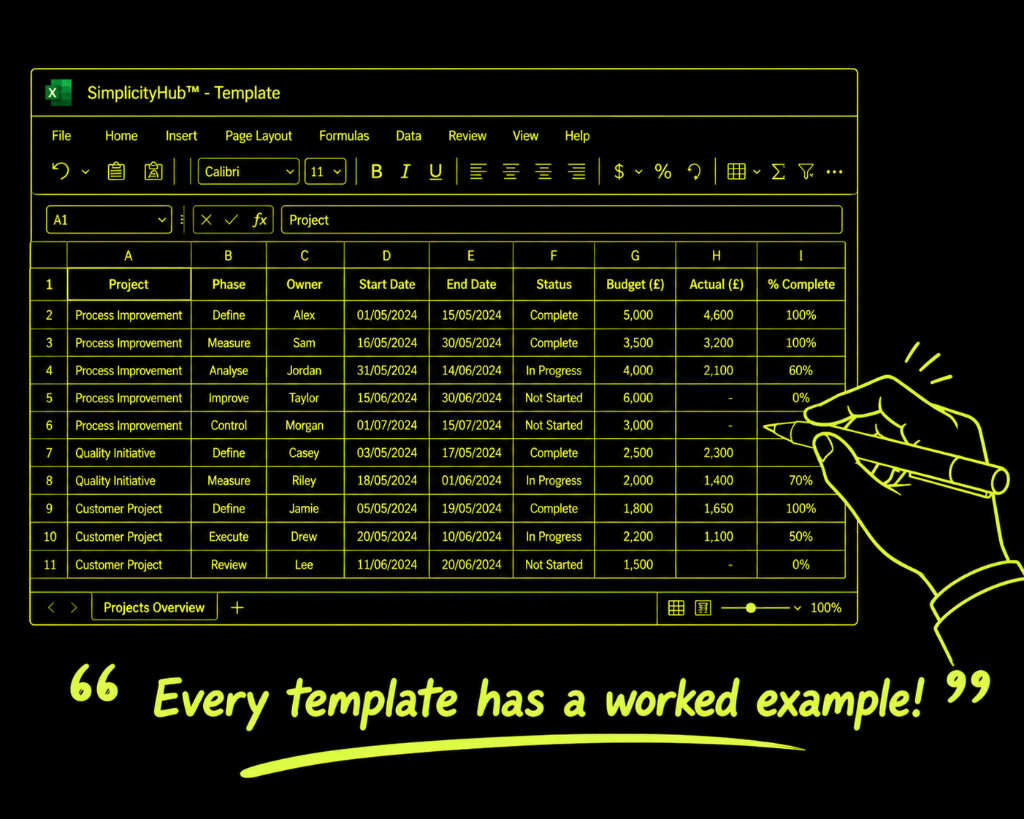
Worked example — Insurance Claims Processing Bottleneck
A claims team mapped 8 process steps and found the medical assessment step had a practical capacity of 18 claims per day against a demand of 26 — the primary bottleneck causing a 4-day backlog and SLA breaches.
Common mistakes — and how to avoid them
Fixing non-bottleneck steps first. Improving a step that is not the constraint does not increase throughput. It only creates more work piling up at the actual bottleneck.
Using theoretical capacity. Theoretical capacity ignores downtime, breaks and rework. Always use practical capacity for bottleneck analysis.
Ignoring variation. Average cycle times can mask a bottleneck. A step with high variation may be the constraint during peaks even if its average looks acceptable.
Not re-analysing after improvement. Fixing one bottleneck reveals the next. Re-run the analysis after every improvement to find the new constraint.
Tips for getting better results
Use a bar chart to visualise capacity vs demand. A simple bar chart showing capacity and demand at each step makes the bottleneck immediately obvious to any audience.
Shadow the bottleneck step. Spend time observing the bottleneck step directly. You will see waste and workarounds that data alone won't reveal.
Apply TOC before adding resource. The Theory of Constraints says to exploit and optimise the constraint before investing in additional capacity. Waste elimination is free.
Frequently asked questions
How do I identify the bottleneck?
The bottleneck is the step with the highest cycle time relative to demand, or where work queues build up. Observe directly.
Can there be more than one bottleneck?
There is always one primary constraint. Once resolved, the next slowest step becomes the new bottleneck.
What is the difference between a bottleneck and waste?
A bottleneck restricts throughput — a capacity or flow issue. Waste is non-value-adding activity anywhere in the process.
How do I calculate bottleneck capacity?
Divide available time by the cycle time per unit at that step and compare to takt time.
Advanced Toolkit Packs — available now
Structured, ready-to-use template packs designed for real improvement work. Pick the pack that matches your project and get started straight away.
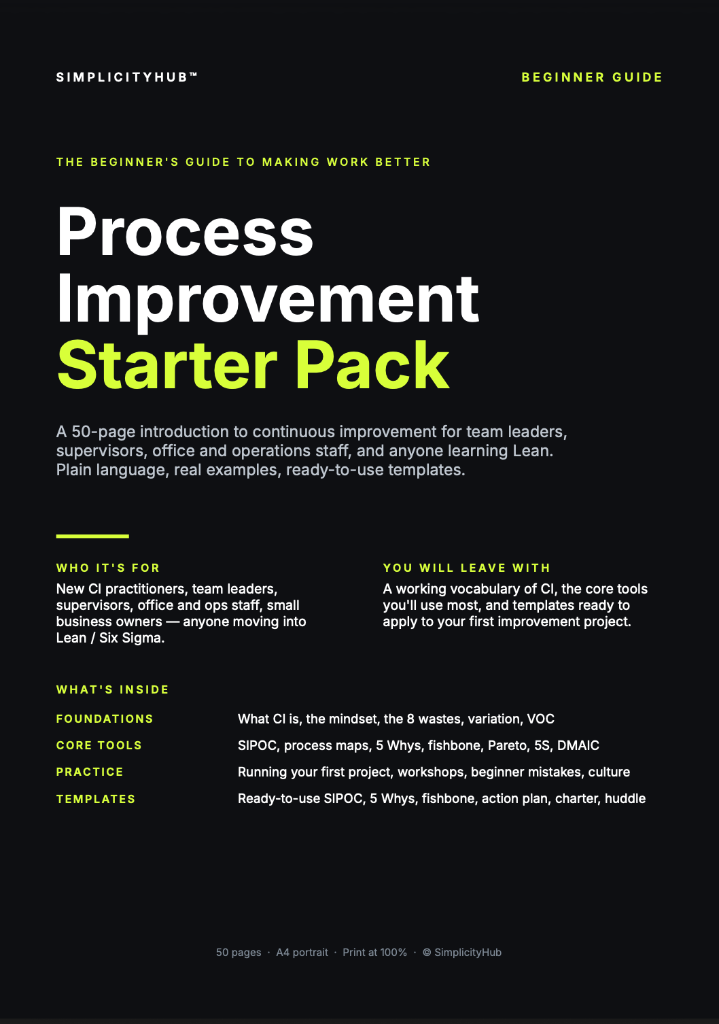
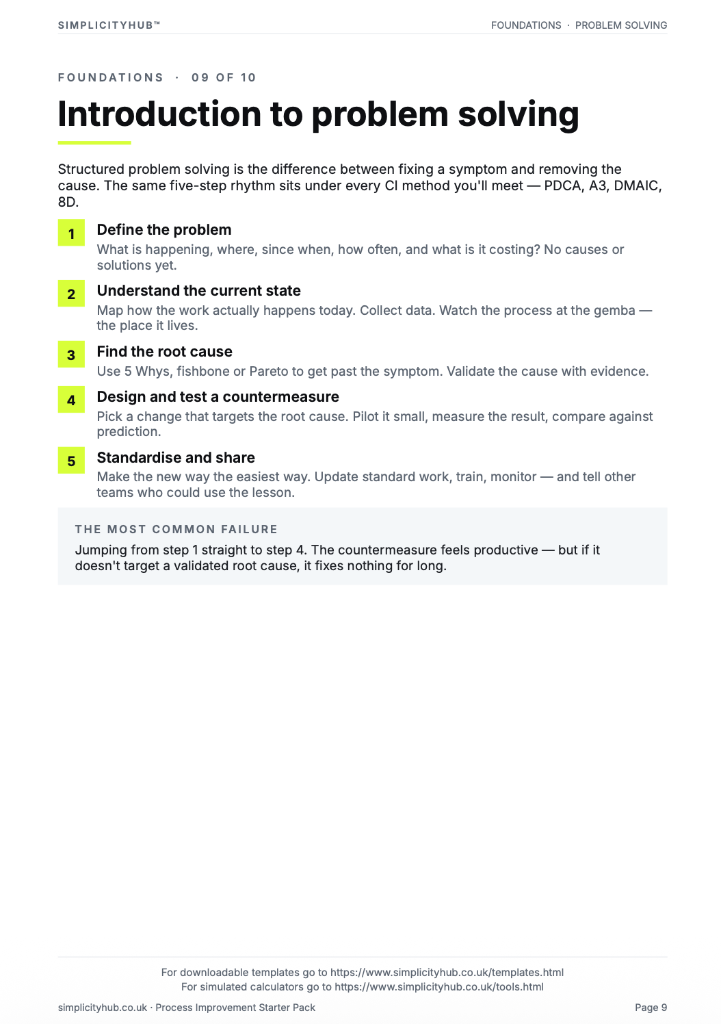
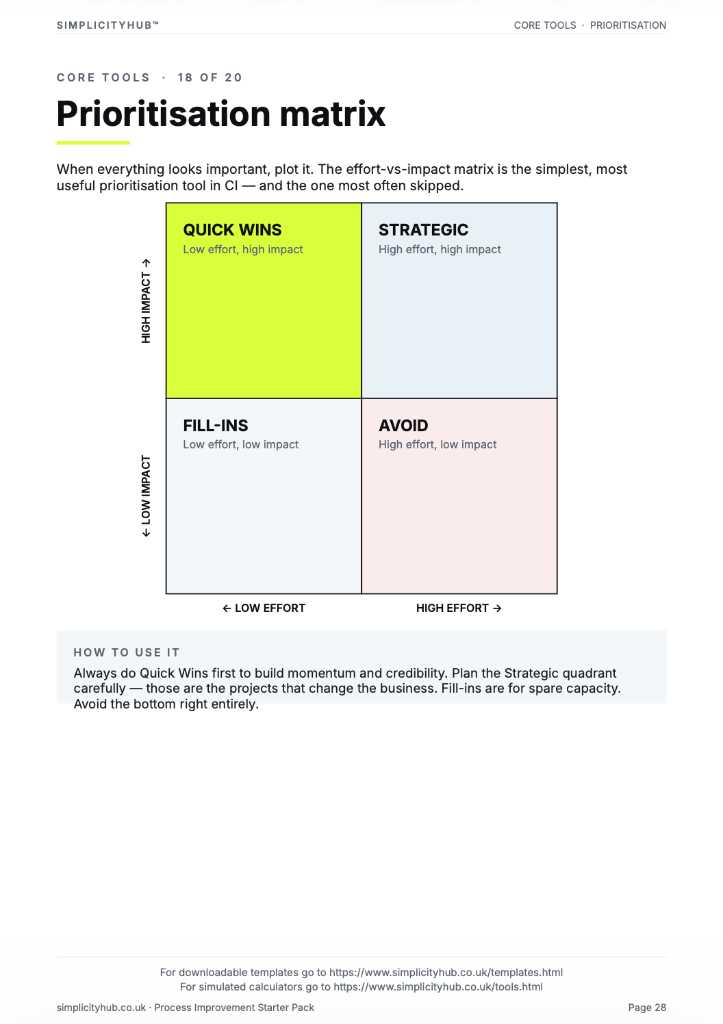
Process Improvement Starter Pack
A starter pack for identifying improvement opportunities, measuring baselines and planning action.
Root Cause Analysis Toolkit
A practical RCA toolkit for defining problems, finding causes, validating evidence and creating action.
A3 Template Pack
A clean A3 problem-solving pack for concise, visual improvement thinking and follow-through.