
What is a Capacity Planning Template?
A Capacity Planning Template provides a structured framework for calculating the available capacity of a process, comparing it to forecast demand and identifying gaps that require action.
When to use a Capacity Planning Template
Use it in the Measure phase to understand current capacity constraints, and in the Improve phase to model the capacity impact of proposed changes.
Who should use a Capacity Planning Template
- Operations managers — planning resource levels to meet demand across shifts, seasons and growth scenarios
- Black Belts and Green Belts — understanding capacity constraints during the Measure phase and modelling improvement impacts in the Improve phase
- Process owners — managing day-to-day capacity utilisation and identifying bottlenecks before they cause service failures
- Finance and planning teams — modelling resource costs against demand forecasts for budget planning
Watch: a quick explainer
New to this? This short video walks you through capacity planning — how to lay out demand scenarios and check them against available capacity — a helpful primer before you download and use the template.

How to use a Capacity Planning — step by step
-
1Write the problem statement at the top
Start with a clear, factual problem statement. 'Machine stopped' or 'Customer received wrong item' — specific, observable, factual. Vague problems produce vague root causes.
-
2Ask 'Why did this happen?' — Why 1
Write down the first-level cause. This is usually a symptom or a direct cause — not yet the root. Examples: 'Machine overheated', 'Wrong item was picked'.
-
3Ask 'Why did that happen?' — Why 2
Challenge the previous answer. Keep the team focused on causes, not blame. If the answer is 'human error', push further — why did the human make the error?
-
4Continue to Why 3, 4 and 5
Keep going until you reach a cause that is systemic — a missing process, a failed control, a gap in training or a design flaw. The number five is a guide, not a rule.
-
5Check the logic by reading upward
Read the chain back to front: 'Because of X, Y happened, which caused Z.' If the logic holds, you have a valid chain. If it breaks, revisit the step where it breaks.
-
6Identify the actionable root cause
The root cause is the deepest level where a corrective action can prevent recurrence. Document it clearly — this feeds your Improve phase solution design.
-
7Validate before acting
Do not jump to solution immediately. Check whether data or observation confirms the root cause is real and significant before committing resource to fixing it.
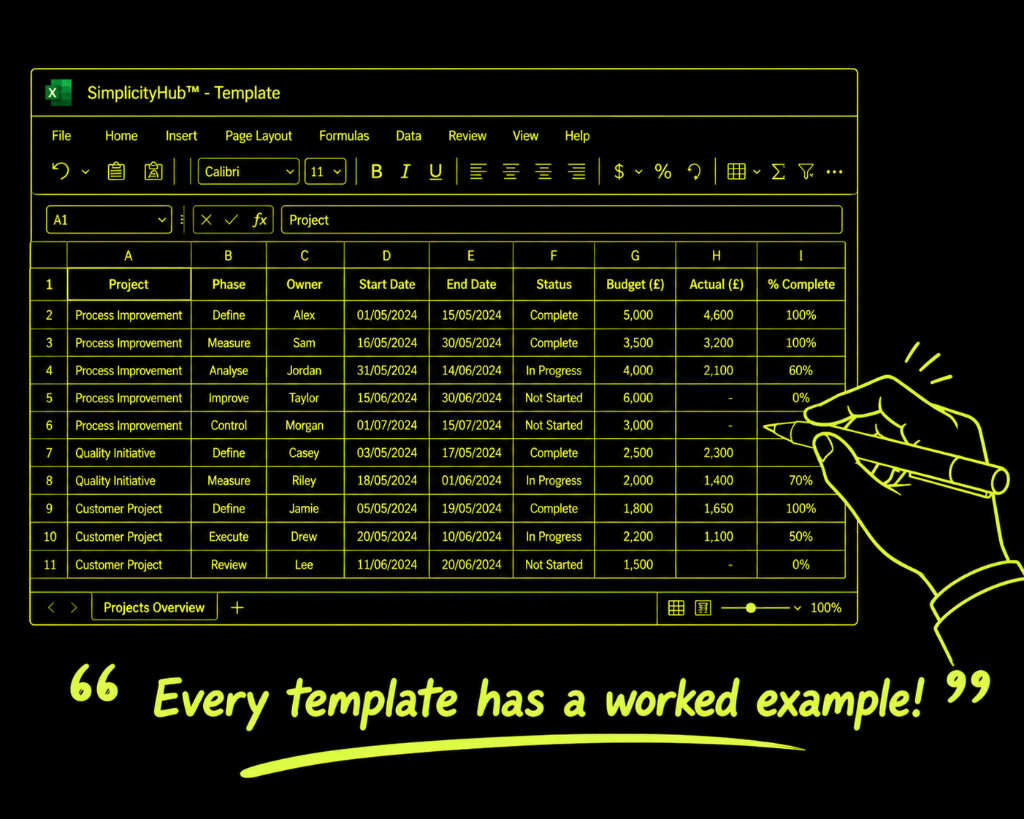
Worked example — Hospital Outpatient Capacity
A healthcare team calculated practical capacity for a 6-clinician outpatient service, identified a 23-patient daily gap against referral demand and used the model to design a new appointment template that closed the gap without adding resource.
Common mistakes — and how to avoid them
Using theoretical capacity instead of practical. Theoretical capacity assumes 100% utilisation with no downtime. Practical capacity is always lower. Using theoretical figures produces plans that consistently underdeliver.
Ignoring variation in demand. Average demand is not a reliable planning figure. Model for peak demand — not average — to avoid systematic capacity failures.
Forgetting the bottleneck. Capacity improvements at non-bottleneck steps do not increase overall throughput. Always identify and prioritise the bottleneck step.
Static plans in dynamic environments. Capacity plans go stale. Build a model that can be updated as demand patterns and resource availability change.
Tips for getting better results
Model three scenarios: base, peak and growth. Planning for average demand is insufficient. Model what happens at peak and what additional capacity is needed to support growth targets.
Express capacity and demand in the same unit. Mixing units (e.g. hours vs headcount vs units) is a common source of planning errors. Standardise on one unit throughout the model.
Validate your cycle time data. Capacity models are only as good as their cycle time inputs. Observe and time the process rather than using historical estimates or target times.
Frequently asked questions
What is the difference between capacity and throughput?
Capacity is maximum output possible. Throughput is actual output achieved.
How do I account for demand variation?
Use average demand as baseline but plan for peaks too. Build buffer capacity for peak periods.
What is a healthy utilisation level?
Aim for 75-85% for complex processes. 100% leaves no room for variation.
When should capacity planning be done?
During Improve, before implementing the new process design.
Advanced Toolkit Packs — available now
Structured, ready-to-use template packs designed for real improvement work. Pick the pack that matches your project and get started straight away.
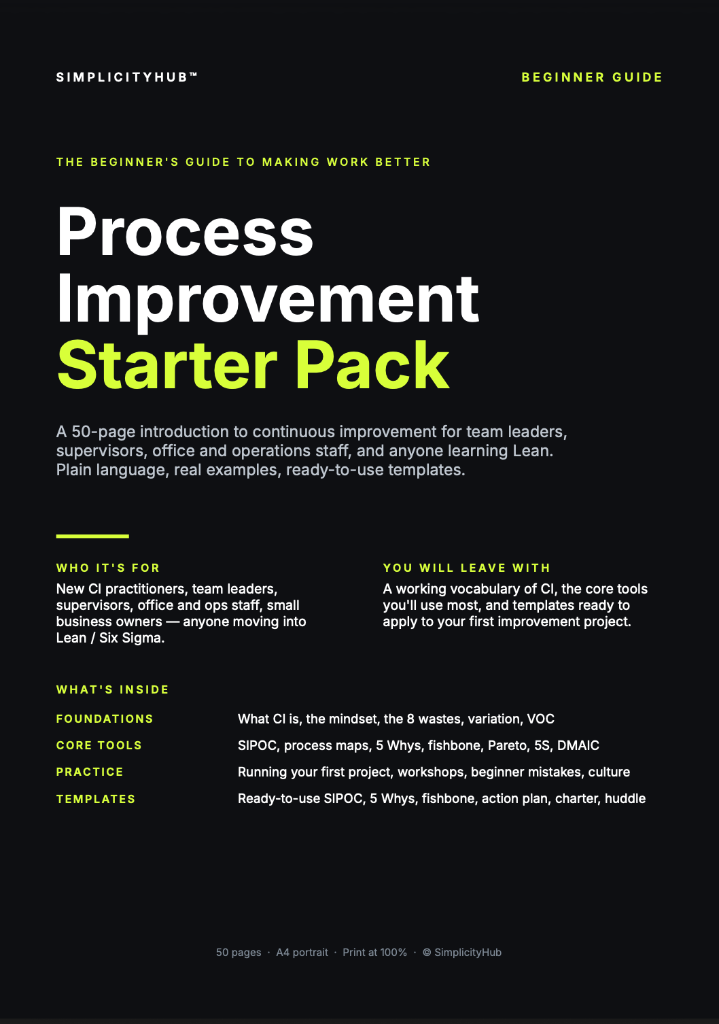
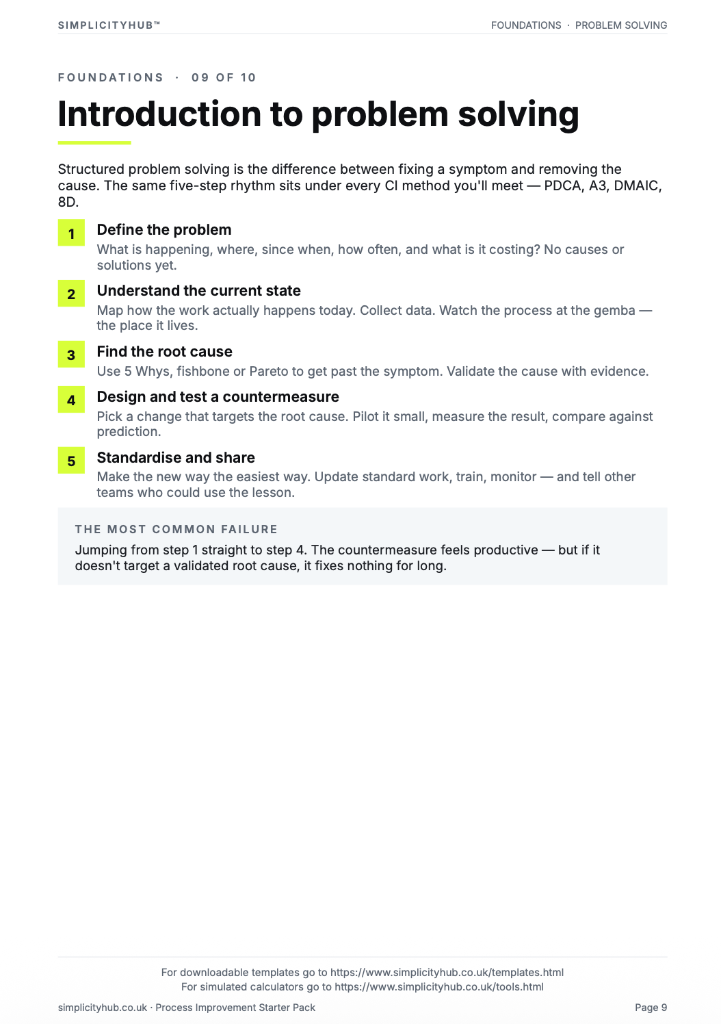
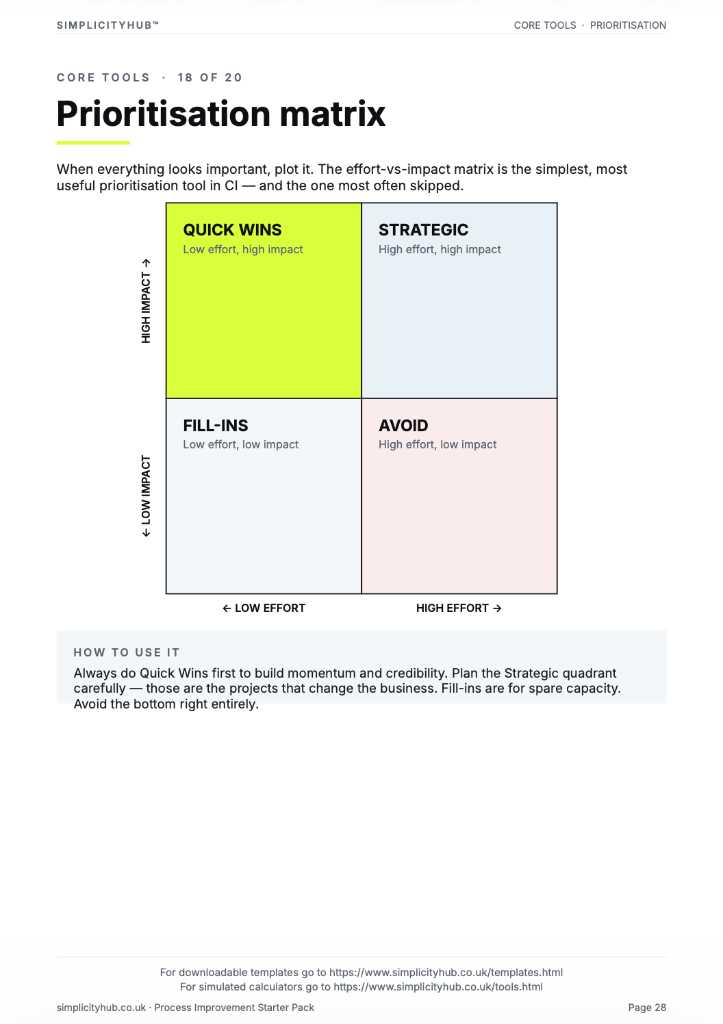
Process Improvement Starter Pack
A starter pack for identifying improvement opportunities, measuring baselines and planning action.
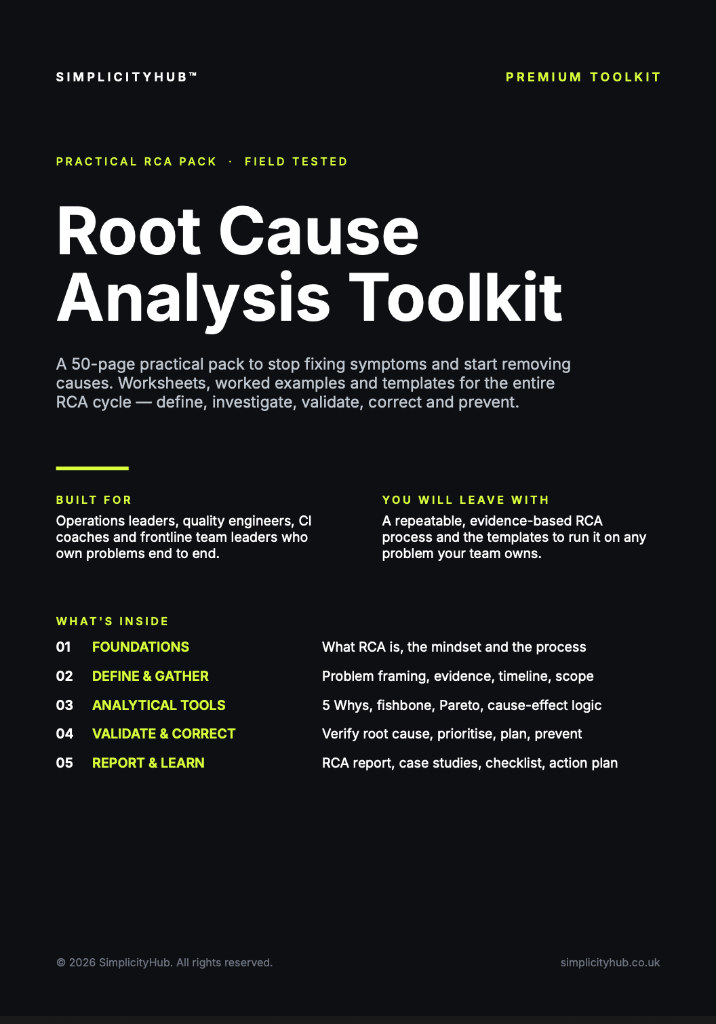
Root Cause Analysis Toolkit
A practical RCA toolkit for defining problems, finding causes, validating evidence and creating action.
A3 Template Pack
A clean A3 problem-solving pack for concise, visual improvement thinking and follow-through.