Lean & Planning
Cycle Time Calculator
Measure how long it actually takes your process to produce one unit, then compare against takt to spot bottlenecks and overproduction risks.
Was this useful?

Measure how long it actually takes your process to produce one unit, then compare against takt to spot bottlenecks and overproduction risks.
Enter your values on the left, then press Calculate.
Watch: Takt Time vs Cycle Time vs Lead Time — Finally Explained Properly
420 minutes available, 65 units completed, takt time 7 minutes. Enter the lab and find out if the team is keeping pace with customer demand.
Use the calculator above to convert net production time and units produced into an actual, measured cycle time per unit. Cycle time is the real time the process takes to complete one unit — and when compared with takt time it tells you immediately whether each step is overproducing, balanced, or behind demand.
Cycle time is the actual, measured time taken to complete one unit of work from start to finish at a given step. It is different from ideal cycle time (the theoretical fastest), and different again from lead time (which includes queues and waits between steps). Cycle time is one of the four Lean foundation metrics.
Cycle Time = Net Production Time ÷ Units Produced. Net production time is the time the process was actually running, after planned breaks, changeovers and downtime. Units produced should normally be good units only — counting rejects flatters the result and hides quality losses.
A packing line runs for 480 minutes of net time and completes 240 good cases. Cycle time = 480 × 60 ÷ 240 = 120 seconds per case, or 30 cases per hour. That is the real pace the line delivered, including all the micro-stops that normally hide in shift notes.
If takt time is 100 seconds per case, this step is the bottleneck — cycle exceeds takt by 20%. SMED on the changeover, a 5S sweep of the operator zone, or a small kaizen on the slowest sub-task is the right place to spend improvement effort before adding capacity.
Cycle time exposes the gap between how fast a process is meant to run and how fast it actually runs. It is the single most useful number for spotting bottlenecks, sizing crews and validating capacity claims.
Use cycle time on every Value Stream Map, OEE study, A3 problem statement and capacity quotation. It is also the foundation measurement for any line-balancing or kaizen event.
Cycle time, takt time, lead time and throughput together describe how a process performs. Cycle time describes one step; lead time covers the whole value stream; takt sets the demand pace; throughput is the output rate.
Plot cycle time per step against takt time. Steps above takt need rebalancing or kaizen; steps well below takt are candidates for re-allocation. Re-measure after each change so the trend is visible to the team.
Pair the cycle time number with a line-balance chart, takt analysis and standard work. Use the resources below to convert the measurement into sustained flow improvement.
Cycle time is the actual measured time it takes a process to produce one unit, end-to-end at that step. It includes small stops and minor variations and is different from ideal (theoretical) cycle time.
Takt time is the target pace dictated by customer demand (available time ÷ demand). Cycle time is the actual measured production rate. Cycle < Takt means overproduction; Cycle > Takt means the step is a bottleneck.
The most effective levers are SMED to cut changeover time, 5S to remove walking and searching waste, line balancing to redistribute work, and small batch sizes to reduce queue time. Automation is usually last, not first.
No. Cycle time measures one unit through one step. Lead time measures one unit through the entire value stream including all queues. Lead time is usually many times longer than cycle time.
Planned downtime is excluded from the available time window. Unplanned downtime is included in the measured cycle time and shows up as a longer per-unit value — which is the whole point of using a measured rather than ideal figure.
Want to understand how Cycle Time reduction fits into a structured Lean improvement? The Lean Associate course covers this in full.
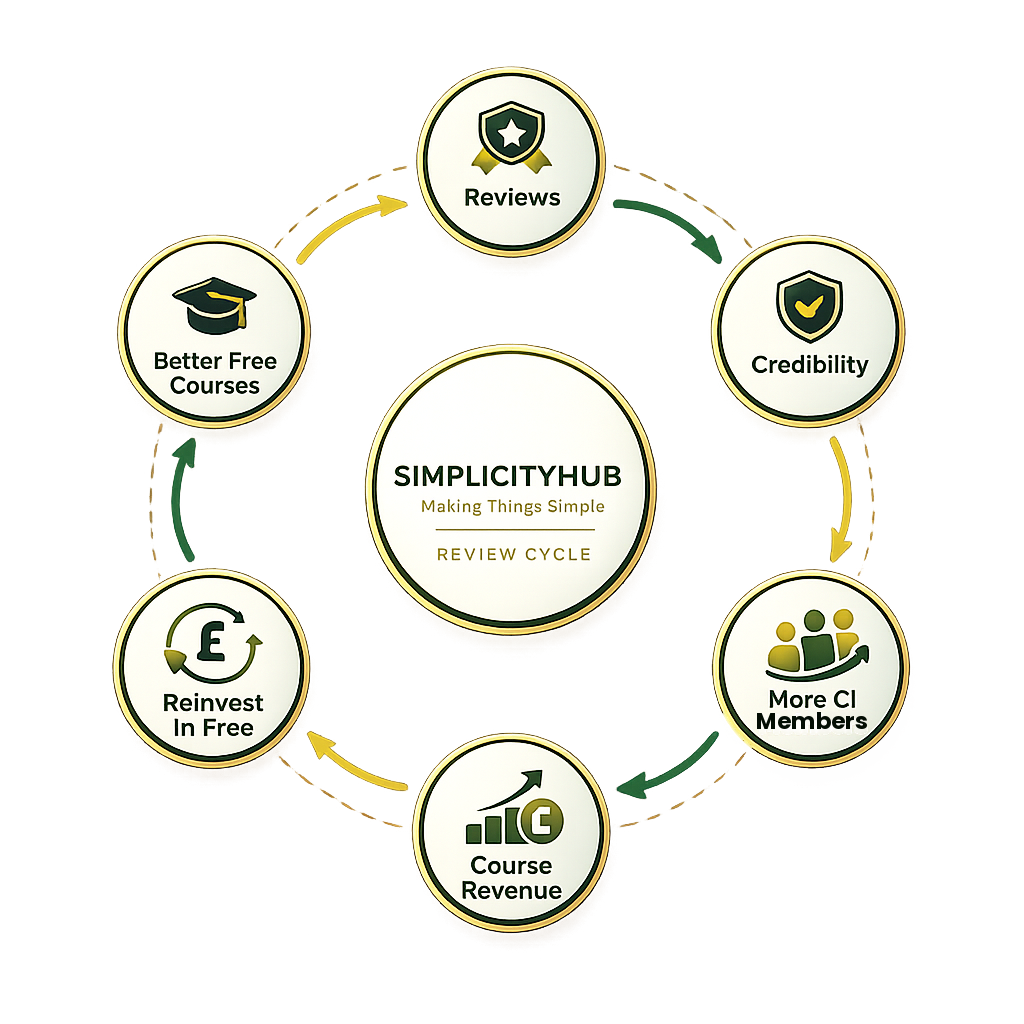
View Lean Associate →Free courses take time and money to create. Your review gives us credibility, brings in more learners, and we plough that revenue straight back into free resources.