What is a Data Collection Plan Template?
A data collection plan defines exactly what data you will collect, why you need it, how it will be collected, by whom, and over what time period — before any data collection begins. It prevents the most common measurement phase failure: collecting the wrong data, or the right data inconsistently.
Without a data collection plan, teams often discover mid-project that their data cannot answer the questions they need to answer, or that different people have been measuring the same metric in different ways.
It is the foundational tool of the Measure phase and should be completed before any data is collected or any measurement system is used.
When to use a Data Collection Plan Template
Complete a data collection plan before you start any measurement activity. You need one when:
- You are entering the Measure phase and need to collect baseline data
- Multiple people will be involved in data collection and consistency is critical
- Data will be collected over an extended period and you need to track completeness
- You need to justify to a sponsor or finance team that your data is reliable
Who should use a Data Collection Plan Template
- Green Belts and Black Belts — as the first deliverable of the Measure phase on every DMAIC project
- Data Analysts — when designing a data collection exercise for an improvement project
- Quality Engineers — when setting up measurement protocols for process or product quality
- CI Coaches — to help project teams plan their measurement before they start collecting
Watch: a quick explainer
New to this? This short video walks you through building a solid data-collection plan — a helpful primer before you download and use the template.
How to complete the Data Collection Plan
Fill in the plan before you collect a single data point. Every row should answer the question: if someone else needed to collect this data in the same way, could they do so from this plan alone?
How to complete the Data Collection Plan — step by step
-
1List each metric to be collected
Start with the Y from your goal statement — that is the primary metric. Then list any input variables (X's) that may affect it. Each metric gets its own row.
-
2Define each metric using operational definitions
Write a precise definition of each metric: what counts, what does not count, how it is measured, in what units and to what precision. Ambiguity here is the root cause of inconsistent data.
-
3Identify the data source
Where does this data come from? System report, manual observation, customer survey, audit log? Name the specific system or document.
-
4Define the collection method
How will data be recorded? Automated extract, manual tally sheet, structured observation, sample audit? Specify the tool and the format.
-
5Set the sample size and time period
How many records or observations are needed? Over what time period? Use your sampling plan to calculate the required sample size for statistical validity.
-
6Name the data collector
Who is responsible for collecting each metric? One named person per metric — not 'the team'. Include a backup if the primary collector is unavailable.
-
7Run a pilot before full collection
Collect a small sample first — 10 to 20 records. Check the data makes sense, the definition is working as intended, and the method is practical. Fix any issues before scaling up.
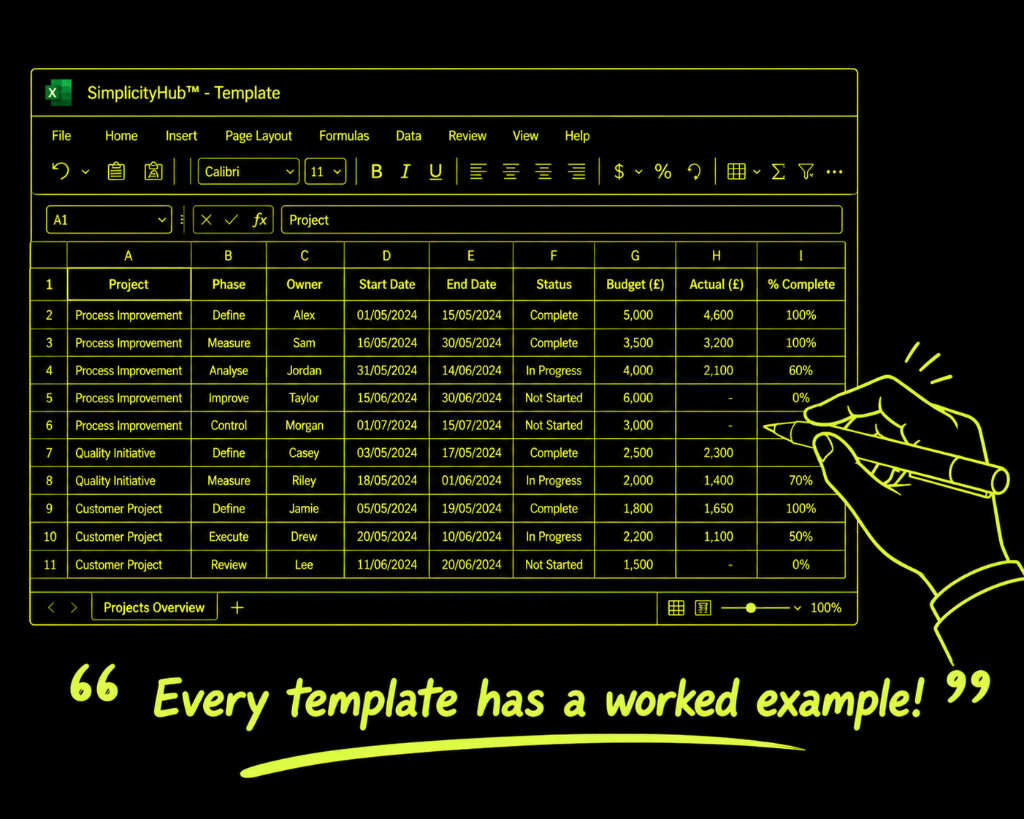
Worked example — Call Handling Time Data Plan
A completed data collection plan for a call centre improvement project, showing metrics, definitions, sources, methods, sample sizes and collection owners.
Common mistakes — and how to avoid them
Starting to collect before the plan is written. Teams that start collecting data before planning inevitably find they have collected the wrong thing. The plan takes two hours to write. Recollecting three weeks of data takes much longer.
Vague metric definitions. If your definition of 'response time' is different from your colleague's, your data is not comparable. Write operational definitions precise enough that two different people measuring the same thing would get the same result.
Ignoring the measurement system. Data is only as good as the system measuring it. Before you collect, confirm that the measurement system is reliable — that it gives consistent results when the same thing is measured repeatedly.
Collecting more than you need. More data is not always better. Collecting 500 records when 100 would suffice wastes time and adds no statistical value. Use your sampling plan to set the right n.
Tips for getting better results
Link each metric to a decision. For every metric on the plan, ask: 'What decision will this data help us make?' If you cannot answer that, you do not need to collect it.
Build in a completeness check. Add a column to track how many records have been collected vs the target. Review completeness weekly — gaps discovered late are hard to fill.
Keep a data collection log. Record the date, collector and any issues for each data collection activity. This helps you spot patterns (e.g. data quality varies by shift or collector) that affect analysis.
Download the Data Collection Plan Template
A clean, editable Excel template for immediate use — structured, professional and ready to fill in.
Frequently asked questions
What should it include?
Metric name, operational definition, data type, collection method, sample size, frequency, who collects it, and how it will be analysed.
Why do I need operational definitions?
Without them different people measure the same thing differently, making data incomparable.
How do I decide on sample size?
30 data points minimum for most statistical analyses.
What if data does not exist yet?
Design the collection system as part of the plan and include a pilot to test the collection method.
Advanced Toolkit Packs — available now
Structured, ready-to-use template packs designed for real improvement work. Pick the pack that matches your project and get started straight away.
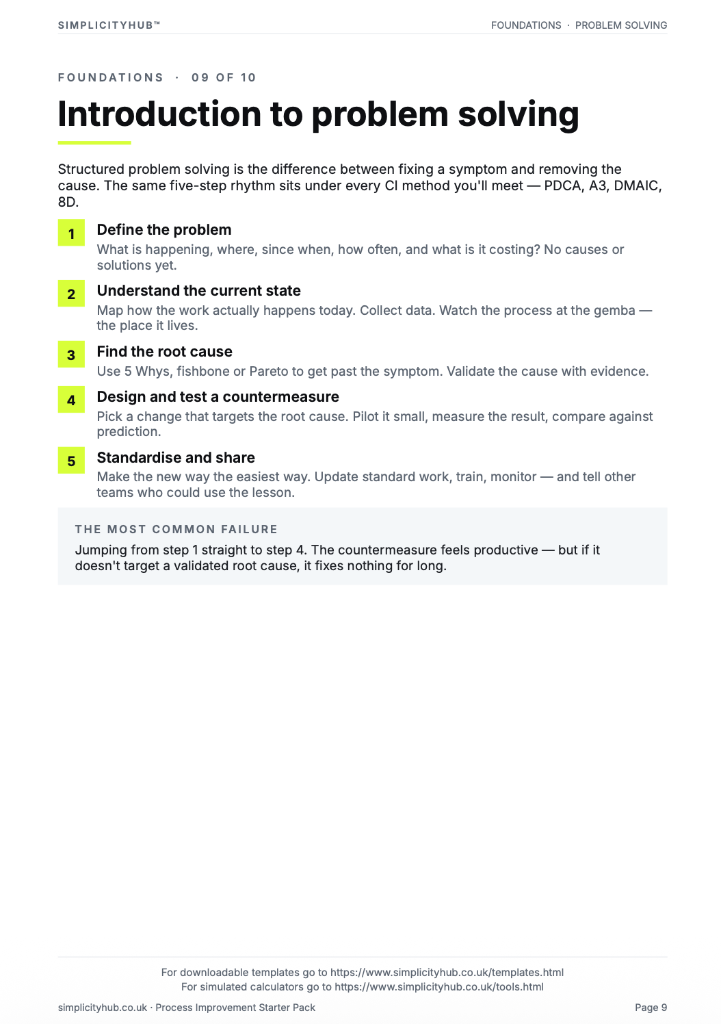
Process Improvement Starter Pack
A starter pack for identifying improvement opportunities, measuring baselines and planning action.
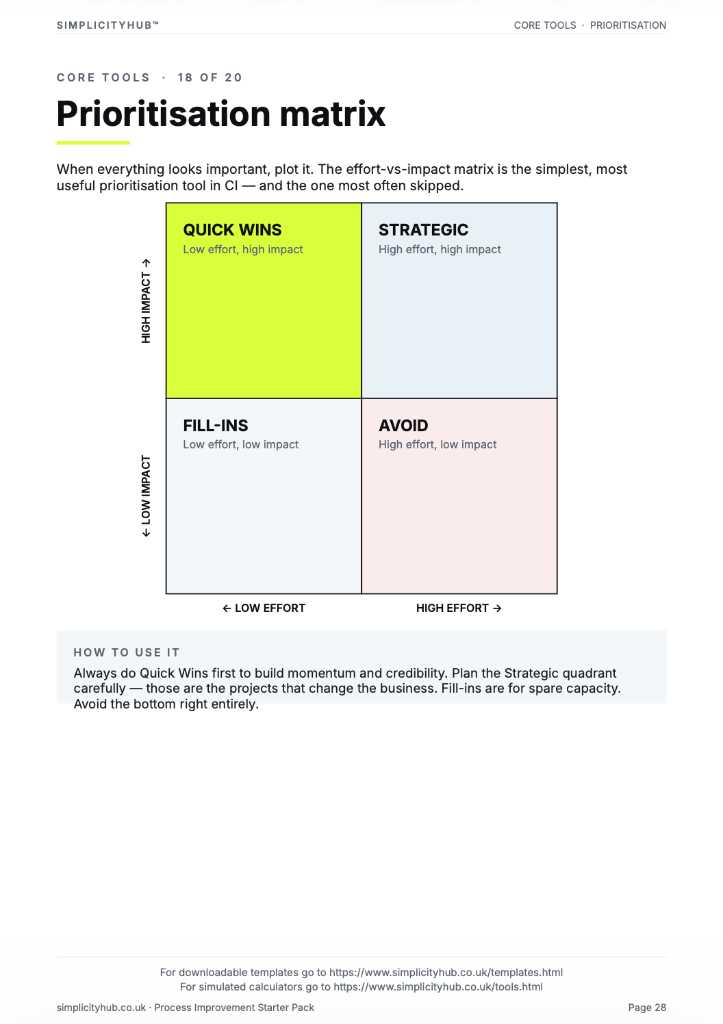
Root Cause Analysis Toolkit
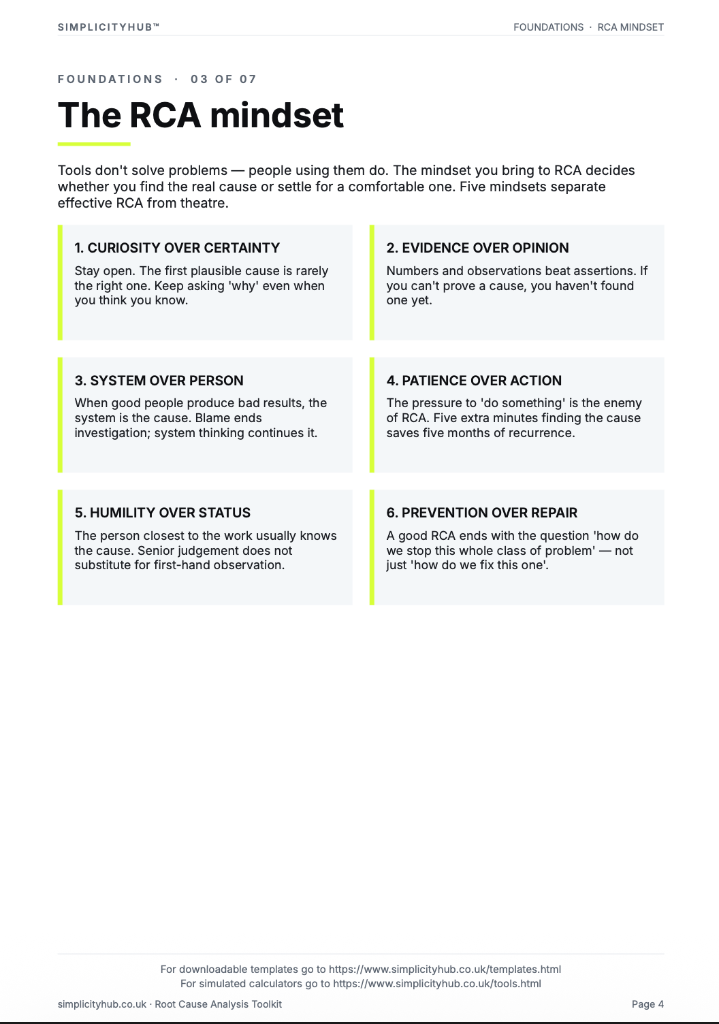
A practical RCA toolkit for defining problems, finding causes, validating evidence and creating action.
A3 Template Pack
A clean A3 problem-solving pack for concise, visual improvement thinking and follow-through.