
What is a Quick Pareto Log Template?
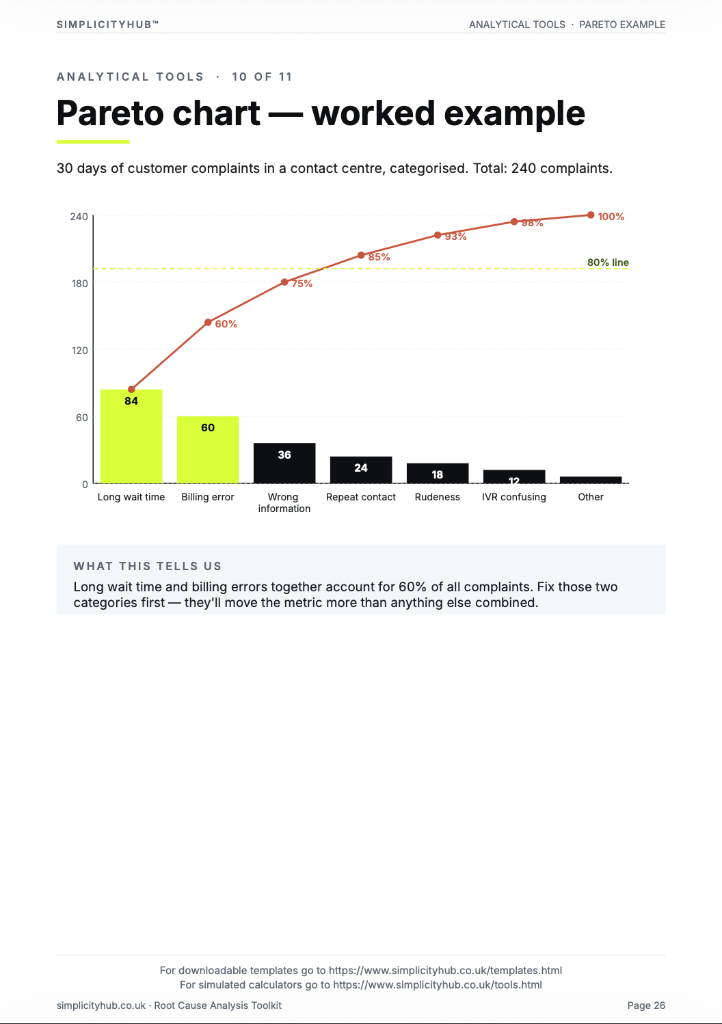
A Quick Pareto Log is a simplified tally-and-rank tool for capturing defect types, error categories or issue frequencies during a Gemba walk or team observation session — then immediately sorting them into a ranked frequency table ready for Pareto analysis.
It combines the tally sheet and Pareto chart into a single lightweight form that can be completed in the field without needing a computer. The result is a clear picture of which problem types are most frequent, ready to present to the team or sponsor within minutes of the observation ending.
Used in the Analyse phase, it is especially useful for Yellow Belts and frontline teams who need a quick, accessible way to prioritise improvement focus.
When to use a Quick Pareto Log Template
Use the Quick Pareto Log during or immediately after process observation. Use it when:
- You need a fast frequency ranking without time to build a full Pareto chart in software
- A Gemba walk or team observation has generated a list of issues to prioritise
- A Kaizen event needs a rapid data snapshot to focus the improvement session
- Frontline teams need a simple tool to record and rank their own quality issues
Who should use a Quick Pareto Log Template
- All belt levels — particularly Yellow Belts and White Belts using a lightweight analysis approach
- Team Leaders and Supervisors — for rapid prioritisation during daily management routines
- CI Facilitators — during Gemba walks and Kaizen events to structure observation outputs
- Frontline Teams — to record and rank their own quality observations without CI support
Watch: a quick explainer
New to this? This short video walks you through using a Pareto chart to focus on the vital few — a helpful primer before you download and use the template.

How to use the Quick Pareto Log
The Quick Pareto Log is designed to be completed at the point of observation — on a clipboard, at a workstation or in a team huddle. Speed is the point. Capture, count, rank, act.
How to use the Quick Pareto Log — step by step
-
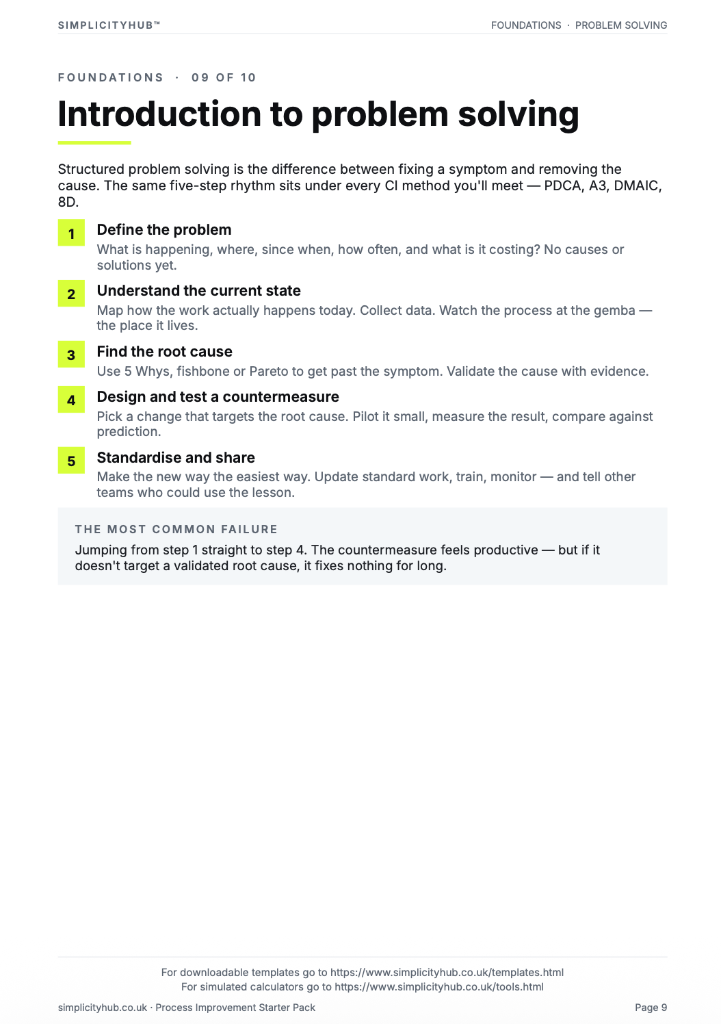
1Define up to eight categories before observing
Write the problem or defect types you expect to see as rows in the log. Include an 'Other' row for anything unexpected. Defining categories in advance prevents post-hoc rationalisation.
-
2Tally each occurrence as it happens
Mark a tally against the relevant category each time an occurrence is observed. Do not group at the end of the session — tally in real time.
-
3Total each category at the end of the session
Count the tallies for each row and write the total. Sum all totals to get the grand total.
-
4Calculate the percentage for each category
Divide each category total by the grand total and multiply by 100. Round to one decimal place.
-
5Rank from highest to lowest percentage
Re-order the categories from most frequent to least frequent. The top two or three categories are your vital few.
-
6Draw the cumulative line
Add the percentages cumulatively from the top category down. Mark where the cumulative total crosses 80% — the categories above that line are your Pareto priority.
-
7Present and agree the focus
Share the ranked log with the team. Agree which category or categories will be the focus of the improvement session or root cause investigation.
Worked example — Warehouse Errors Quick Pareto
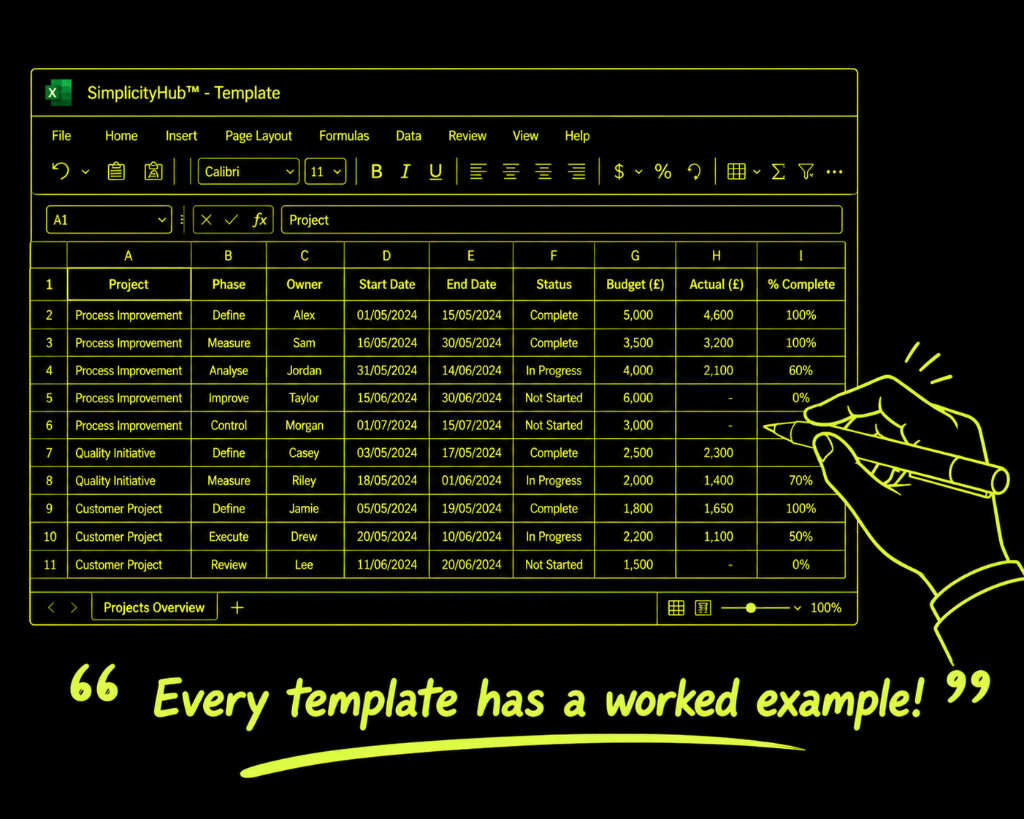
A completed Quick Pareto Log from a warehouse Gemba walk, showing five defect categories tallied, ranked and cumulative-percentage calculated, identifying picking errors as 49% of all observations.
Common mistakes — and how to avoid them
Completing from memory after the observation. Memory is unreliable and biases towards the most recent and most dramatic events. Tally in real time, at the point of observation.
Too many categories. More than eight categories makes real-time tallying difficult and the ranked output hard to act on. If a category produces only one or two observations, consider merging it with a related category.
Acting on the log without validating over time. A single observation session may not be representative. Use the Quick Pareto Log to form a hypothesis about the priority category, then validate with a longer data collection period before committing to a solution.
No 'Other' category. Without 'Other', unexpected occurrences either go unrecorded or distort existing categories. Always include it, and investigate what ends up there after a few sessions.
Tips for getting better results
Run the log across multiple shifts or days. A single observation session may capture shift-specific patterns. Running the same log across multiple shifts or days reveals whether the pattern is consistent or concentrated in one area.
Use it as a weekly team routine. Teams that complete a Quick Pareto Log weekly build a running picture of their most common problems — and can track whether improvement actions are shifting the frequency distribution over time.
Link directly to the action plan. After ranking, the top one or two categories should generate at least one action in the team action plan before the observation session closes.
Download the Quick Pareto Log Template
A clean, editable Excel template for immediate use — structured, professional and ready to fill in.
Frequently asked questions
Quick log vs full Pareto template?
Use the quick log for rapid collection in a session. Use the full template when you need a polished visual.
How many categories?
Five to ten. Use an Other category for low-frequency items.
Can I use tally marks?
Yes — for point-of-work collection, tally marks are faster and less error-prone.
How long should I collect data?
At least one full process cycle, ideally two to four weeks for a daily process.
Advanced Toolkit Packs — available now
Structured, ready-to-use template packs designed for real improvement work. Pick the pack that matches your project and get started straight away.
Process Improvement Starter Pack
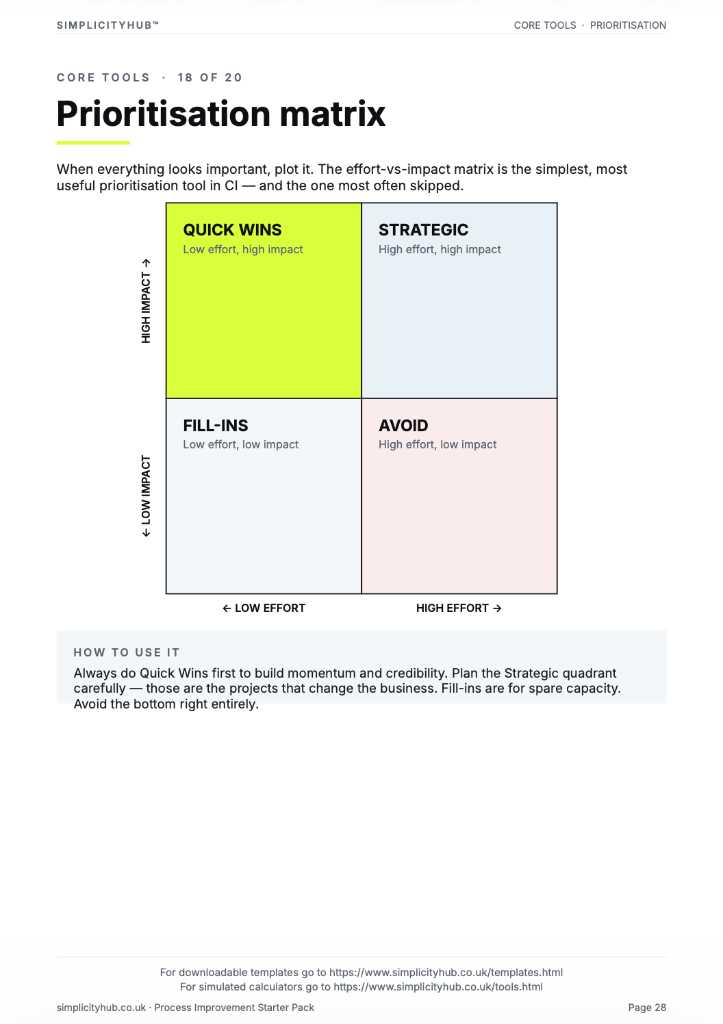
A starter pack for identifying improvement opportunities, measuring baselines and planning action.
Root Cause Analysis Toolkit
A practical RCA toolkit for defining problems, finding causes, validating evidence and creating action.
A3 Template Pack
A clean A3 problem-solving pack for concise, visual improvement thinking and follow-through.