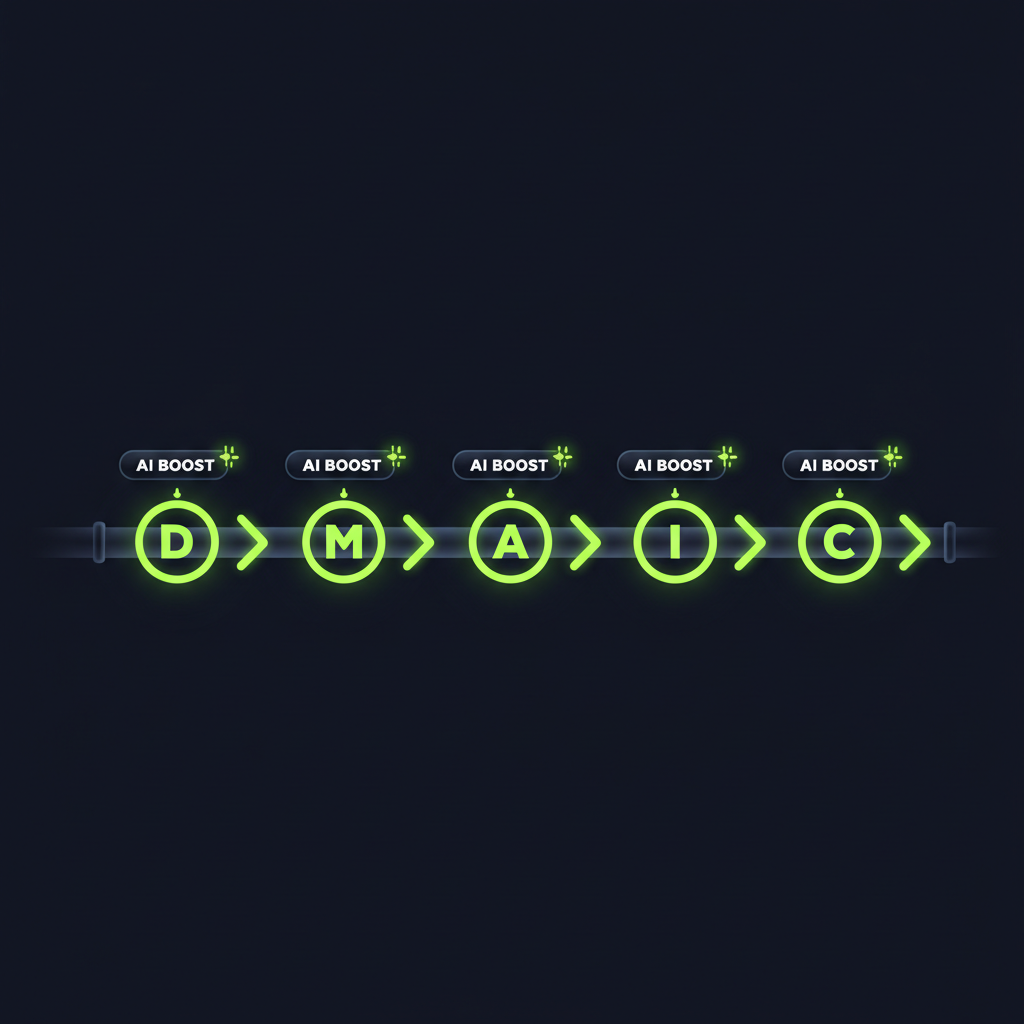
Define Phase: AI-Assisted Problem Scoping
The Define phase sets the direction for everything that follows. AI tools help practitioners write sharper problem statements, identify the right projects to prioritise, and gather Voice of the Customer data at scale.
AI for Project Prioritisation
Machine learning models can analyse operational data, customer complaints, cost records and safety incidents simultaneously to rank improvement opportunities by impact — removing the subjectivity from project selection.
A logistics company used an NLP model to analyse 12,000 customer complaint emails. The AI categorised and ranked issues by frequency and financial impact in 2 hours — a task that previously took a team of analysts 3 weeks.
Voice of the Customer at Scale
LLMs can analyse thousands of customer reviews, survey responses and support tickets to extract CTQ (Critical to Quality) themes automatically. Use tools like ChatGPT with structured prompts or dedicated VoC platforms like Medallia AI.
Measure Phase: Automated Data Collection & MSA
The Measure phase is often the most time-consuming — manually collecting data, conducting gauge studies and creating baseline metrics. AI dramatically compresses this work.
Automated Data Collection
IoT sensors and connected machines can stream process data directly into your measurement system, replacing manual tally sheets and human observation. Data is cleaner, more granular and available in real time.
A hospital trust replaced manual patient flow tracking with an RFID-based system feeding an AI dashboard. The system provided real-time visibility of patient journeys, identifying that 28% of A&E wait time was spent waiting for initial triage assessment — a bottleneck invisible in previous manual data collection.
Analyse Phase: Machine Learning for Root Cause
The Analyse phase is where AI delivers some of its biggest DMAIC wins. ML models can identify root causes and variable interactions that would take a human analyst weeks to uncover.
Identifies which X variables most strongly predict your Y outcome — ranked by impact and with confidence intervals.
Groups data into natural segments — revealing hidden subpopulations that behave differently (e.g. defect clusters by shift, operator or time of day).
Flags unusual process events that correlate with defects or failures — even when the pattern isn't visible to humans.
Extracts themes and root causes from free-text data: technician notes, complaint descriptions, maintenance logs.
Improve Phase: AI-Optimised Solutions
In the Improve phase, AI shifts from diagnosing problems to generating and testing solutions — compressing the time from hypothesis to validated improvement.
Digital Twins for Solution Testing
A digital twin is an AI model of your process that allows you to test process changes virtually before implementing them physically. Change a parameter in the model and see the predicted impact on cycle time, quality or cost — with zero risk to live production.
A specialty chemicals manufacturer used a digital twin to test 847 combinations of temperature, pressure and catalyst concentration changes in 4 hours. The optimal settings — which would have taken 6 months of physical trials — improved yield by 8.3% and reduced energy cost by 12%.
Control Phase: Predictive SPC and AI Monitoring
The Control phase is where improvement projects most commonly fail — gains are made but not sustained. AI transforms the control phase by making monitoring continuous and automated.
AI-Powered SPC
Traditional control charts require someone to look at them. AI SPC monitors all critical process parameters simultaneously and sends instant alerts when any signal suggests the process is drifting out of control — before defects are produced.
Adaptive Process Control
The most advanced AI control systems don't just alert — they adjust. In some manufacturing environments, AI controllers make real-time micro-adjustments to process parameters to keep output within specification, entirely autonomously.