
What is a Simple Cycle Time Log Template?
A Simple Cycle Time Log Template provides a straightforward recording sheet for measuring how long each unit of work takes to complete. It is the quickest way to establish baseline cycle time data before more detailed process analysis.
When to use a Simple Cycle Time Log Template
Use it in the Measure phase at the start of any project where cycle time, throughput or capacity is the primary concern. It requires no specialist equipment or software — just a timer and this sheet.
Who should use a Simple Cycle Time Log Template
- Green Belts and Yellow Belts — collecting baseline cycle time data during the Measure phase with minimal setup
- Operators and team leaders — self-recording cycle times as part of standard work development or capacity review
- Black Belts — gathering quick cycle time data before building a more detailed capacity model
- Operations managers — establishing current performance benchmarks before improvement decisions
Vote yes and we’ll prioritise a quick walkthrough showing you exactly how to use it.
How to use a Simple Cycle Time Log — step by step
- 1Define the cycle
What constitutes one complete cycle? Define the start and end point clearly before measuring. Consistency is everything.
- 2Select the recording method
Use a stopwatch and paper log for simplicity. A smartphone timer app also works well for solo observation.
- 3Record at least 20–30 cycles
A minimum of 20 observations gives enough data to calculate a meaningful average and understand the range of variation.
- 4Capture the start and end time for each cycle
Don't just record the duration — note the time of day. Cycle times often vary by time of shift.
- 5Record any abnormal events
If a cycle is interrupted or unusually long, note why. Outliers are often the most useful data points.
- 6Calculate the average and range
Mean cycle time, minimum, maximum and standard deviation. The range reveals process stability.
- 7Plot a run chart
A simple run chart of cycle times in sequence reveals patterns — improving, degrading or cyclical — that a single average hides.
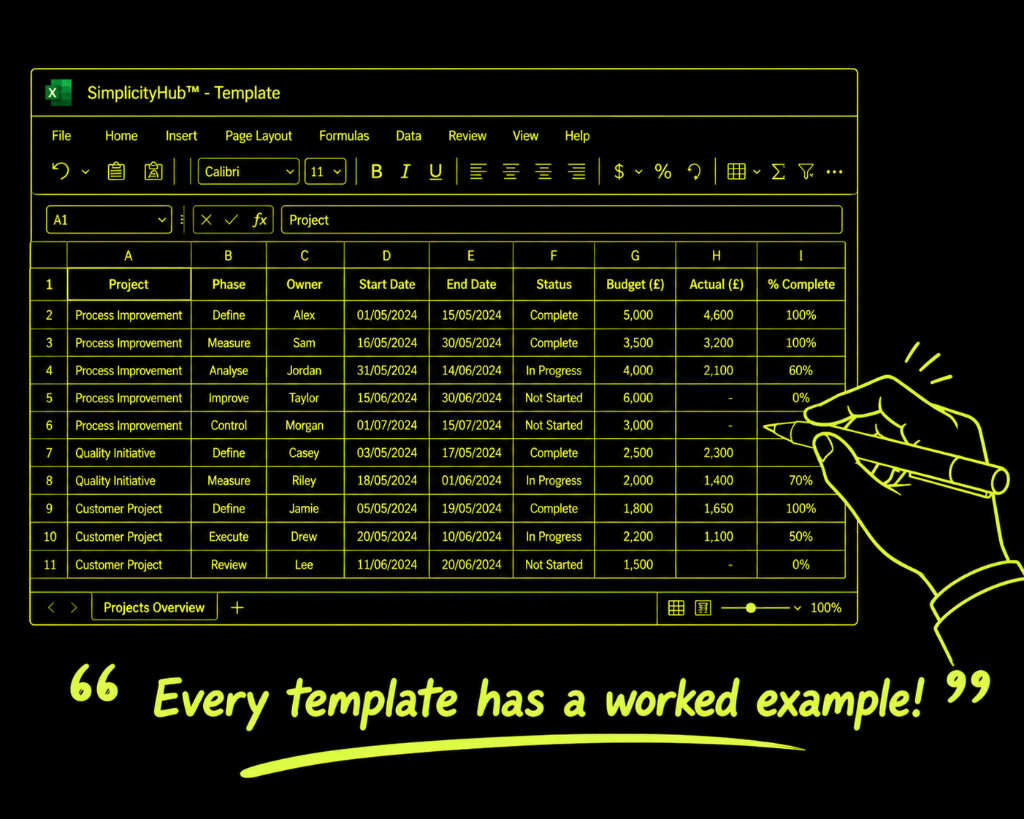
Worked example — Parcel Sorting Cycle Time
A logistics team recorded 40 parcel sorting cycles over 2 hours, finding an average cycle time of 47 seconds (range: 31–94 seconds) — with the outliers all linked to damaged barcodes, which became the focus of the improvement project.
Common mistakes — and how to avoid them
Too few observations. Fewer than 20 cycles produces an unreliable estimate of average and no useful understanding of variation.
Timing only the 'normal' cycles. Interrupted and atypical cycles are data too. Record everything and note what was different.
Not defining the cycle start and end. Without a clear definition, different observers time different things. Define start and end points before recording begins.
Only calculating the average. The range and standard deviation are as important as the mean. High variation is often the real problem, not the average level.
Tips for getting better results
Observe multiple operators. If two people do the same task in significantly different times, the variation itself is an improvement opportunity.
Collect data at different times of day. Cycle times often vary by shift, time of day or day of week. Spread your observations to capture this.
Feed the data into a takt time calculation. Once you have average cycle time data, compare it to takt time to understand whether the process can meet customer demand.
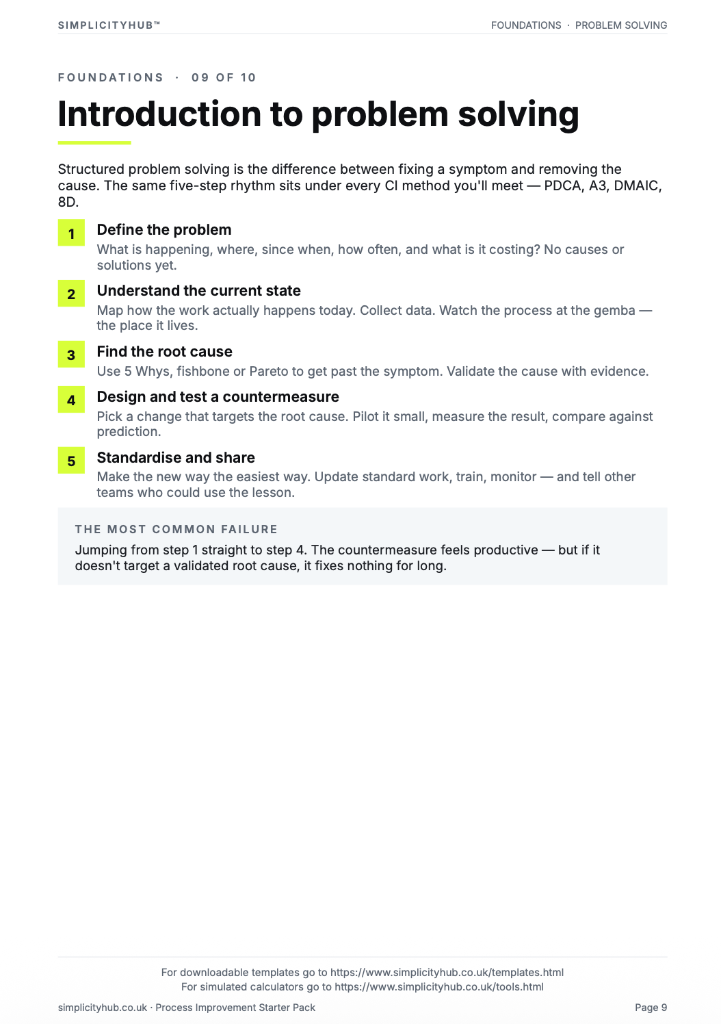
Frequently asked questions
What is cycle time?
Time to complete one unit at a specific step, from when work starts to when it passes to the next step.
How do I measure it accurately?
Time actual items from start to completion. Avoid estimates — people consistently underestimate step duration.
Cycle time vs takt time?
Takt time is the rate needed to meet demand. If cycle time exceeds takt time, the step is a bottleneck.
What variation is acceptable?
High variation indicates an unstable process — investigate the extremes to find the root cause.
Advanced Toolkit Packs — available now
Structured, ready-to-use template packs designed for real improvement work. Pick the pack that matches your project and get started straight away.
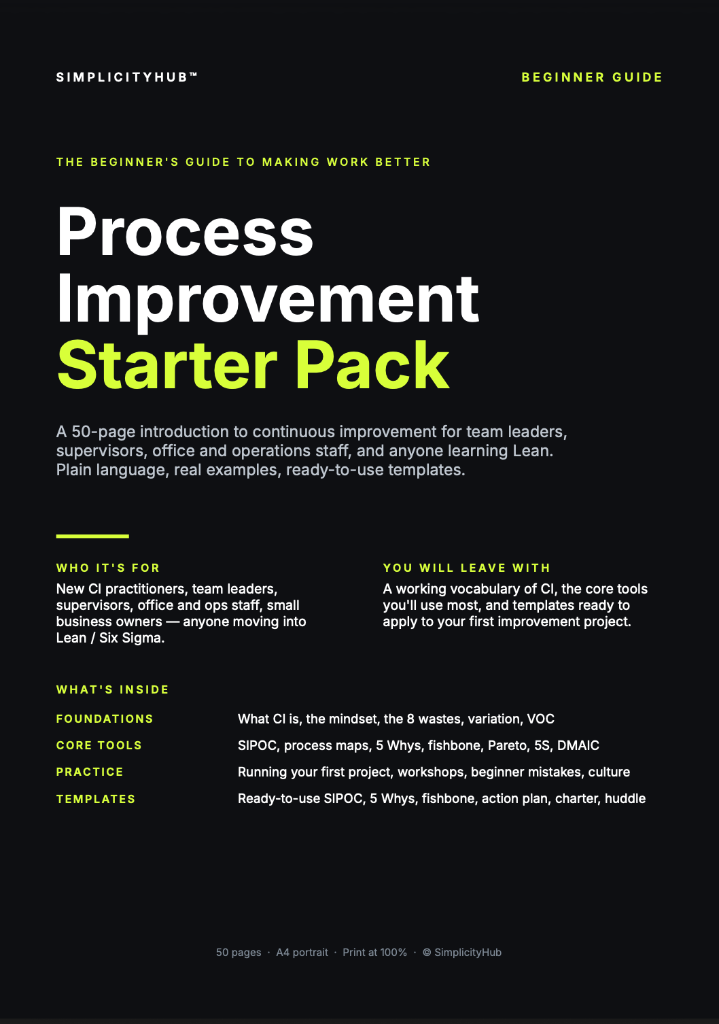
Process Improvement Starter Pack
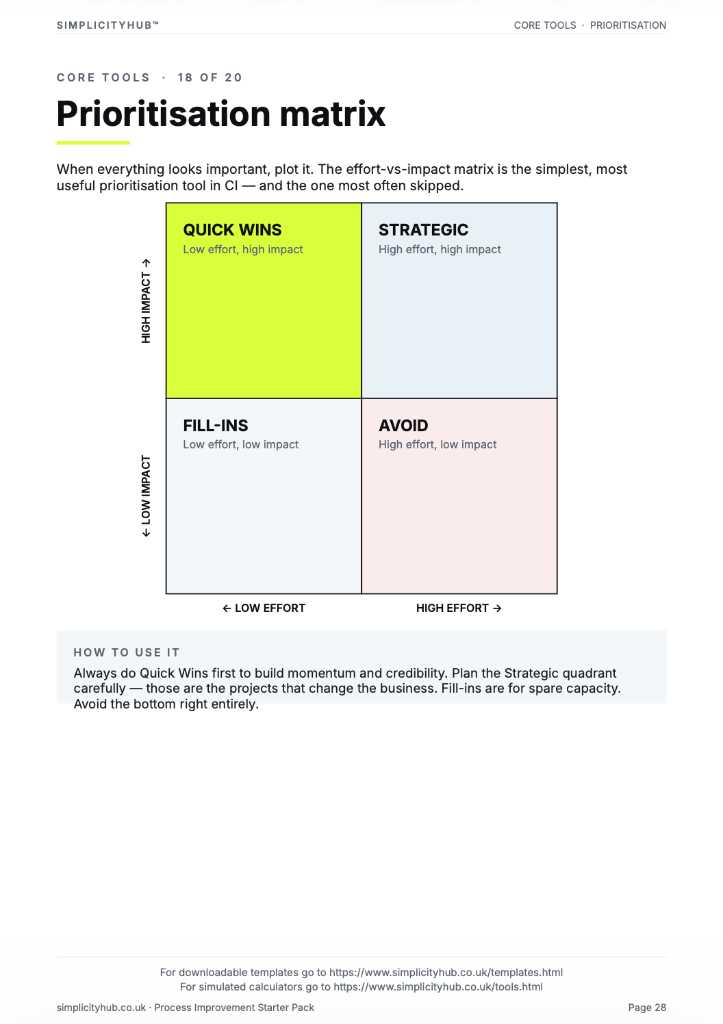
A starter pack for identifying improvement opportunities, measuring baselines and planning action.
Root Cause Analysis Toolkit
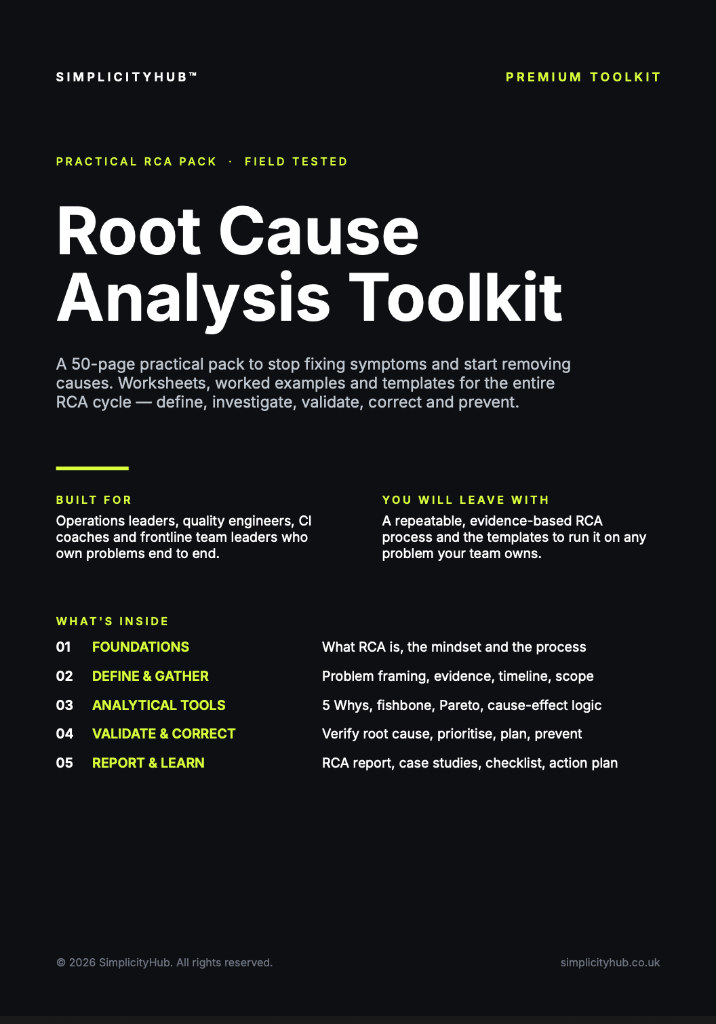
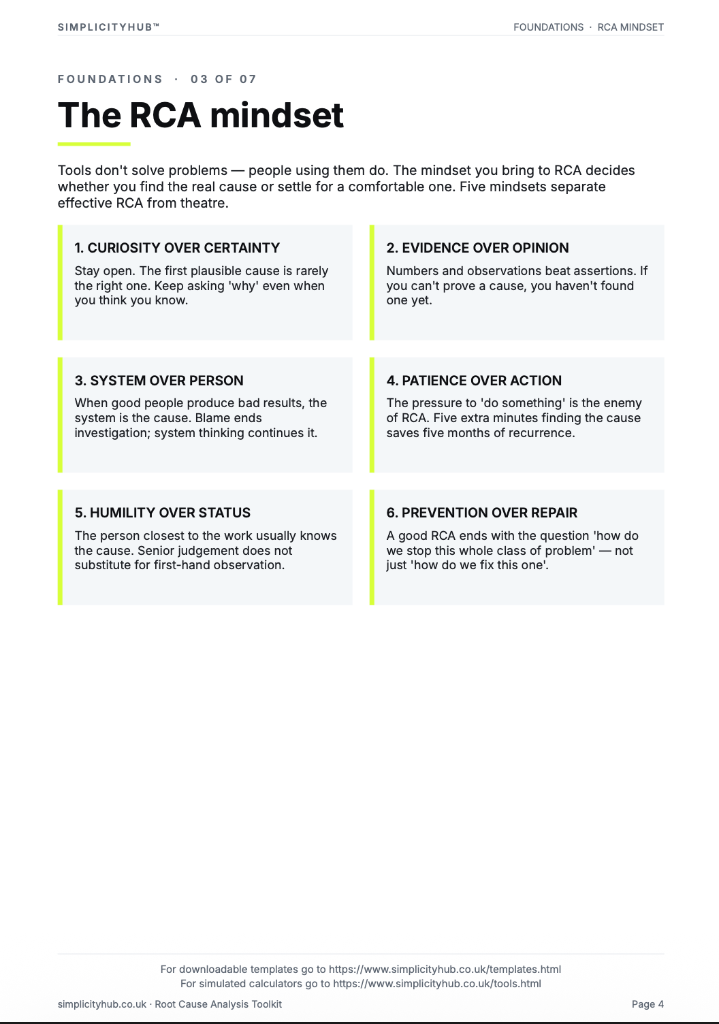
A practical RCA toolkit for defining problems, finding causes, validating evidence and creating action.
A3 Template Pack
A clean A3 problem-solving pack for concise, visual improvement thinking and follow-through.