Home Software Templates Calculators Academy Videos About Glossary Contact Login
Lean Six Sigma tools

What is a control plan in Lean Six Sigma?

A control plan is a structured document that defines how a process is monitored and kept stable after improvements have been made. It belongs in the Control phase of DMAIC and ensures that gains are sustained after the project team disbands.

Swipe to see the full plan
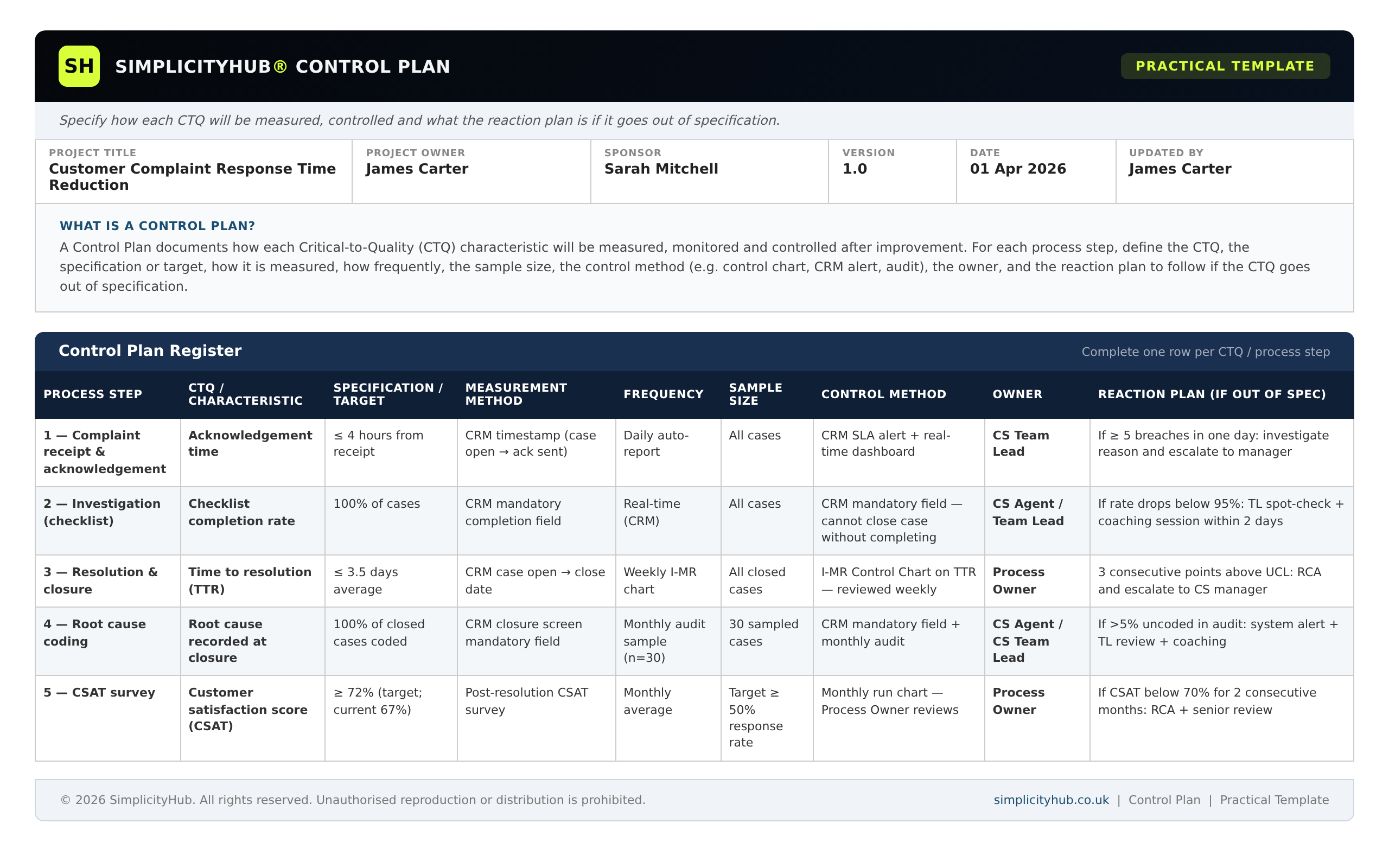
SimplicityHub control plan completed example — Customer Complaint Response Time Reduction project showing 5 process steps with CTQs, specifications, measurement methods, control methods and reaction plans

A completed SimplicityHub control plan for a customer complaint response time reduction project — 5 process steps with CTQs, specs, measurement methods, control charts and reaction plans.

When to use a control plan

What a control plan contains

  • The process parameter being controlled and its specification limits
  • The measurement method and measurement system used
  • The control method: statistical process control chart, inspection, automated alarm, or visual check
  • The frequency of monitoring (per shift, hourly, daily, weekly)
  • The person or role responsible for monitoring each parameter
  • The reaction plan: what to do when the parameter goes out of control
  • The corrective action owner and escalation path
  • Records and documentation requirements for audit traceability

Common mistakes

  • Listing every measurable parameter instead of the critical ones — a control plan that tries to monitor everything becomes impossible to maintain
  • Writing a reaction plan that says “inform supervisor” without specifying what the supervisor should actually do
  • Creating the control plan after the project team has disbanded, when the detailed process knowledge is already gone

Download the Control Plan template

SimplicityHub's free Control Plan template includes a completed example showing how each field is used on a real improvement project.

Frequently asked questions

Is a control plan the same as a monitoring plan?

They are similar but not identical. A monitoring plan focuses on what to measure and how often. A control plan is broader — it includes monitoring but also the reaction plan, ownership, and escalation procedures for when the process goes out of control. In Lean Six Sigma, “control plan” is the standard term.

Who owns the control plan?

The process owner — typically the operational manager responsible for the process day to day — owns the control plan after the improvement project closes. The project team creates it during the Control phase, but ownership transfers to the process owner on handover.

When is a control plan complete?

A control plan is never truly “complete” — it is a living document. It should be reviewed whenever the process changes, new risks are identified, or audit findings require updates. The initial version is ready when it has been signed off by the process owner and the project sponsor.

Choose the format that fits your work

Explore all belt levels, support features and start options.