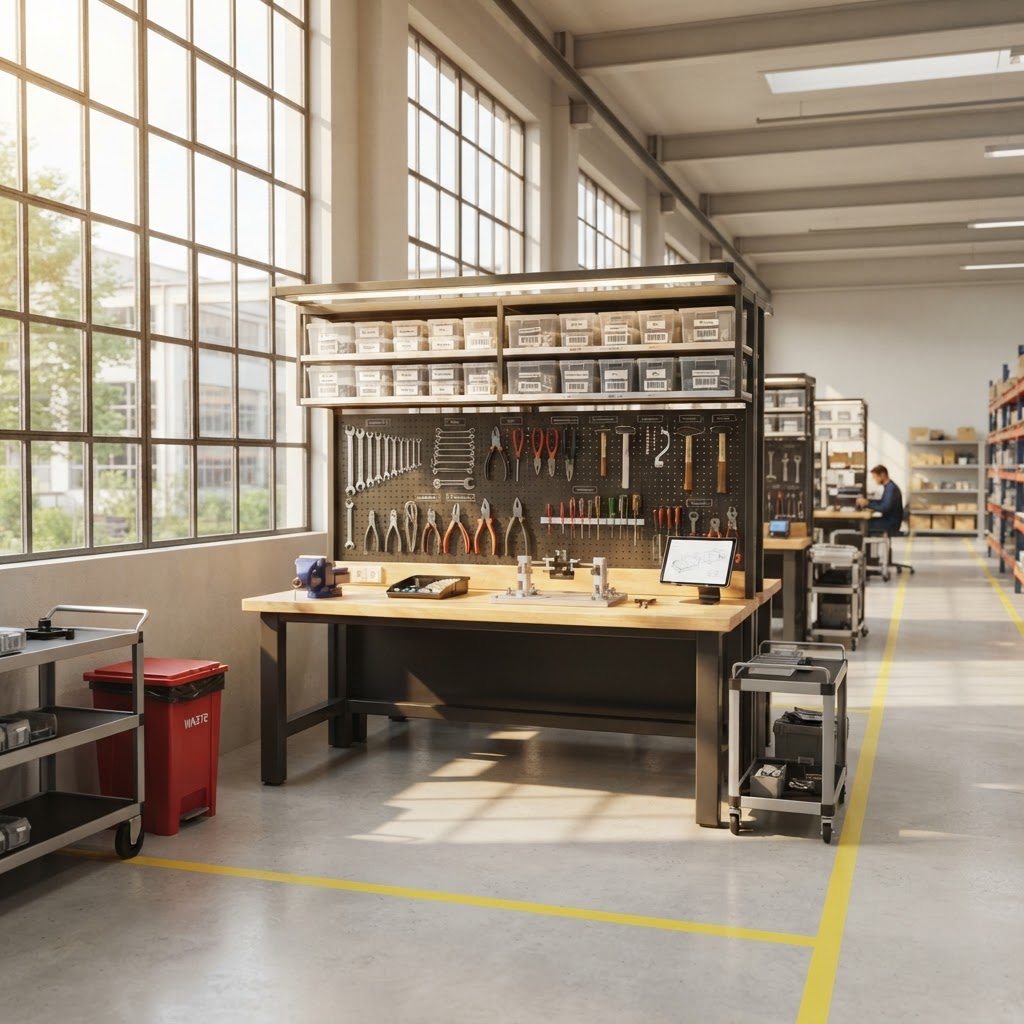
5S is a system to reduce waste and optimise productivity through maintaining an orderly workplace and using visual cues to achieve more consistent operational results. The name comes from five Japanese terms, each beginning with "S," developed as part of the Toyota Production System.
Five steps. A tidy workplace. Sounds straightforward. And the first four steps are. Sort, Set in Order, Shine, Standardize: follow them properly and your workspace will look transformed within a week. But looking transformed and staying transformed are different things. The EPA describes 5S as cyclical, not linear. The five steps loop back on themselves, producing continuous improvement rather than a one-time result. That cycle runs on one step: Sustain.
Every 5S failure pattern looks the same. A team runs a Sort event, labels the shelves, cleans the machines, takes a photo for the newsletter. Six weeks later, the shelves are cluttered again. The issue is rarely that the first four steps were done badly. It is that nobody built the habit of maintaining them. Sustain is often the most difficult S to implement, and without it, the achievements of the other four pillars will not last long.
This guide covers all five steps, but it weights Sustain accordingly. If your organisation has tried 5S before and watched it fade, that weighting is the reason.
Why 5S Is the Starting Point for Lean
If you are wondering where to begin with lean, 5S is the standard answer. It is typically the first lean method organisations implement because it cleans up and organises the workplace in its existing configuration. No capital equipment changes. No value stream redesign. You work with what you already have and make it visible, accessible, and orderly.
That matters because 5S provides the foundation on which other lean methods can be introduced: TPM, cellular manufacturing, just-in-time production, and six sigma all rely on a stable, organised work environment. Running a DMAIC project in a chaotic workspace is like tuning an engine while the bonnet is buried under scrap. 5S clears the surface so you can see what you are working with.
It also maps into PDCA, DMAIC, lean fundamentals, and lean House of Quality frameworks, which means the discipline you build during 5S transfers directly into more advanced lean six sigma work.
The Five Steps Explained
The five pillars, as Hirano's 1995 framework structured them, each build on their predecessor.
1. Seiri (Sort)
Go through every item in the work area and ask one question: is this needed here, now, for the work being done? Everything that is not needed gets removed.
The practical tool for this is red tagging. A red tag is placed on all items that are not important for operations or that are not in the proper location or quantity. Tagged items are then evaluated: relocate, store, sell, recycle, or dispose.
Red tagging works because it makes the decision visible. A tag on a box forces a conversation. An unmarked box sits there indefinitely.
2. Seiton (Set in Order)
Once Sort has cleared the workspace of unneeded items, Set in Order can begin. This step cannot happen first. You cannot organise what you have not yet sorted.
Strategies include painting floors, affixing labels and placards to designate proper storage locations, outlining work areas and locations, and installing modular shelving. The goal is that any person, including someone unfamiliar with the area, can find what they need and return it to the right place without asking.
3. Seiso (Shine)
Shine is daily cleaning and inspection, not a one-off deep clean. Cleaning the workspace is the mechanism; the real purpose is noticing problems early. A leak, a worn belt, a cracked guard. These show up when you are wiping down a machine. They stay hidden when nobody touches it.
The standard for Shine) is that anyone unfamiliar with the environment should be able to detect any problems within 15 metres in 5 seconds. If something is out of place, it should be visually obvious.
There is an environmental benefit as well. Painting machines light colours and cleaning windows decreases energy needs associated with lighting, a detail that often surprises teams focused purely on tidiness.
4. Seiketsu (Standardize)
The common English translation is "standardize," but this is a mistranslation). The Japanese word Seiketsu actually means "to maintain hygiene and cleanliness." The original idea had no association with standardisation or uniformity.
In practice, what this step does is create a consistent approach through three actions: assigning Sort, Set in Order, and Shine responsibilities to specific people, integrating those duties into regular work rather than treating them as extras, and checking on maintenance. The second part is prevention: preventing accumulation of unneeded items, preventing procedures from breaking down, and preventing equipment and materials from getting dirty.
This is where 5S stops being an event and starts becoming part of daily work. Without clear ownership, the first three steps decay. With it, they become routine.
5. Shitsuke (Sustain)
Sustain means forming the habit of always following the first four steps without having to be told.
That sentence is easy to write and difficult to achieve. Changing entrenched behaviours is hard, and the tendency is to return to the status quo and the comfort zone of the old way. This is why people skip standard work even when they helped create it, and why Gemba walks exist to catch the drift before it becomes the default.
Tools for sustaining 5S include signs and posters, newsletters, pocket manuals, team and management check-ins, performance reviews, and department tours. Organisations reinforce 5S messages in multiple formats until it becomes "the way things are done."
An audit process is central to Sustain. Without regular checks, there is no feedback loop. A 5S audit sheet gives teams a consistent scoring method. Pair it with a Gemba walk checklist and you have both a structured review and an informal walk-the-floor habit feeding the same cycle.
What 5S Implementation Produces
A typical 5S implementation results in significant reductions in the square footage of space needed for existing operations. It also produces tools and materials organised into labelled and colour-coded storage locations, as well as kits containing just what is needed to perform a task.
Beyond the physical changes, the ASQ lists measurable programme benefits:
- Reduced non-value-added activity
- Improved safety and morale
- A foundation for continuous improvement
- Employee empowerment (people own their work environment)
- Improved productivity
There is also a less obvious gain. 5S achieves "a place for everything and everything in its place" and is the basis of customers' first impressions. A visitor walking through a well-maintained facility draws conclusions about quality before they see a single product specification.
How to Implement 5S: A Step-by-Step Sequence
Start with a red-tag event
Pick one area. Do not attempt the entire facility at once. Run a red-tag event: every item gets evaluated, tagged if unneeded, and dealt with within a set timeframe (two weeks is typical). Use a standard work template to document the process so the next area follows the same method.
Organise what remains
Once Sort is complete, apply Set in Order. Paint floor markings, install labels, outline tool storage locations. A visual management board in the area makes the new layout visible and reinforces where things belong.
Build a cleaning schedule
Daily Shine tasks should take minutes, not hours. Assign specific machines or zones to specific people and specify what "clean" looks like. Remember the 15-metre, 5-second standard: if a problem is not obvious from across the room, the area is not yet at the Shine standard.
Assign ownership and integrate into daily work
Standardize means writing down who does what and when, then folding those tasks into existing job responsibilities. If 5S tasks sit on a separate checklist that people do "when they have time," they will not get done. Build them into the daily routine.
Set an audit cadence
Weekly audits in the first month. Fortnightly once scores stabilise. Use a 5S audit sheet and share results visibly. The cycle restarts here: audit findings feed back into Sort and Set in Order, keeping the loop running.
5S Beyond Manufacturing
5S can be practised in almost any workspace, including virtual spaces such as digital desktops or SharePoint sites. The principles transfer directly: sort your files, organise your folder structure, clean out what you no longer need, standardise naming conventions, and sustain with periodic reviews.
In offices, 5S addresses the desk drawers full of dead stationery, the shared drives with three versions of the same document, the meeting rooms where nobody can find a working marker. In healthcare, it keeps crash carts stocked and treatment rooms consistent across shifts. In supply chain and logistics, it reduces pick errors and speeds up cycle counts.
The common thread across all these environments is the same: the system works when Sustain is active and decays when it is not.
Why Most 5S Programmes Fail (and How to Fix It)
They fail at Sustain. Almost always.
The first four steps produce visible results. People see a clean workspace and feel good about it. But that feeling is not a system. Without an audit process, without clear ownership, without management check-ins, the workspace slowly reverts. The tendency is to return to the status quo because the old way is comfortable and familiar.
Three things keep Sustain alive:
- Visible accountability. Names on a board, not vague team responsibilities. When everyone owns it, nobody owns it.
- Regular audits with consequences. Not punitive consequences. Informational ones. A score that the team sees, tracks, and discusses. A Gemba walk that checks the same areas each week.
- Leadership presence. If managers do not walk the floor and reference 5S standards, the team reads that as permission to let things slide.
Some organisations extend the framework to 6S by adding safety as a sixth element). Whether or not you add that formal step, safety observations during Shine and audit walks are a natural fit.
5S is not complicated. Five steps, clearly defined, with decades of practice behind them. The gap between organisations that get lasting results and those that do not is almost always in one place: the willingness to sustain what they started.